What Coffee Defects Taste Like (And What Causes Them)
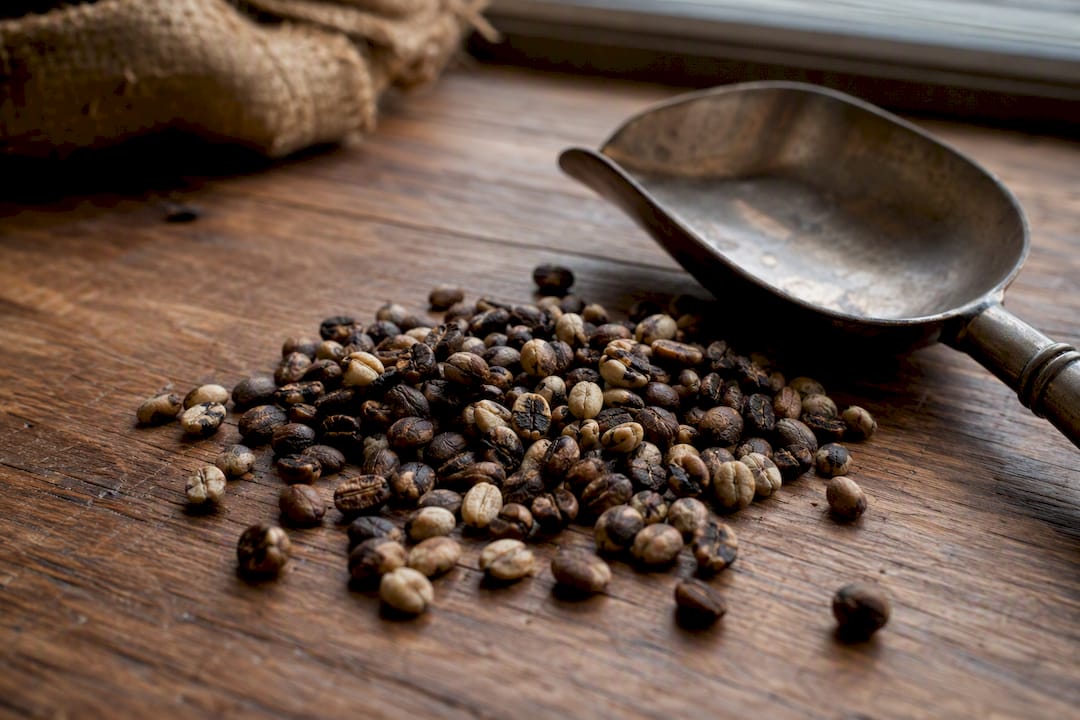
The defects most likely to ruin your cup are potato taste defect (raw potato, dirt), phenolic taint (medicinal, iodine), fermentation faults (rotten fruit, vinegar), mold (musty, damp basement), baggy taste (jute, cardboard), underdeveloped roast (grassy, sour), baked roast (flat, oaty), scorched or burnt roast (ashy, acrid), and quakers (peanut, straw). Most of these wreck flavor without posing any real health risk, though mold and heavy fermentation are worth taking more seriously.
TL;DR:
- Potato taste defects can be caused by mechanical damage during harvest or transport, not just pest infestation, and can spoil an entire bag’s aroma even if only one affected bean is present.
- Roast defects such as underdeveloped, baked, scorched, tipped, or burnt beans are highly fixable through adjustments in temperature, airflow, and development time during roasting.
- Green bean defects like mold, fermentation faults, and insect damage primarily result from poor storage, processing, or handling, and affect flavor quality more than health.
- Detecting defects early involves smelling raw beans, roasting small samples, and tasting them before committing to large batches, with small sample roasts often catching issues missed by visual inspection.
- Most defects stem from specific failure points in the supply chain, emphasizing the importance of origin transparency, careful handling, and thorough sampling for accurate quality control.
Table of Contents
- What Do Coffee Defects Taste Like? A Quick Reference
- Roast Defects: Underdeveloped, Baked, Scorched, Tipped, and Burnt
- What Causes Potato Taste Defect and Other Green Bean Faults
- How Do You Detect Coffee Defects Before You Brew?
- Where Coffee Defects Come From and How the Trade Reduces Them
- What to Do When You Find a Defect in Your Coffee
- How Moustache Coffee Club Approaches Quality Control
- The Real Skill Isn’t Naming Defects, It’s Trusting Your Palate
- Sources
- FAQ
What Do Coffee Defects Taste Like? A Quick Reference
Before you go hunting for causes, you need to know what you’re smelling and tasting in the cup. Here’s a working cheat sheet you can keep next to your cupping setup or your kitchen scale.
- Potato taste defect (PTD): raw potato, dirt, or raw pea. Even a single affected bean can dominate a whole bag’s aroma, and it’s invisible on green beans until roasted or ground.
- Fermentation/overfermentation: rotten fruit, vinegar, sometimes a dumpster-like funk. Usually strong enough that you’ll catch it in dry aroma before the first sip.
- Mold/musty: wet cardboard, basement, old paper. Common in beans stored in humid conditions and often visible as gray or white bloom on green beans.
- Baggy/jute: cardboard, burlap sack. Subtle, and easy to mistake for a flat or tired roast rather than a defect.
- Quakers: peanut, raw grain, straw. They roast lighter than the rest of the batch and taste hollow rather than sweet.
- Insect-damaged beans: woody, earthy, sometimes slightly sour. Mild enough to blend into the background unless several beans are affected.
Scorched roast and heavy overfermentation can both read as “smoky” or “off” on a quick sniff, so when you’re not sure, roast a small fresh sample and taste it side by side with a batch you trust.
Roast Defects: Underdeveloped, Baked, Scorched, Tipped, and Burnt
Roast defects come from the fire, not the farm, which makes them the most fixable category if you roast your own beans. Each one leaves a distinct signature in the cup and on the bean surface.
Underdeveloped coffee tastes grassy, green, or like raw peas, often with a sharp, sour edge that lingers unpleasantly instead of resolving into acidity. The beans look pale and uneven, sometimes with a visible center “tiger stripe” seam that never fully colored. It happens when the roast ends before the bean’s sugars and acids have had time to transform, usually from too short a development time or a charge temperature that’s too low.
Baked coffee tastes flat, oaty, and papery, with acidity that seems to have vanished entirely rather than balanced out. Beans often look dull and matte rather than glossy. This comes from stalling in the roaster too long at moderate heat, often from underpowered airflow or a drum that’s overloaded, according to Perfect Daily Grind’s breakdown of roast defects.
Scorched beans taste smoky and ashy on the surface, sometimes bitter at the edges, and you’ll usually see dark, uneven spotting on the bean before you even grind it. It’s a sign of applying too much heat too fast at the start of the roast.
Tipped beans show small charred marks at the pointed ends, tasting slightly bitter and acrid in that specific spot even when the rest of the roast is clean. Excess charge temperature or too rapid an early rise is the usual culprit.
Burnt coffee is unmistakable: ashy, bitter, almost charcoal-like, with beans that look uniformly dark and oily well past the intended finish. This is simply too much heat for too long, full stop.
Quick roast fixes:
- Extend or shorten development time by 15 to 30 seconds and retaste.
- Lower charge temperature if you see tipping or scorching.
- Increase airflow if cups taste baked or flat.
- Cup the batch within 24 hours of roasting, since roast faults often mask the origin’s actual flavor notes, per Perfect Daily Grind.
Pro Tip: Keep a small notebook with charge temp, development time, and tasting notes for every batch. After three or four suspect roasts, you’ll usually spot the one variable that’s actually causing the problem, instead of guessing all over again each time.
What Causes Potato Taste Defect and Other Green Bean Faults
Green and processing defects happen before the bean ever sees a roaster, which is why they’re harder to catch early and why they matter so much to how you evaluate raw coffee.
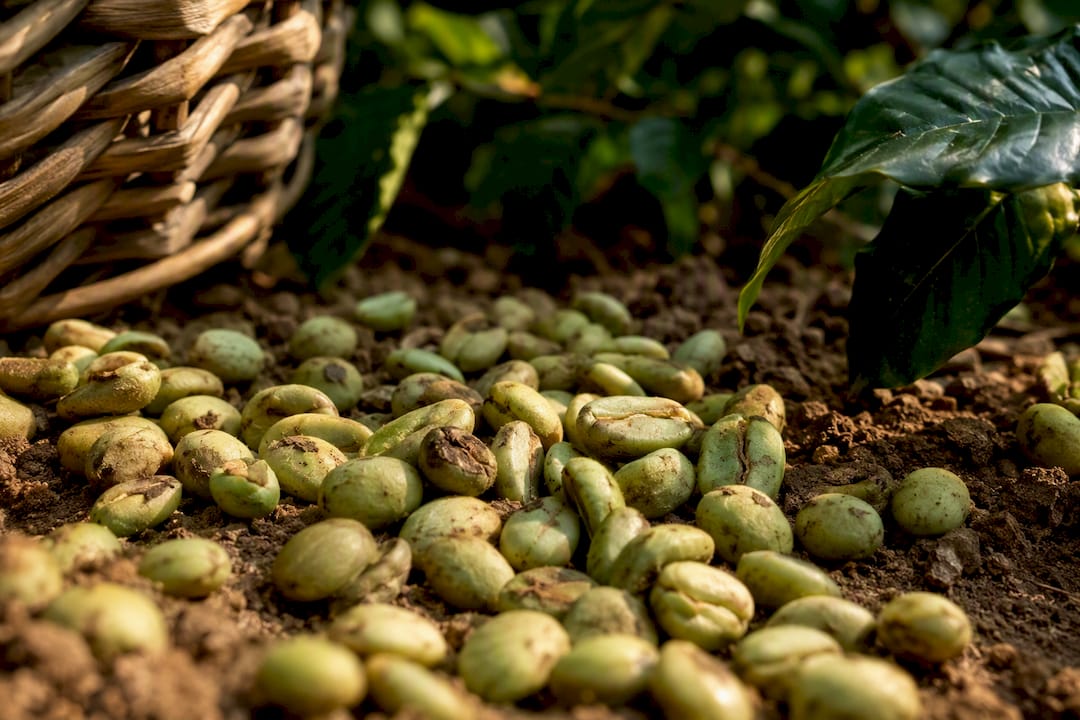
Potato taste defect is the one every East African coffee buyer fears. It tastes like raw potato skin, sometimes with a dirt-like or raw pea edge, and it’s chemically linked to elevated levels of 3-isopropyl-2-methoxypyrazine (IPMP). For years, the accepted explanation was that the Antestia bug injected bacteria into the cherry while feeding, triggering the defect. A 2025 peer-reviewed study found something that upends that assumption: mechanical damage to the berry alone, with no insect involved, produced the same PTD outcome and the same elevated IPMP signature under GC–MS analysis. That means pest control alone won’t fully solve the problem; handling during harvest and transport matters just as much.
World Coffee Research documents PTD as especially common in coffees from Rwanda, Burundi, the Democratic Republic of Congo, and Uganda, and warns that a single affected bean can spoil the aroma of an entire bag.
- Fermentation/overfermentation: putrid, boozy, or dumpster-like notes from processing that ran too long, too warm, or with inconsistent water quality during washing or fermentation tanks.
- Mold/musty: damp cardboard or basement smell, tied directly to storing green coffee in high humidity. Beyond the flavor hit, mold contamination is one of the few defects worth treating as a genuine food safety concern, not just a quality one.
- Quakers: immature beans that roast to a pale, peanut-yellow color and taste like raw peanuts, grass, or straw. They resist detection by pre-roast color sorting because unripe green beans often look nearly identical to healthy ones, according to Espresso Academy’s green defect guide.
- Insect damage: woody, earthy, occasionally sour notes from beans that insects bored into during drying or storage.
How Do You Detect Coffee Defects Before You Brew?
You don’t need a lab to catch most defects. You need your nose, a small sample roast, and a willingness to trust what you taste even when it contradicts the bag’s origin story.
- Smell the green beans first. Raw potato, mustiness, or a sour funk on unroasted coffee is a strong early warning sign.
- Roast a small sample batch, no more than a few ounces, before committing a whole lot to your main roaster.
- Grind and smell immediately after roasting. Many defects, PTD especially, show up more clearly in dry aroma than in the cup itself.
- Cup using SCA protocol basics: evaluate the crust before breaking it, note the aroma released on the break, then track how acidity and body shift as the cup cools. Defects that hide at first often reveal themselves as the coffee drops below 140°F.
- Run a blind taste test against a coffee you already trust, so you’re not anchoring your judgment to what the label says the coffee should taste like.
Sample size matters more than people assume. Because PTD concentrates in individual beans rather than spreading evenly, a single affected bean in a brewed dose can dominate the aroma of the entire cup, even when incidence across the full bag is low, according to Counter Culture Coffee’s writeup on PTD. That’s why tasting several small batches beats relying on one brew.
If you suspect PTD and want confirmation beyond your palate, GC–MS analysis can quantify IPMP directly, the same method used in the 2025 mechanical-damage study. That level of testing is really only worth pursuing for larger commercial lots or when you’re building a case to send back to a supplier.
Pro Tip: When you report a defect to a supplier, include the bag or lot code, roast date, and specific sensory language, “raw potato aroma on the break,” not just “tastes off.” Specific notes get taken seriously; vague complaints get a form-letter response.
Where Coffee Defects Come From and How the Trade Reduces Them
Every defect traces back to a specific failure point in the chain from cherry to cup, and each stage has its own fix.
- Harvest timing and pests: Antestia bug feeding and picking unripe cherries both feed directly into PTD and quaker counts. Hand sorting at harvest catches a meaningful share before processing even starts.
- Mechanical damage: the 2025 study’s key finding means rough handling during transport or pulping can trigger PTD on its own, so gentler equipment and careful cherry handling matter even where Antestia pressure is low.
- Processing errors: fermentation tanks left too long, inconsistent water changes, or drying on contaminated surfaces all produce fermentation faults and mold.
- Storage conditions: high humidity during green bean storage is the main driver behind musty and moldy defects.
- Roast miscontrol: covered above, but it’s worth repeating that most roast defects are fixable with data, not guesswork.
At origin, mills combine pest management with manual sorting of both cherries and dried parchment, exactly what World Coffee Research recommends for reducing PTD incidence. Roasteries add another layer: cupping every incoming lot, running color sorters for visible defects, and pulling small-batch samples before committing large volumes to production. Understanding how processing shapes flavor at each of these stages makes it much easier to spot where a specific defect probably originated.
Home roasters can borrow the same logic at a smaller scale: inspect green beans visually before loading the roaster, always run a sample roast before a full batch, and taste that sample critically instead of assuming a reputable origin guarantees a clean cup; our mushroom coffee purchase guide offers helpful tips on judging packaged coffee products to elevate your selection process.
What to Do When You Find a Defect in Your Coffee
- Retest before you decide anything. Smell the green beans if you have them, roast a small fresh sample, and brew a side-by-side comparison with another bag from the same origin.
- Document what you find. Note the bag code, roast date, and precise sensory language, and take a photo of the beans if the defect shows visually.
- Contact the supplier with that documentation attached rather than a vague complaint.
- Decide on remediation: a refund or replacement for a clearly defective bag, blending to dilute a minor issue across a larger batch, or outright rejecting a lot that fails specialty standards, since defects directly affect a lot’s market grade and price.
How Moustache Coffee Club Approaches Quality Control
Freshness is the first defense against most defects you’ll ever taste. Moustachecoffeeclub ships every order roasted to order, so beans reach you close to peak flavor rather than after weeks sitting on a shelf where staleness and off notes have time to develop. Origin transparency plays a role too. Knowing a coffee’s processing method and harvest window helps you judge whether a strange note is a defect or simply an unfamiliar varietal characteristic. For deeper study, the coffee education hub covers brewing guides and origin reports, and the tasting notes guide is a solid next stop for anyone building out their sensory vocabulary beyond “good” and “bad.”
The Real Skill Isn’t Naming Defects, It’s Trusting Your Palate
Most guides to coffee defects read like a list to memorize, and that’s backwards. You can know every term, potato taste defect, quaker, baked roast, and still miss a bad cup if you don’t trust what your own nose and tongue are telling you before you check the label.
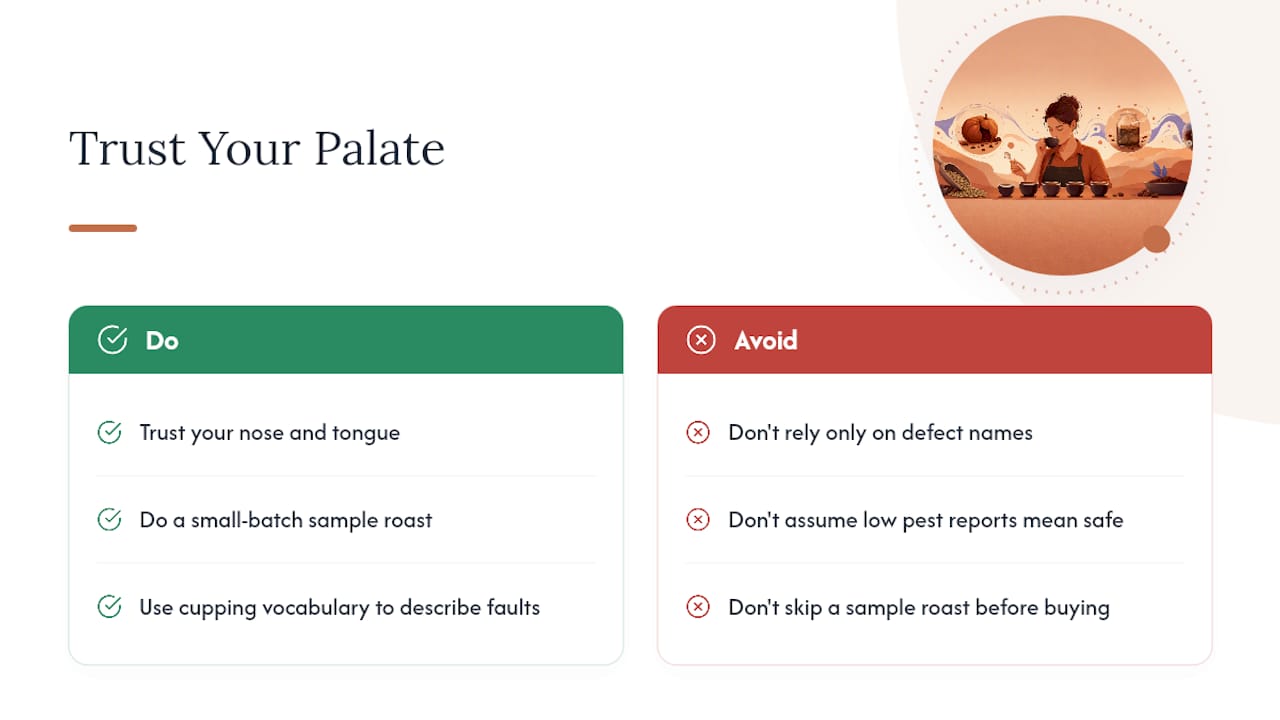
The 2025 finding on mechanical damage causing PTD without any Antestia bug involvement matters more than it might seem at first. It means you can’t assume a coffee is safe from PTD just because a supplier says pest pressure was low that season. Rough handling during harvest or transport is enough on its own. That should change how skeptical you are of any single bag, regardless of its origin story.
If I had to prioritize one habit for enthusiasts and home roasters, it’s the small-batch sample roast before committing a full lot. It costs you a few ounces of coffee and ten minutes of attention, and it catches the majority of defects covered here before they reach your daily brew. Cupping vocabulary helps you describe what you’re tasting. It’s the sample roast that actually protects your cup.
— Sean
Sources
- Mechanical Damage Causes Potato Taste Defect in Coffee Without Antestia Bug Infestations: Evidence from Experimental Data
- Potato taste defect — World Coffee Research
- Roast defects in coffee: How to identify them in the cup — Perfect Daily Grind
- Green coffee defects: Complete guide with examples and SCA table — Espresso Academy
FAQ
Why does coffee taste weird all of a sudden?
A sudden change usually points to staleness, a shift in roast batch, or storage in a humid environment that introduced musty or baggy notes. Check the roast date first, since flavor typically degrades within two to three weeks of roasting even with good storage.
Why does my coffee taste so bad lately?
Persistent bad flavor across multiple brews often traces to a specific roast defect (baked or scorched) or a green-bean issue like potato taste defect, rather than your brewing method. Try a different bag from the same roaster; if the problem disappears, the previous batch likely carried a defect.
What is the unhealthiest type of coffee?
Coffee defects themselves are mostly quality issues rather than health hazards, with mold and fungal contamination being the main exception worth real caution. Beyond defects, coffee brewed with unfiltered methods and high sugar or cream additions carries more health concerns than any specific roast or processing style.
Why does coffee taste different now compared to before?
Coffee flavor shifts naturally with each new harvest, processing batch, and roast profile, so a favorite coffee rarely tastes identical bag to bag. If the change feels like a genuine defect rather than natural variation, run a side-by-side cupping against an older bag to confirm whether it is a quality issue or just seasonal variation in the crop.
Recommended
- How Coffee Processing Affects Taste: A Flavor Guide | Blog | The Moustache Coffee Club
- Why Coffee Has Fruity Tasting Notes Explained | Blog | The Moustache Coffee Club
- How to buy specialty coffee: expert tips for flavor and quality | Blog | The Moustache Coffee Club
- How Brewing Method Affects Specialty Coffee Flavor | Blog | The Moustache Coffee Club
