Freshness, Not Price: Coffee Subscriptions for Home Brewers
Coffee subscriptions are worth it if you brew at home daily or near-daily and care more about freshness and discovery than squeezing out the lowest possible price. If you’re a two-cup-a-week drinker who’s happy with whatever’s on the grocery shelf, they’re a harder sell. The real trade-off is fresher beans and less hassle against a higher per-bag cost and the risk of stockpiling coffee faster than you can drink it. The math below will tell you which camp you’re in.
TL;DR:
- Coffee subscriptions generally cost around $1.50 to $2.50 per cup, with savings mainly benefiting daily drinkers switching from cafes.
- Roast-date transparency and roast-to-ship speed are crucial factors in trusting subscription quality; Bags without a roast date are a red flag.
- Most subscriptions suit those who brew daily or enjoy trying new single-origin coffees, while infrequent brewers may overpay or accumulate stale stock.
- Starting with a slower delivery cadence and adjusting based on actual weekly consumption helps prevent over-ordering and stale coffee.
- Combining a subscription for daily use with occasional local roaster visits can optimize freshness, variety, and cost-efficiency.
Table of Contents
- What Do Coffee Subscriptions Actually Deliver?
- How Does the Cost Really Break Down?
- Who Should Subscribe and Who Should Skip It?
- How Do You Choose the Right Cadence and Plan?
- What Mistakes Do Subscribers Actually Make?
- Why Moustache Coffee Club Fits the Freshness-First Case
- What I’ve Learned Weighing Subscriptions Against Local Buying
- Sources
- FAQ
What Do Coffee Subscriptions Actually Deliver?
The core promise of a coffee subscription is timing. Most services roast to order or ship within a few days of roasting, which matters because coffee starts losing its brightest flavor compounds within two to three weeks of the roast date. Bags on grocery shelves are often already a month or more past that window by the time they reach your cart, even when the packaging looks pristine.
Roast-date transparency has become one of the clearest signals of a subscription worth trusting. When a company prints the actual roast date on the bag, rather than a vague “best by” stamp, that transparency and a fast roast-to-ship window are the two things worth checking before you buy. If a bag doesn’t list a roast date at all, treat that as a red flag, not an oversight.
Beyond freshness, subscriptions typically offer a handful of practical features:
- Grind customization for drip, French press, pour-over, or espresso, so you’re not stuck grinding whole beans wrong for your brewer.
- Roast-level and flavor preferences, often set through an onboarding quiz and refined through ongoing feedback.
- Flexible cadence, letting you receive bags weekly, biweekly, or monthly depending on how fast you burn through coffee.
- Pause, skip, and cancel controls, which matter more than people expect once life gets busy or a vacation throws off your rhythm.
Compared to walking into a local roaster’s shop, a subscription trades a bit of spontaneity for consistency. You lose the ability to chat with the roaster about what just came off the drum, but you gain a bag showing up on your counter without you thinking about it. Compared to grocery store bags, the difference is starker. Grocery coffee is almost always older, often blended for shelf stability rather than peak flavor, and rarely tells you when it was actually roasted.
How Does the Cost Really Break Down?
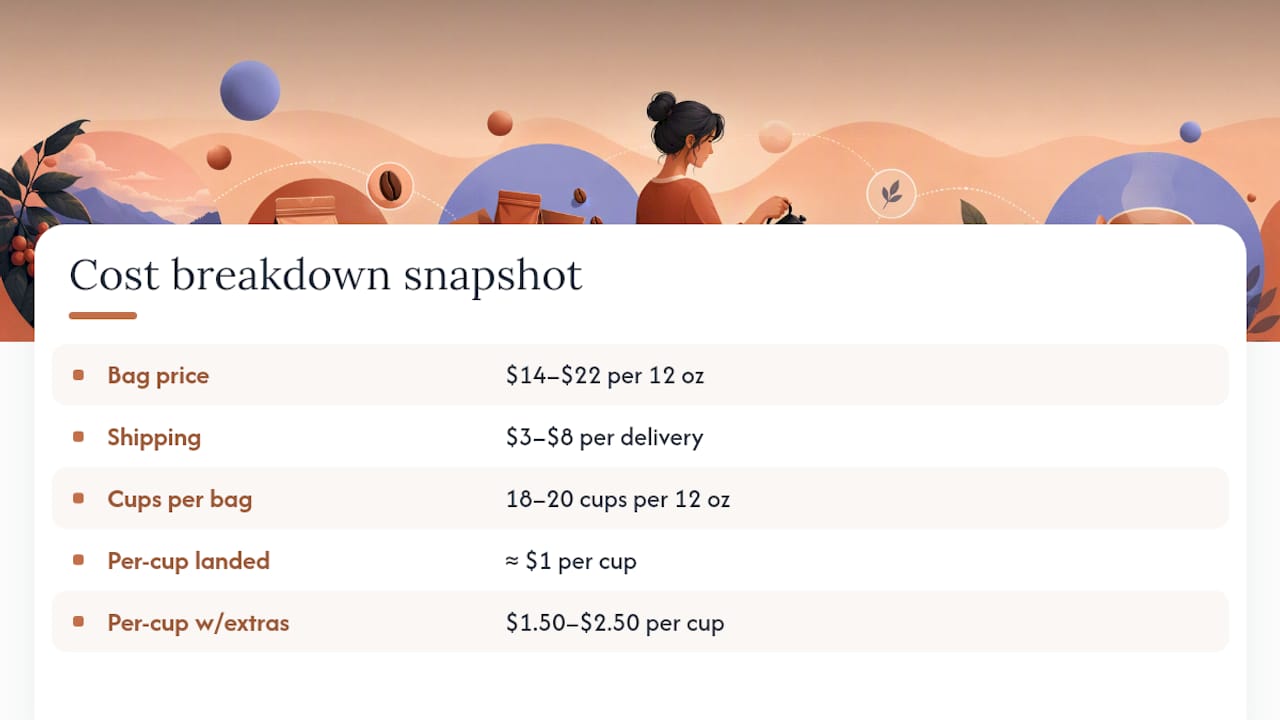
Specialty subscription bags generally run $14 to $22 for a 12-ounce bag, with shipping adding another $3 to $8 per delivery when it isn’t bundled into the price. That often results in subscriptions falling within a mid-range price per bag, depending on the roaster and your cadence.
Here’s the formula that actually matters: take the bag weight, estimate cups per bag, then divide total cost by cups. A standard 12-ounce (340-gram) bag yields roughly 18 to 20 cups using a typical 15 to 18 grams of coffee per 12-ounce brew. At a typical landed cost including shipping, the cost per cup commonly is around or just above $1, increasing somewhat with pricier bags. That tracks with the broader pattern: per-cup subscription costs commonly land between $1.50 and $2.50 once you account for milk, filters, or a slightly heavier scoop than the math above assumes.
Cost comparison snapshot
The pattern holds across most comparisons: subscriptions rarely beat grocery-store beans on raw price, but they consistently beat daily café habits by a wide margin. If you’re currently a daily $5 latte person switching to home brewing with a subscription, you’re looking at savings of $90 to $130 a month even after factoring in a grinder and basic gear.
Three scenarios make this concrete. A daily café buyer switching to a subscription usually saves the most in dollar terms, even if their per-cup cost triples compared to grocery beans. A regular home brewer already buying from a local roaster might see costs wash out close to even, with the subscription winning mainly on convenience and variety. An occasional brewer, someone who drinks coffee three or four times a week, often ends up overpaying relative to their actual consumption, because most subscription cadences are built around daily drinkers.
Pro Tip: Bulk shipments and prepay discounts change the math more than people realize. Loyalty and prepay discounts commonly run 5% to 15%, and many services waive shipping past a certain order size, which can shave $3 to $5 off your effective per-bag cost without changing what you’re drinking.
Who Should Subscribe and Who Should Skip It?
Subscription value clusters around three recognizable habits, and matching your actual behavior to the right one saves you money and stale coffee. Buyer guides converge on roughly three archetypes: discovery drinkers, freshness-maximalists, and people who simply forget to reorder. Where you fall determines whether a subscription earns its premium.
- The daily café-to-home switcher. If you’re buying coffee out five or more times a week, a subscription almost always wins on cost and convenience, even at the higher end of the $1.50 to $2.50 per-cup range.
- The discovery-focused drinker. If you like trying new origins and roast profiles, a subscription’s rotating selection beats guessing at unfamiliar bags on a shelf. This is where the format shines hardest, since single-origin variety is exactly what most subscriptions are built to deliver.
- The decaf drinker. Fresh, well-roasted decaf is genuinely hard to find in stores, which gives subscriptions a stronger case here than for regular coffee.
- The irregular or low-volume drinker. If you’re brewing two or three cups a week, most cadences will out-pace your consumption, and you’ll be sitting on stale coffee before you finish a bag.
A rough threshold: if you drink one cup a day or more, a biweekly 12-ounce bag keeps pace without waste. Two cups a day pushes you toward weekly delivery or a larger bag. Below four or five cups a week, consider a slower cadence or skip subscriptions altogether in favor of occasional purchases.
Proximity to a good local roaster changes this calculus too. If you live near one you trust, a subscription’s main advantage, delivered freshness, shrinks considerably, since you can just walk in and buy beans roasted the same week.
How Do You Choose the Right Cadence and Plan?
Start by measuring, not guessing. Count how many cups you actually brew in a typical week, then multiply by the grams of coffee per cup your brewer uses (15 to 18 grams for drip or pour-over, closer to 18 to 20 grams for espresso). That total tells you how many bags you’ll realistically finish before staleness sets in.
Whole beans should be your default unless you’re brewing within minutes of grinding every single time, since ground coffee loses aromatic compounds far faster than whole beans once exposed to air. Match grind setting to your actual brewer: coarse for French press, medium for drip, fine for espresso, and don’t assume a subscription’s default grind setting is right for your setup without checking.
Before you commit to any plan, run through a short checklist:
- Does the bag show a printed roast date, not just a vague freshness window?
- Can you pause or skip a shipment without calling customer service or navigating a maze of settings?
- What does shipping actually cost, and does it scale down with a bigger or less frequent order?
- How easy is cancellation, and is there a minimum commitment before you can walk away?
The general rule that holds up across most buying guides: start with the slowest cadence you think you need, then speed up only if you find yourself running out early. It’s far easier to notice you’re low on coffee and bump up frequency than to work through a backlog of stale bags. For a deeper breakdown of how plan sizes and pricing tiers stack up against each other, a comparison of subscription plan tiers is worth a look before you lock in a cadence.
Pro Tip: Ask about prepay or referral discounts before you sign up. Many services offer 5% to 15% off for prepaying several months, and referral credits can offset a bag or two a year for almost no effort.
What Mistakes Do Subscribers Actually Make?
Over-ordering is the single biggest way people undo a subscription’s entire freshness advantage. If your cadence outpaces your drinking, you end up with three half-finished bags stacked on the counter, all going stale at the same rate a grocery bag would. The fix is mechanical: drop to the next slower cadence the moment you notice a bag lasting more than two to three weeks past its roast date.
Variety fatigue is the quieter problem. Rotating single-origin selections are exciting for the first few months, then some drinkers realize they just want their favorite Ethiopian or Colombian lot every time. Most services let you lock preferences or switch to a single-roaster plan once you know what you like, so use those settings instead of just canceling out of boredom.
Shipping overhead quietly erodes small-bag economics. A $4 shipping charge on a $16 bag adds 25% to your real cost, while the same $4 charge on a larger, less frequent shipment barely registers. If you’re ordering small bags often, you’re paying a shipping tax that a bigger, slower order would largely erase.
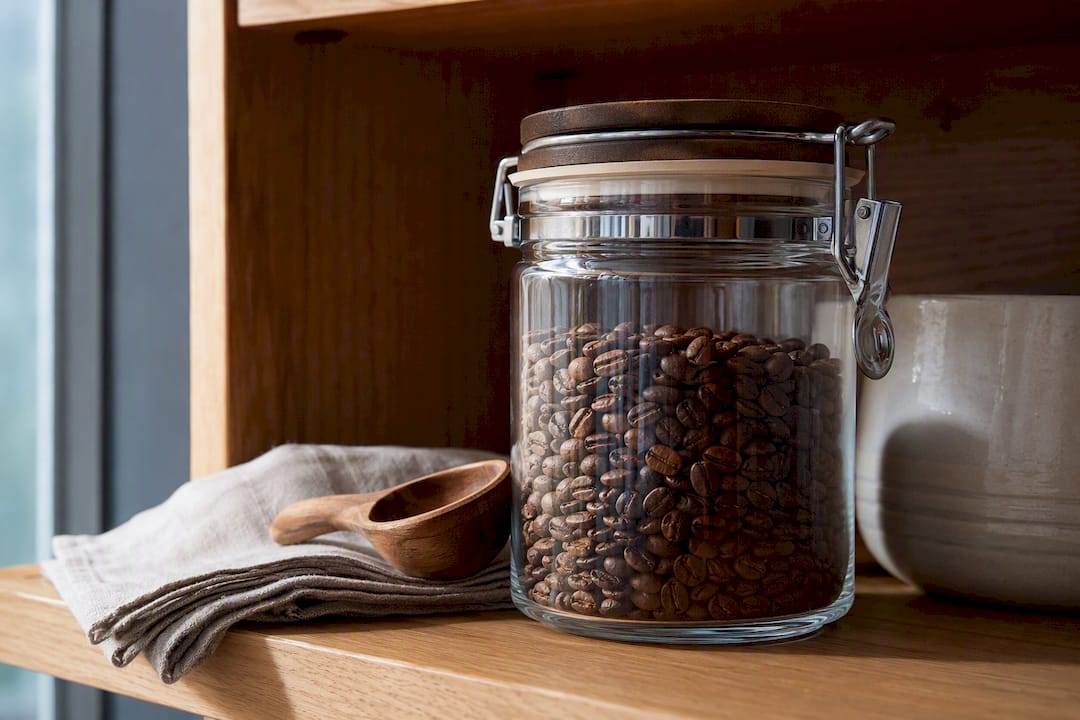
Once the bag arrives, storage matters more than most people think. Keep beans in an airtight container away from light and heat, and skip the freezer unless you’re storing more than two weeks’ worth at once, since repeated temperature swings do more damage than a cool pantry shelf. Readers weighing packaging waste alongside freshness might also check an eco-friendly coffee subscription checklist before choosing a plan.
Why Moustache Coffee Club Fits the Freshness-First Case
This subscription service is built around exactly the profile this article keeps circling back to: home brewers who want beans roasted to order, not beans that sat on a shelf for a month. The subscription focuses on ultra-light, Nordic-style roasting of single-origin coffees, a style chosen specifically to preserve the flavor character that heavier roasting tends to flatten. Coffee ships the day it’s roasted, and plans adjust to your grind, roast preference, and feedback over time rather than locking you into a fixed rotation.
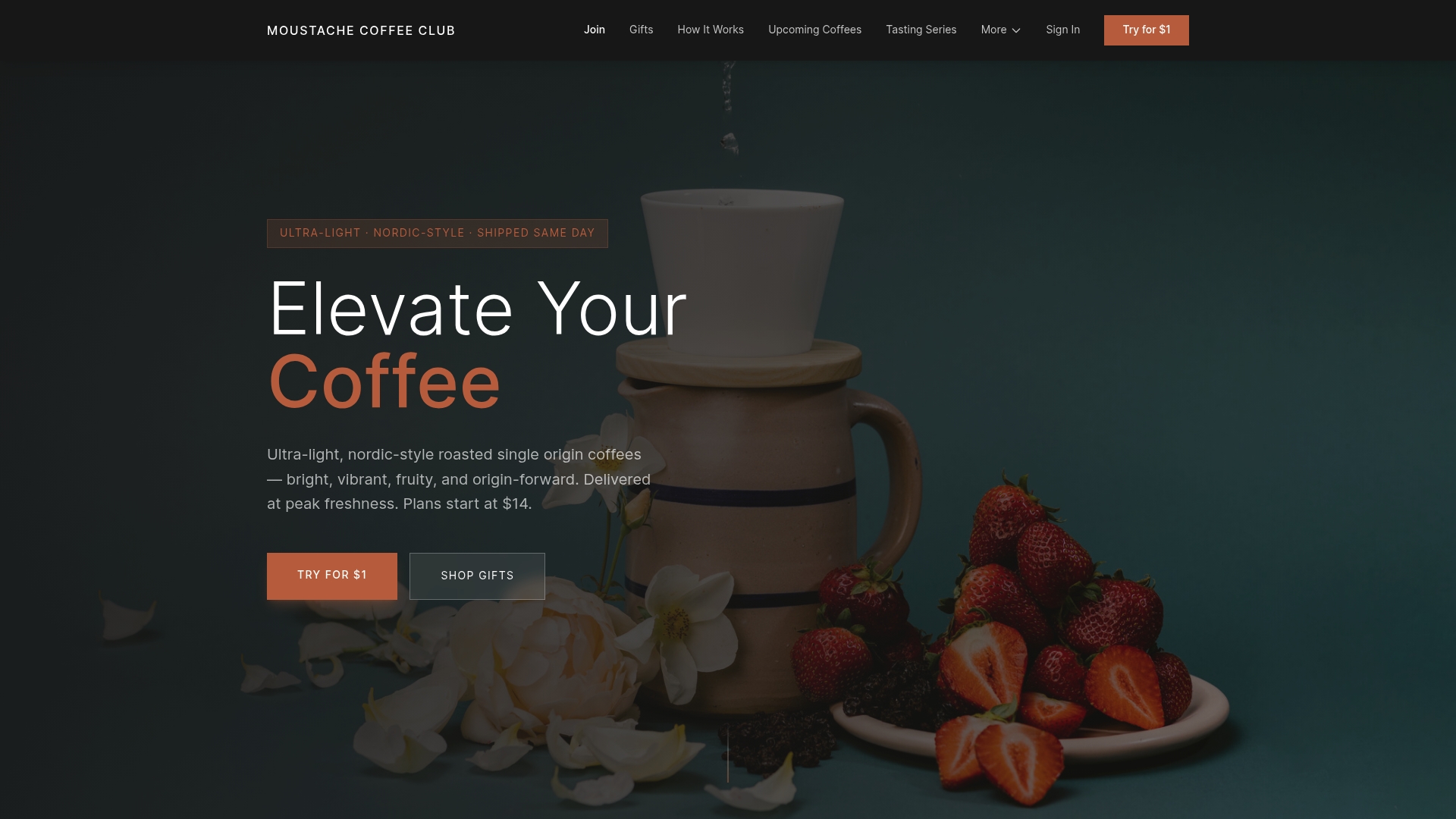
This setup suits two readers especially well: the freshness-first daily brewer tired of guessing how old their grocery bag really is, and the discovery-focused drinker who wants single-origin variety without hunting down a new roaster every month. If you’re not ready to commit, the Tasting Series offers a low-stakes way to sample the Nordic-style approach, and a gift subscription works well if you’re testing the idea on someone else’s behalf first. Plans range from the Northern Duet at $32.99 per week per bag up to larger formats like the Orchestra at $89.99 per week per bag, so you can start small and adjust cadence once you know your real consumption. Browse the full plan lineup or head straight to sign up if you already know which cadence fits.
What I’ve Learned Weighing Subscriptions Against Local Buying
The honest answer is that a hybrid approach beats going all in on either side. A single subscription covers your daily driver, the coffee you know you’ll finish before it goes stale, while occasional trips to a local roaster fill in variety and let you support a shop in person. That combination avoids the two failure modes people run into most: overpaying for beans you don’t finish, or settling for grocery coffee that’s already flat by the time you buy it — and it pairs well with coffee accessories like a coffee-themed mug to brighten your mornings.
Three rules have held up consistently. First, start slower than you think you need. It’s a much smaller problem to run out early than to sit on four stale bags. Second, treat the pause button as part of the plan, not an emergency measure. Life gets busy, and skipping a week costs you nothing if the option exists. Third, judge a subscription by whether the roast date actually changes how the coffee tastes, not by the marketing copy describing it.
None of this requires blind trust in any one company. It requires doing the per-cup math for your own habits, honestly, before you commit to a cadence.
— Sean
Sources
- Coffee Subscription Service: Is It Worth the Extra Cost?
- Coffee Subscription vs Buying Bags: Which Fits You – Barista Life
- Best coffee subscriptions
- Are Coffee Subscriptions Worth It in 2026? An Honest Breakdown | My Coffee Explorer
FAQ
Are Coffee Subscriptions Cheaper Than Buying Coffee Elsewhere?
Subscriptions are rarely cheaper than the lowest-priced grocery store beans, but they’re consistently cheaper than daily café purchases. Switching from café buying to a home subscription commonly saves $90 to $130 a month for a one-cup-a-day habit, once you factor in the per-cup math.
What Is the 15-15-15 Coffee Rule?
There’s no single, universally agreed-upon definition of a “15-15-15” coffee rule across brewing sources, so treat any specific version you see with some skepticism. Some guides use similar numbers to describe ratios like 15 grams of coffee to 15 ounces of water with a roughly 15-minute steep for certain brew methods, but this isn’t a standardized industry term.
Which Coffee Subscription Delivers the Best Value?
Value depends on what you’re optimizing for: raw cost, freshness, or discovery. For freshness-first home brewers who want ultra-light, single-origin roasts shipped the day they’re roasted, Moustache Coffee Club’s plan lineup is built specifically around that trade-off rather than lowest possible price.
How Do I Know Which Coffee Subscription Cadence Is Right for Me?
Count your weekly cups, multiply by the grams your brewer uses per cup, and match that total against a 12-ounce bag’s roughly 18 to 20 cup yield. Most guides recommend starting with the slowest cadence that covers your consumption and speeding up only if you run out early, which avoids stale backlog.