Home Brewers: Read Origin, Process, Roast Date for Ethiopian Heirloom

On a coffee bag, “Ethiopian heirloom” means a mixture of indigenous landrace varieties, not a single cultivar or an automatic quality guarantee. It’s an honest label for a genetically diverse crop, but it tells you almost nothing about how the coffee will taste. Region, processing method, and roast date do that work instead. Judge the bag by those three factors and the word “heirloom” becomes a footnote, not a selling point.
TL;DR:
- The term “heirloom” indicates a genetic mixture of landrace varieties, not a specific quality or cultivar, making regional and processing details more relevant for flavor prediction.
- Different regions like Yirgacheffe, Guji, and Sidama produce distinct cup profiles, with altitude and local conditions heavily influencing taste, beyond the heirloom label.
- JARC numbers identify more specific selections within the broad heirloom pool, but they still require context like region and processing to inform expectations.
- Processing method (washed, natural, honey) significantly alters flavor, often more than genetic origin, with washed highlighting floral and citrus notes and natural emphasizing fruity and jam-like qualities.
- Buying decisions should prioritize detailed information about origin, processing, and roast date rather than relying solely on the heirloom label for quality or flavor assurance.
Table of Contents
- What “Heirloom” Actually Means in Ethiopian Coffee
- Ethiopian Heirloom Coffee Varieties by Region: What to Expect in the Cup
- JARC Numbers: The Closest Thing to a Named Varietal
- How Processing and Roast Level Shape Heirloom Flavor
- Brewing Heirloom Ethiopian Coffee to Highlight Its Best Traits
- How Moustache Coffee Club Sources and Roasts Ethiopian Heirloom Lots
- Why the “Heirloom” Label Deserves More Skepticism, Not Less
- Taste the Range With a Rotating Ethiopian Subscription
- Sources
- FAQ
What “Heirloom” Actually Means in Ethiopian Coffee
“Heirloom” is shorthand for indigenous landrace varieties that have grown wild or semi-wild across Ethiopia’s highlands for centuries, often crossbred and unnamed. Unlike Colombia’s Castillo or Costa Rica’s Catuai, most Ethiopian farms don’t grow a single documented cultivar. Small plots often mix dozens of genetic types in the same rows, and exporters frequently blend lots from multiple farmers before they ever reach a mill. That’s why DNA-level varietal labeling is rare here: the traceability infrastructure other origins built around named cultivars simply doesn’t exist at the same scale in most of Ethiopia.
A few things separate a heirloom lot from a named-varietal one elsewhere in the world:
- Genetic mixture: One heirloom lot can contain many distinct plant types, not one.
- No cultivar registry: Most smallholders never selected or bred for a specific strain.
- Ethiopia’s coffee origin status: The country is the birthplace of Coffea arabica and holds the deepest reservoir of arabica genetic diversity on the planet.
- JARC as the exception: The Jimma Agricultural Research Center has isolated and numbered specific selections, which is the closest Ethiopia gets to named varietals.
That JARC exception matters enough to cover on its own, further down.
Ethiopian Heirloom Coffee Varieties by Region: What to Expect in the Cup
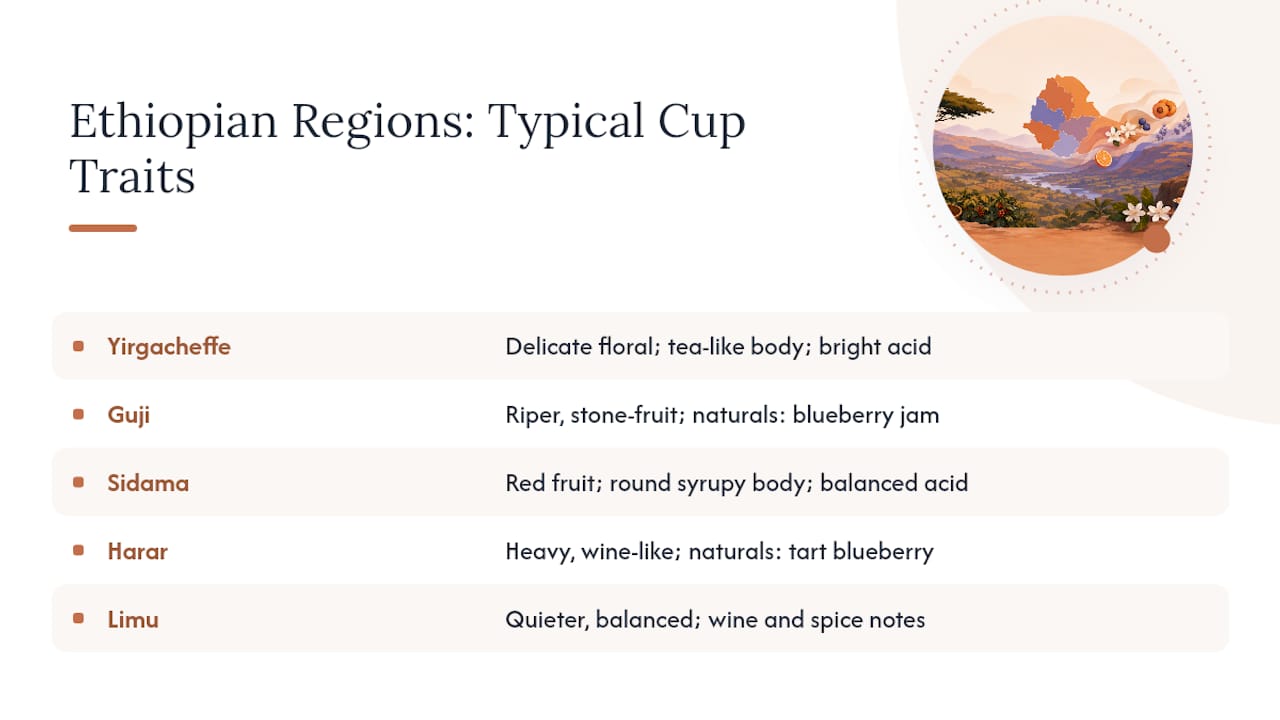
Region beats the word “heirloom” every time when you’re trying to predict flavor. Ethiopia’s coffee zones sit at different altitudes, soil compositions, and rainfall patterns, and each pushes cup character in a different direction.
Yirgacheffe is the benchmark for what people mean by “delicate and floral.” Bergamot, jasmine, and lemon verbena notes show up often, especially in washed lots. Ask what Yirgacheffe coffee tastes like and most cuppers reach for the same words: tea-like body, bright acidity, a citrus finish that lingers.
Guji coffee, grown just south of Yirgacheffe, tends to run riper and more stone-fruit forward. Natural-processed Guji lots often taste like blueberry jam or dried apricot, while washed versions lean toward peach and honey.
Sidama sits in between the two, offering red fruit and a rounder, syrupy body. Harar, grown in the east on drier terrain, is the outlier: heavy, wine-like, sometimes almost blueberry-sour in its natural form. Limu is quieter and more balanced, with wine and spice notes that make it a good entry point for someone new to Ethiopian coffee.
Altitude plays a real role here. Most specialty lots from these regions grow at high elevations typical for Ethiopian highland coffee, and the higher altitudes tend to produce denser beans with sharper acidity. But don’t assume uniformity within a single region. Two farms a few kilometers apart, at different elevations or with different processing setups, can produce lots that taste nothing alike. Specialty reporting consistently flags heirloom cups as floral, tea-like, or fruity, but the variation inside that description is enormous.
JARC Numbers: The Closest Thing to a Named Varietal
When a bag lists a JARC number like 74110 or 74112, you’re looking at something more specific than “heirloom.” The Jimma Agricultural Research Center has spent decades isolating individual plant selections from the broader landrace pool, testing them for disease resistance, yield, and cup quality, then assigning each one a catalogue number.
A JARC number on a bag signals that someone in the supply chain, whether a farm, a washing station, or an exporter, took the trouble to separate that selection out and track it. That’s not nothing. It usually means:
- The lot went through more deliberate sorting than a generic mixed-landrace batch.
- The exporter or roaster had access to better traceability data.
- The selection has a track record; JARC 74112 in particular gets cited often as a high-scoring selection in specialty circles.
Treat a JARC-numbered lot the way you’d treat a named cultivar from Central America: a starting point for expectations, not a guarantee. It’s still grown alongside other heirloom types on many farms, and the number tells you about genetic identity, not necessarily about how it was processed or roasted. Pair the number with region and process information before you decide anything.
How Processing and Roast Level Shape Heirloom Flavor
Processing does more to change an heirloom coffee’s flavor than genetics alone. Washed processing strips the fruit off the cherry before drying, which produces the clean, floral, tea-like cup most people associate with Yirgacheffe. Natural processing dries the whole cherry intact, fermenting sugars into the bean and pushing the flavor toward jammy, boozy, fruit-forward territory. Honey and other experimental fermentation methods land somewhere between the two, often adding tropical or wine-like complexity that neither classic method produces.
Roasters who work with heirloom lots tend to roast light, and there’s a reason beyond trend. Delicate floral and citrus compounds break down fast under heat. Push a Yirgacheffe past a light roast and you lose the bergamot notes to generic roasted-sugar flavor. Ultra-light, Scandinavian-style roasting exists specifically to protect those aromatics rather than caramelize over them.
- Washed lots: expect floral, citrus, tea-like profiles.
- Natural lots: expect berry, stone fruit, sometimes wine-like fermentation notes.
- Honey/experimental lots: expect a blend of both, often with unusual sweetness.
Pro Tip: Check the roast date before the tasting notes. A heirloom lot roasted more than six weeks ago will taste flat no matter how well it was grown or processed.
Roasters who publish process and roast date openly are giving you the two most useful data points on the bag, more useful than the word “heirloom” itself.
Brewing Heirloom Ethiopian Coffee to Highlight Its Best Traits
Pour-over methods like the V60 or Chemex are the standard recommendation for heirloom lots, and it’s not just tradition. Pour-over gives you control over extraction time and clarity that immersion brewing can’t match, which matters when the whole point of the coffee is a clean, floral, layered cup rather than a heavy, muddy one.
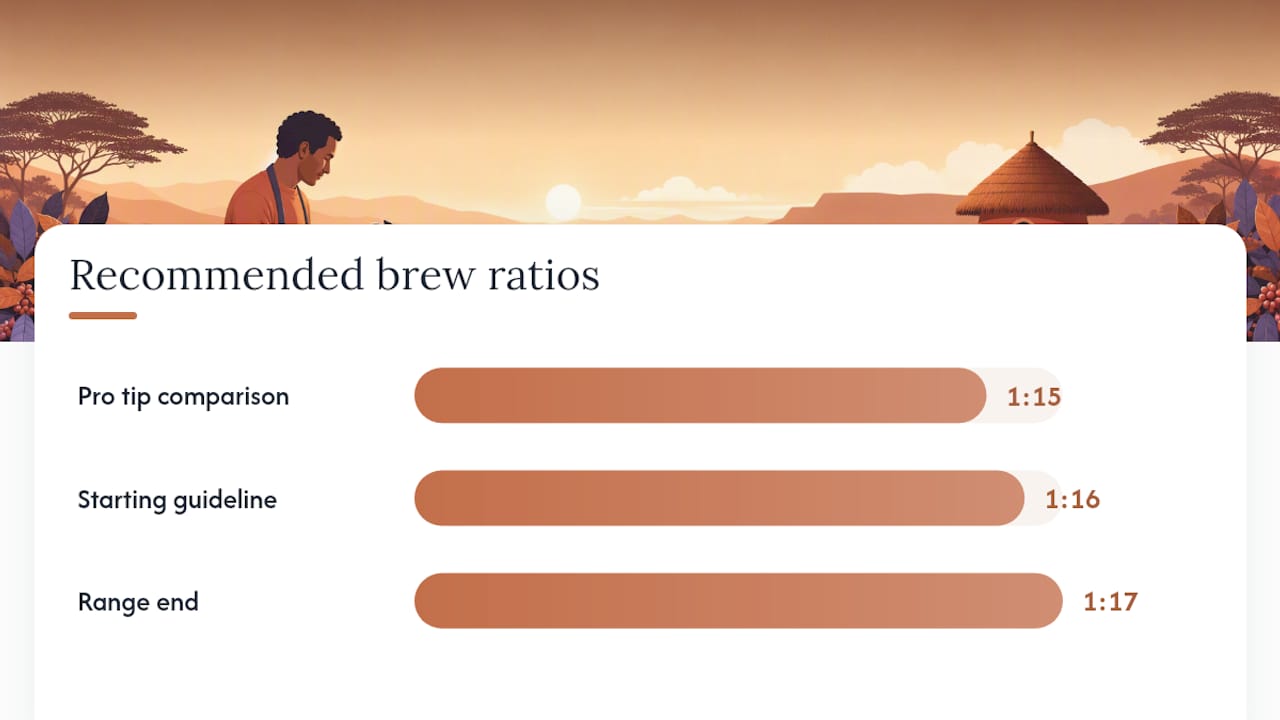
- Start with water around 200°F. Heirloom lots, especially washed ones, can turn sour if the water runs too cool.
- Use a ratio in the 1:16 to 1:17 range as a starting point, then adjust to taste.
- Grind finer if the cup tastes thin or unclear, coarser if it tastes bitter or harsh.
- Bloom for 30 to 45 seconds before the main pour to let carbon dioxide escape evenly.
Once it’s in the cup, work through a short tasting checklist: aroma first (floral versus fruity versus neutral), then acidity quality (bright and citric versus soft and mellow), body (light and tea-like versus syrupy), and finish (how long the flavor lingers, and what it turns into as the cup cools).
Pro Tip: Brew the same origin two ways, once at a 1:15 ratio and once at 1:17, side by side. The difference will teach you more about extraction than any brewing guide.
Compare a washed Yirgacheffe against a natural Guji side by side and the process differences become obvious fast, often more obvious than the regional differences.
How Moustache Coffee Club Sources and Roasts Ethiopian Heirloom Lots
The club roasts single-origin coffee in an ultra-light, Nordic-inspired style intended to preserve the aromatics typical of heirloom lots. Every Ethiopian listing states region, processing method, and roast date, as those details better predict the cup than the word “heirloom” alone.
The goal with any Ethiopian lot is simple: separate the marketing language from the information that actually tells you what’s in the cup. Region and process do that job. The label alone never will.
Sean, who writes on origin sourcing and roasting practice for Moustache Coffee Club, built this guide around that same principle: buy for traceable, specific information, not for a romantic word on the bag.
Why the “Heirloom” Label Deserves More Skepticism, Not Less
The coffee industry treats “heirloom” like a badge of authenticity, and that’s backwards. It’s a logistical description of Ethiopia’s smallholder supply chain, not a quality claim. A bag can say “heirloom” and contain a mediocre mixed lot picked at the wrong time, or it can say “heirloom” and contain a spectacular, carefully separated Guji natural. The word carries zero information about which one you’re getting.
What gets underestimated is how much processing changes the equation compared to region. Buyers obsess over Yirgacheffe versus Sidama, but a natural-processed lot from either region will taste more similar to each other than a washed and natural lot from the same farm. Process is the bigger lever, and most buying guides bury that point.
My advice: stop asking whether a coffee is heirloom. Ask where it’s from, how it was processed, and when it was roasted. If a roaster can’t answer all three, that’s the real red flag, not the absence of a varietal name.
— Sean
Taste the Range With a Rotating Ethiopian Subscription
Reading about Yirgacheffe’s citrus notes or Guji’s stone-fruit character only gets you so far. The fastest way to actually learn the difference is to drink several regional lots back to back, roasted fresh rather than sitting on a shelf for weeks.

Moustache Coffee Club’s coffee subscription ships single-origin beans roasted to order, with region, process, and roast date printed clearly on every bag, plus tasting notes so you know what to expect before the first pour. Rotate through a washed Yirgacheffe one month and a natural Guji the next, and you’ll build a working palate for how region and process actually shift a cup, faster than any tasting note on a website could teach you. Pair a subscription with the brewing and origin guides in the coffee education hub if you want the technical side alongside the beans. Start a subscription and pick your first origin to see how quickly the differences become obvious in your own cup.
Sources
- Exploring Ethiopian heirloom coffee varieties — Perfect Daily Grind
- What Is Heirloom Coffee? Ethiopian varieties, explained — Inheritance Coffee
FAQ
Is Heirloom Coffee Any Good?
It can be excellent, but the label itself doesn’t guarantee it. Quality depends on region, processing, and how carefully the lot was separated and roasted, not on the word “heirloom.”
What Is Considered the Best Ethiopian Coffee?
There’s no single best, since Yirgacheffe, Guji, Sidama, and Harar all offer distinct profiles. Washed Yirgacheffe is the most consistently prized for floral clarity, while natural Guji wins fans for its fruit-forward intensity.
What Does “Heirloom Coffee” Mean?
It refers to indigenous landrace coffee varieties native to Ethiopia, typically grown as genetic mixtures rather than a single documented cultivar. It describes genetic origin, not cup quality.
Where Is Heirloom Coffee From?
Heirloom coffee comes from Ethiopia, the birthplace of Coffea arabica and home to the world’s richest arabica gene pool. Major growing regions include Yirgacheffe, Guji, Sidama, Harar, and Limu.