Kalita Wave Technique: Recipe, 155 vs 185 and Fixes
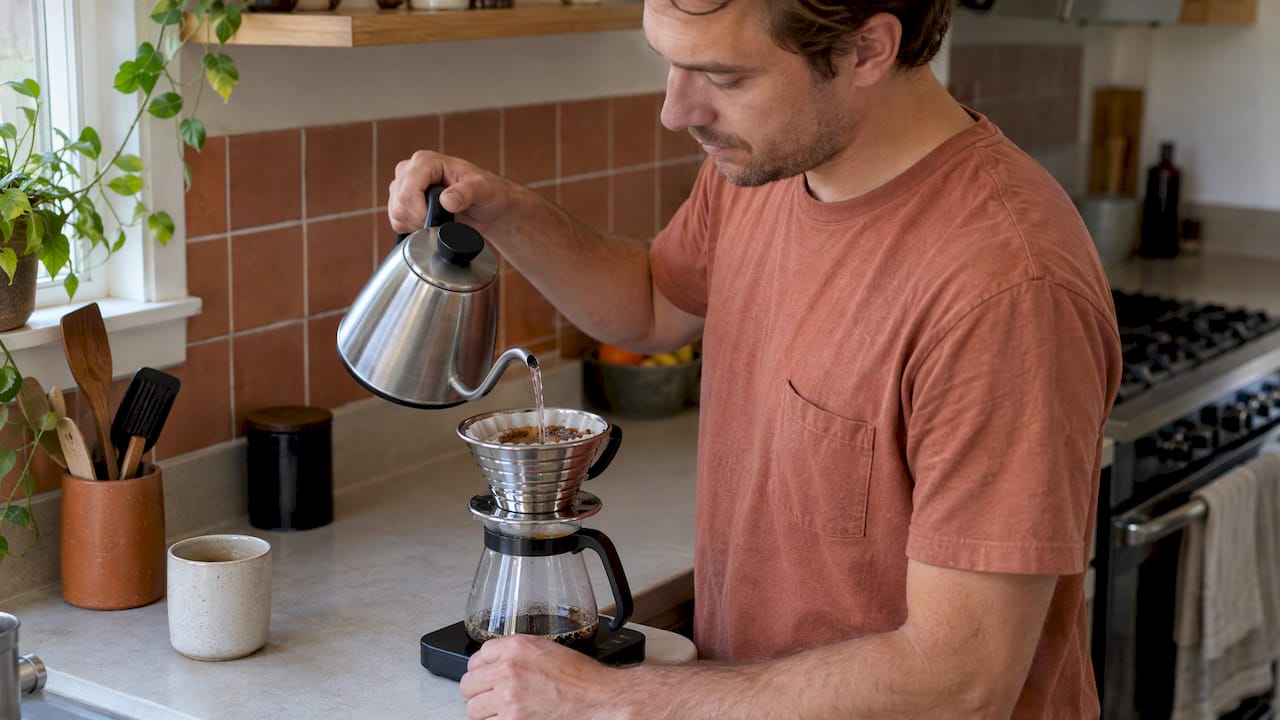
The Kalita Wave technique comes down to one idea: build a level bed of medium-coarse coffee, bloom it, then add water in gentle pulses so the flat bed extracts evenly. Pick the right dripper size (155 for one cup, 185 for one to four), use a ratio near 1:16 or 1:17, aim for about three to four minutes, and change only the grind when the clock or the taste is off. The recipe below works with any good beans. It rewards the freshest, lightest-roasted single origins most, the kind we roast and ship on the day of roasting at Moustache Coffee Club.
TL;DR
- Use a ratio around 1:16 to 1:17: roughly 17-18 g of coffee to 300 g of water in a 155, or 29-30 g to 500 g in a 185.
- Grind medium to medium-coarse, bloom for 30-45 seconds, then pour in small, even pulses without stirring.
- Target a total brew time of about 3:00-4:00. Too fast means grind finer; too slow means grind coarser.
- Match the filter to the dripper: a 155 filter in a 155, a 185 filter in a 185. They are not interchangeable.
- When the cup tastes sour, bitter or weak, change one thing at a time, starting with grind size.
Table of Contents
- Why the Kalita Wave behaves differently from other drippers
- Kalita Wave 155 vs 185: which size to buy
- What you need before you start
- The Kalita Wave technique, step by step
- Recipe reference: ratios, grind and time
- The golden ratio question
- Fixing a Kalita Wave brew that went wrong
- Habits that make every Wave brew better
- Which coffee suits the Wave
- Get fresh single origins for your Wave
- FAQ
- Sources
Why the Kalita Wave behaves differently from other drippers
Most cone drippers drain through one large hole, so your pouring speed decides a lot of the result. The Wave has a flat bottom with three small holes, and it uses a pleated, “wave” shaped paper filter. According to a brewing guide that describes the design, the flat bottom and three extraction holes allow a very even brew, and the folds keep the paper’s contact with the dripper wall low, so coffee can drip through before bitter flavors develop.
The practical effect is forgiveness. A flat bed of grounds sits in a shallow pool of water, and that pool evens out small pouring mistakes. The INeedCoffee tutorial notes that the Wave comes in glass or stainless steel, with the larger size also made in ceramic, and that it needs its own custom filters because standard basket filters will not fit.
The waves also create a small air gap between paper and dripper. One filter guide explains that this gap slows heat loss and limits water slipping down the wall instead of through the coffee. That is why the Wave is often described as a clean, sweet, repeatable brewer rather than a technical one.
Kalita Wave 155 vs 185: which size to buy
This is the first decision, and the one people get wrong most often. The number refers to the dripper and filter size, and each dripper takes only its own filter.
| Wave 155 | Wave 185 | |
|---|---|---|
| Best for | One cup | One to four cups |
| Typical dose | About 12-18 g | About 12-30 g |
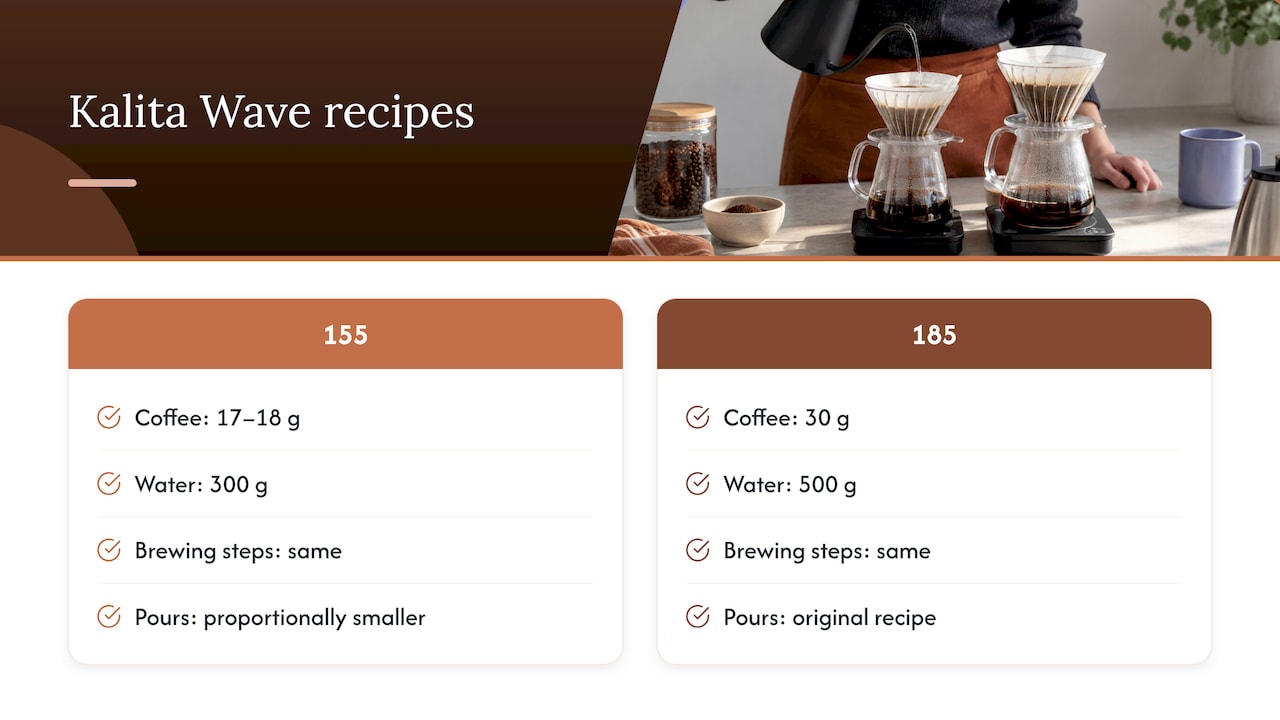
| Example batch | 17-18 g coffee to 300 g water | 29-30 g coffee to 500 g water |
| Filter | Wave 155 only | Wave 185 only |
The dose ranges come from a filter guide, which also notes that a 185 filter will not seat correctly in a 155 dripper, and a 155 filter will not reach the walls of a 185. The pairing of 17-18 g to 300 g and 29-30 g to 500 g comes from the INeedCoffee tutorial. Serving ratings from a comparison table list one to two servings for the 155 and two to four for the 185.
How to choose
- You brew one mug at a time: the 155. A small dose in the 185 forms a thin bed, while the 155 generally gives a more consistent bed depth for a single cup.
- You brew for two or more, or like a large mug: the 185. It gives you room for a 30 g dose and 500 g of water.
- You are not sure: think about the biggest batch you will realistically make. If it is more than about 18 g of coffee, go with the 185.
One more point on recipes: scaling a recipe between sizes does not scale brew time proportionally. A recipe guide warns that changing batch size changes bed depth and drawdown, so start from a recipe written for your dripper size and adjust by grind from there.
What you need before you start
- A Kalita Wave dripper and matching Wave filters.
- A gooseneck kettle, for a thin, controlled stream.
- A scale with a timer. Weighing is the single biggest step toward consistency.
- A burr grinder able to produce an even medium to medium-coarse grind.
- Freshly roasted whole beans. Grind just before brewing.
- Good water. If your tap water is hard or heavily chlorinated, our note on why filtered water improves coffee flavor explains what changes in the cup.
The Kalita Wave technique, step by step
The recipe below is for a 185 and a 500 g brew, built from the published methods. For a 155, use 17-18 g of coffee and 300 g of water and follow the same steps with proportionally smaller pours.
1. Set up and wet the filter
Seat the filter in the dripper and place everything on the scale over your server or mug. To rinse, pour hot water straight into the center rather than around the edges. The tutorial advises this so the filter keeps its shape. Rinsing is optional with this brewer: the same tutorial reports that 2013 World Brewers Cup winner Erin McCarthy skipped it, because the thin Wave filters do not impart a papery taste. If you rinse, empty the server afterward, since the water also warms the brewer.
2. Weigh and grind
Weigh 30 g of coffee for 500 g of water. Serious Eats describes the target grind as coarser than a traditional filter brew but finer than a French press, similar to coarse corn meal. Other recipes say medium to medium-coarse. They are describing the same neighborhood. Start there and let the clock correct you.
3. Level the bed
Add the grounds to the filter and give the dripper a gentle shake or tap so the bed is flat. A flat bed is the whole point of the flat-bottom design, so this takes five seconds and pays back every brew.
4. Heat the water
Use water just off the boil. Published recipes sit around 200°F: one guide uses about 200°F (93°C) and another 201°F (94°C). A range of 195-205°F is the typical working window.
5. Bloom
Start the timer and pour about 60 g of water, wetting every bit of the bed. Let it rest for 30-45 seconds, per the Serious Eats method. Blooming releases carbon dioxide trapped in freshly roasted coffee so that water can extract evenly afterward. Fresh coffee blooms visibly, and the surface may puff up like a small dome. If you want the detail on timing, see our guide to coffee bloom time.
6. Pour in pulses
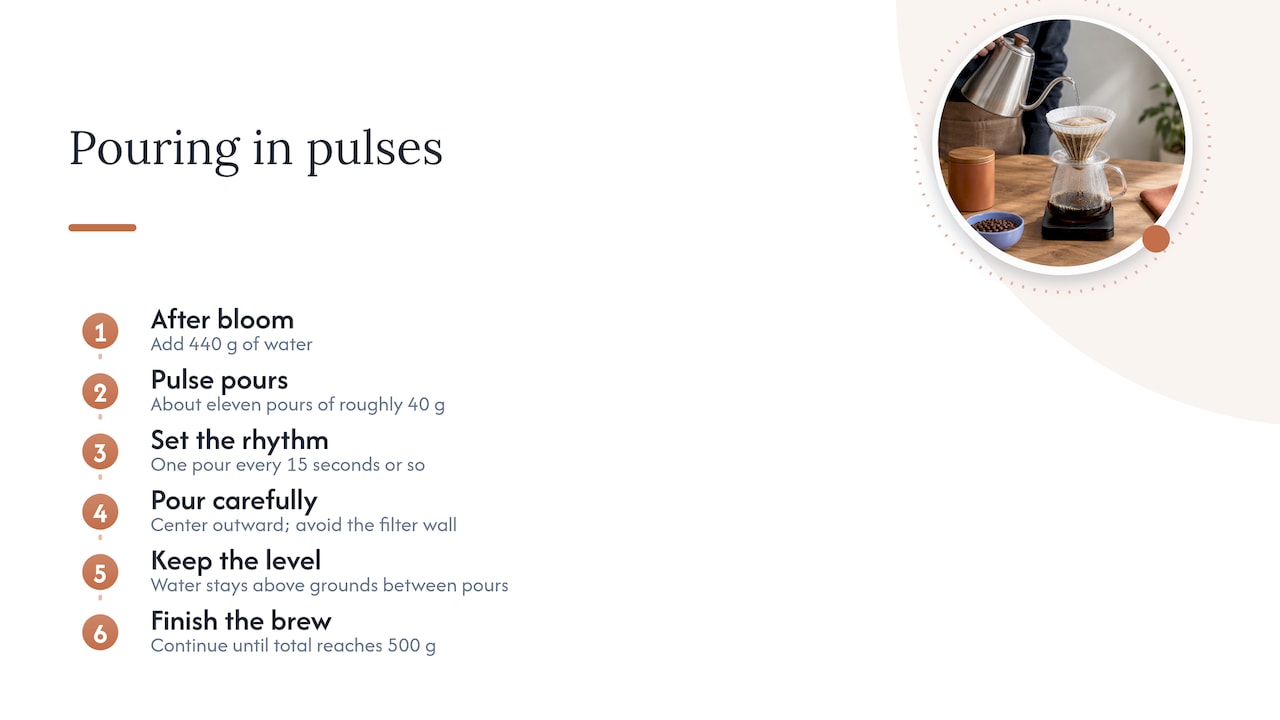
After the bloom, add water in roughly 40 g concentric pours, moving from the center outward, until you reach 500 g. Keep the water level above the grounds between pours and do not pour onto the filter wall. The INeedCoffee tutorial describes two schools, slow steady continuous pouring and the pulse method (pour, let it pass through, repeat), and says both work well. It also advises not to stir the coffee.
If you want a simple pattern to follow, take the 440 g of water after the bloom and add it in about eleven 40 g pours, one every 15 seconds or so, or in fewer, larger pours if you prefer. Whatever the rhythm, keep it the same from brew to brew so that the only thing you change is the grind.
7. Let it drain and check the clock
The Serious Eats method lands at about 3:30-4:00 total. The INeedCoffee tutorial targets 3:00-3:30 for a slightly smaller batch. If the brew finishes much faster, grind finer next time; if it drags on, grind coarser. Once the bed is dry and the dripping stops, remove the dripper, swirl the server and taste.
Recipe reference: ratios, grind and time
Published Wave recipes agree more than they differ. Here is how the numbers compare.
| Source | Dose / water | Bloom | Total time |
|---|---|---|---|
| INeedCoffee | 17-18 g / 300 g (155); 29-30 g / 500 g (185) | n/a | 3:00-3:30 |
| Serious Eats | 30 g / 500 g | 60 g for 30-45 s | about 3:30-4:00 |
| Online Coffee Guide | 20 g / 320 g (185) at 201°F | 40 g for 30-45 s | 2-3 minutes from first water |
The ratios sit between about 1:16 and 1:17. The last recipe also shows how to change strength without changing the dose: keep 20 g of coffee and use 300 g of water for a 1:15 ratio or 340 g for 1:17.
The golden ratio question
People often ask for a single golden ratio for pour-over. In practice it is a starting point. At 1:16, 25 g of coffee gets 400 g of water. At 1:17, 30 g of coffee gets 510 g. A stronger cup needs a lower number, a lighter one a higher number. Pick one ratio, hold it steady, and use grind and pouring to dial in the flavor.
Fixing a Kalita Wave brew that went wrong
Change one variable at a time and taste after each change. Troubleshooting guides such as this one agree on the order: grind first, then temperature and ratio.
Sour, sharp or thin-tasting
This is usually under-extraction. Grind a little finer, which slows the water and gives it more time. If the brew drained in under three minutes, that confirms it. A slightly hotter kettle or a longer bloom can also help.
Bitter, dry or harsh
This points to over-extraction. Go a little coarser so the water moves through faster, and check that you are not pouring so slowly that the bed sits for too long. A slightly higher ratio, such as 1:17 instead of 1:16, also softens the cup.
Weak but not sour
The coffee is probably dilute rather than under-extracted. Add dose or lower the ratio number, for example moving from 1:17 to 1:15, before touching the grind.
Drawdown too slow or stalling
A bed that drains very slowly usually means the grind is too fine or the water is hitting the filter and pushing fine particles into the paper. Coarsen the grind, pour more gently into the center, and make sure the filter is the correct size. Stainless steel Wave models can drain more slowly than glass, according to one detailed hands-on review, so expect to adjust grind if you switch materials.
Brew time very short
Grind finer, and make sure the bed is level. A tilted bed lets water channel through one side.
For a deeper look at tuning variables, our guide on how to adjust your pour over for the perfect cup walks through the same logic across brewers. If you want to compare the Wave with a cone dripper, see our Hario V60 brew guide, and for the fundamentals of pour-over in general, our step-by-step pour-over guide.
Habits that make every Wave brew better
- Weigh everything. Cups and scoops hide the variation that wrecks consistency.
- Use the same pour pattern each time. Center outward, gentle, no stirring.
- Keep notes. Write down dose, grind setting, time and taste. After three or four brews, the right setting for a given coffee becomes obvious.
- Use fresh coffee. Freshness shows in the bloom and in sweetness. Beans that were roasted recently carry more aroma into the cup.
- Keep the filters matched and dry. Store Wave filters flat and away from moisture and odors.
Which coffee suits the Wave
The Wave’s even, clean extraction makes it a good brewer for coffees with clear flavor: floral Ethiopian lots, bright Colombian coffees, anything where you want to taste the origin rather than the roast. That is the kind of coffee we roast. Our ultra-light, Nordic-style roasting is designed to preserve each coffee’s origin flavor profile, so a flat-bed brewer that treats the grounds gently is a natural partner for it.
Our view on the Wave
We roast ultra-light, Nordic-style single origins, and we think a brewer should get out of the coffee’s way. The Kalita Wave does that. Its flat bed and shallow pool mean you spend less time fighting technique and more time tasting what the farm and the roaster put in the bag.
Our advice is to treat the Wave as a tool for learning. Fix your ratio, fix your pour pattern, and change the grind alone. After a few cups you will know how a particular coffee wants to be brewed, and that knowledge carries from one origin to the next.
That is also why we ship beans on the day they are roasted and let you give feedback on what you drink. Fresh coffee plus a consistent routine, and a subscription that learns your preferences, is the simplest way to keep every cup in the Wave interesting.
Sean
Get fresh single origins for your Wave
A good technique deserves coffee worth brewing. Our subscription plans deliver freshly roasted, ultra-light single-origin beans, roasted to order and shipped the day they are roasted, with selections shaped by the feedback you give us. The Duet plan, for example, is listed at $24 per week per bag, and you can see every plan on the plans page. Buying for someone who already owns a Wave? A gift subscription lets them discover new origins cup by cup.

If you like to explore, our Tasting Series offers limited premium coffees to put through your Wave recipe.
FAQ
Should I rinse a Kalita Wave filter?
It is up to you. Rinsing warms the dripper and server, and the water should go into the center so the edges keep their shape. The INeedCoffee tutorial reports that a former World Brewers Cup champion skipped the rinse because the thin filters add no papery taste. Try both and keep what tastes better to you.
Can I use a 185 filter in a 155 dripper?
No. A filter guide explains that a 185 filter will not seat correctly in a 155, and a 155 filter will not reach the walls of a 185. Buy the filter that carries the same number as your dripper.
What grind size should I use for a Kalita Wave?
Medium to medium-coarse. Serious Eats compares it to coarse corn meal, coarser than standard filter coffee but finer than French press. Use total brew time as your guide: finer if the brew runs fast, coarser if it runs slow.
How long should a Kalita Wave brew take?
About three to four minutes in total for a 300-500 g brew, including the bloom. Smaller recipes may finish in two to three minutes. If your time is far outside that, adjust the grind before anything else.
Is the Kalita Wave better than a V60?
They suit different habits. The Wave’s flat bed is more forgiving of pouring variation, while a cone dripper gives you more control through pouring speed. Our Hario V60 guide covers the cone method if you want to try both.
Sources
- Kalita Wave Coffee Brewing Tutorial, INeedCoffee
- How to Brew Coffee Using a Kalita Wave Dripper, Serious Eats
- Kalita Wave Filters guide, Little Cup Experts
- Kalita Wave Guide: 155 vs 185, PourxLab
- Kalita Wave Recipe: Ratio, 155 vs 185 and Filters, Online Coffee Guide
- Kalita Wave Coffee Brewing Guide
- Coffee Troubleshooting Guide, The Coffee Calculator
- The Big Kalita Wave Review, The Coffee Chronicler


