Coffee Traceability Explained: What Buyers Need to Know

Coffee traceability is the documented ability to track a coffee lot through every stage of the supply chain, from the specific farm where it was grown to the cup where it is brewed. A fully traceable coffee can be linked back to a named producer, a harvest date, a processing method, and a lot ID — not just a country of origin. For buyers and consumers, that verifiable history is the difference between a marketing claim and a provable fact.
What a fully traceable lot includes:
- Producer name (individual farmer or cooperative)
- Harvest date and crop season
- Processing method (washed, natural, honey, anaerobic)
- Lot or batch ID (the unique identifier that follows the coffee through the chain)
- Altitude, region, and varietal where relevant
- Handler identity at each stage (washing station, exporter, importer, roaster)
Table of Contents
- What does coffee traceability mean in plain language?
- How is coffee traced from farm to cup?
- Why does traceability matter for quality, ethics, and market access?
- How is traceability actually implemented?
- What are the two main types of traceability systems?
- Why is perfect traceability so hard to achieve?
- How can consumers and buyers verify traceability claims?
- What do traceability projects cost, and how long do they take?
- Which certifications and standards support traceability in the U.S. market?
- How Moustachecoffeeclub documents origin in practice
- Key Takeaways
- Why traceability shapes every sourcing decision we make
- Useful sources and further reading
- FAQ
What does coffee traceability mean in plain language?
Coffee traceability is a verifiable history of a coffee lot. Think of it as a paper trail — or increasingly a digital one — that answers the question: “Who grew this, how was it handled, and when did each step happen?” Every time the coffee changes hands or undergoes a transformation, a record is created. The strength of the traceability system is measured by how complete, accurate, and independently verifiable those records are.
A weak origin statement reads: “Single origin, Ethiopia.” A strong one reads: “Ethiopia, Yirgacheffe, Kochere Cooperative, washed, 1,900 masl, harvested November 2024, Lot #KOC-24-11.” The second version gives a buyer enough information to ask follow-up questions, verify claims, and trace quality issues back to their source. That specificity is what lot traceability actually means in specialty coffee.
- Country + region: narrows origin to a growing zone, not just a nation
- Producer or cooperative name: identifies the accountable party
- Lot ID: the unique tag that makes the coffee findable in records
- Processing method: explains flavor profile and handling conditions
- Harvest date: confirms freshness and crop year
Pro Tip: When evaluating a roaster’s origin claims, count the data fields. A bag that names only the country and a vague region (“Ethiopian highlands”) has weak traceability. Five or more specific fields — producer, region, varietal, processing method, and lot ID — signals a roaster who actually has the paperwork to back the story.
How is coffee traced from farm to cup?
The supply chain for specialty coffee has more handoffs than most consumers realize. Each stage is a potential gap in the record. Understanding coffee sourcing from cherry to roasted bean shows exactly where data gets created — and where it gets lost.
- Farm / producer: GPS coordinates or region, producer name, varietal, altitude, farm size, and agronomic practices recorded
- Harvest: date range, picking method (selective hand-pick vs. strip), and initial cherry quality assessment
- Primary processing (wet or dry mill): processing method, water source, fermentation time, and washing station identity
- Drying and storage: drying method (raised beds, patio), duration, moisture content at departure, and storage conditions
- Milling and warehousing (origin country): green coffee grade, screen size, defect count, moisture, and warehouse lot assignment
- Export: export permit number, shipping container ID, departure date, and exporter identity
- Import: arrival date, port of entry, importer lot number, and any re-grading or quality inspection
- Green coffee warehousing (destination): storage temperature and humidity, warehouse lot ID, and custody transfer record
- Roasting: roast date, roast profile, batch number, and roaster identity
- Packaging: package date, bag lot code, and QR or barcode assignment
- Distribution and retail: shipment date, retailer or subscriber ID, and delivery confirmation
- Brew (café or home): brew date and method (less commonly recorded, but relevant for quality feedback loops)
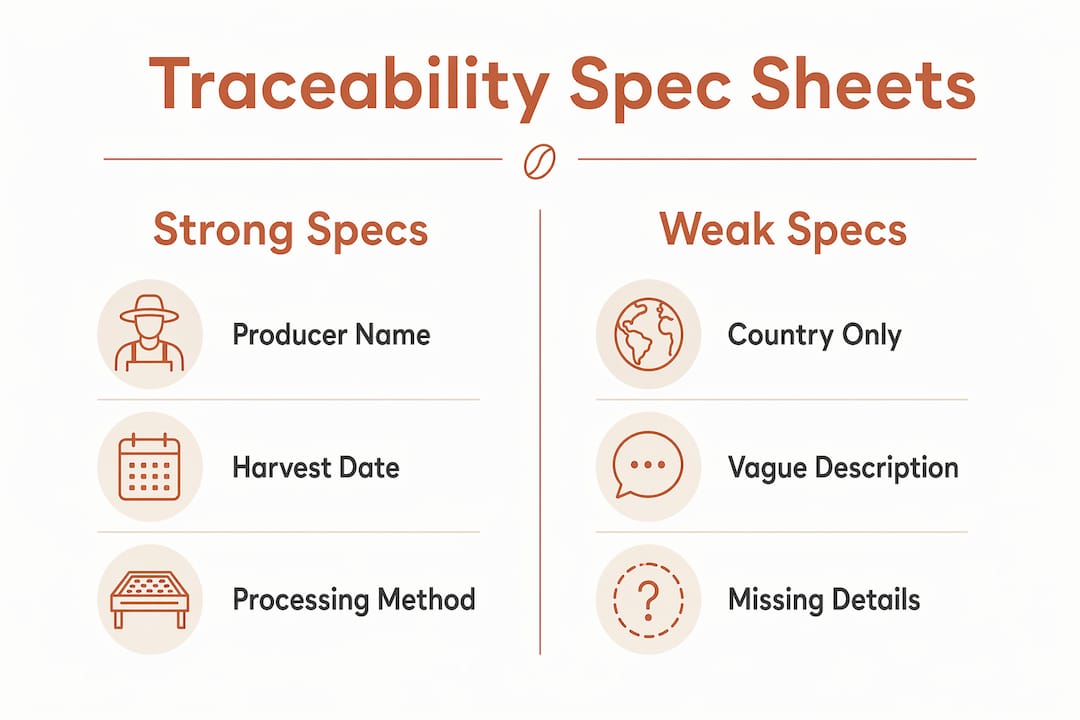
The table below shows what a buyer should expect on a complete spec sheet versus what is commonly missing from weaker documentation.
| Field | Expected on a strong spec sheet | Commonly missing on weak documentation |
|---|---|---|
| Producer name | Named individual or cooperative | Generic “smallholder” or omitted |
| Lot ID | Unique alphanumeric code | Absent or replaced by a batch range |
| Harvest date | Month and year | Crop year only (“2024”) |
| Processing method | Specific method + fermentation detail | “Washed” with no further detail |
| Altitude | Meters above sea level | Omitted |
| Moisture at export | Percentage reading | Omitted |
| Chain-of-custody handlers | Named at each stage | Only origin country and roaster listed |
Why does traceability matter for quality, ethics, and market access?
Traceability is not a transparency exercise for its own sake. It has concrete, commercial consequences at every level of the supply chain.
Quality accountability is the most immediate benefit for specialty buyers. When a roast underperforms or a lot arrives with unexpected defects, lot-level traceability lets a buyer trace the problem back to a specific processing step or storage condition. Without a lot ID and handler records, that feedback loop breaks. Lot traceability is a core pillar of specialty sourcing precisely because it enables targeted feedback and producer recognition — the kind that leads to repeat contracts and higher prices.
Ethical sourcing and supply-chain accountability depend on traceability in a more structural way. Claims about fair wages, safe labor conditions, and sustainable land use are only as credible as the records behind them. A roaster who can name the cooperative, the harvest date, and the premium paid has something verifiable. One who can only say “ethically sourced” has a marketing line. The importance of coffee traceability for ethical sourcing is that it converts intentions into documented facts.
Commercial reasons are equally real. Traceable lots command price premiums in the specialty market. They also protect brands from fraud: a roaster who can verify origin with lot IDs and handler records is far less exposed to mislabeling risk than one relying on supplier assurances alone. For producers, documented traceability is often a prerequisite for accessing specialty buyers, export markets, and certification programs.
A systematic review of 42 peer-reviewed studies on blockchain and coffee supply chains found that digital traceability tools reduce information asymmetries between producers and buyers — but only when governance and infrastructure conditions support them. The technology alone does not create accountability; the records and the relationships behind them do.
How is traceability actually implemented?
Implementation ranges from a notebook at a washing station to a satellite-connected IoT sensor on a shipping container. Most supply chains use a mix of methods, and the level of digitization varies sharply by geography and scale.
- Paper records: the baseline. Farmers and washing stations record lot IDs, weights, and dates by hand. Cheap and accessible, but prone to transcription errors and gaps when records change hands.
- Spreadsheets and ERPs: a step up from paper. Exporters and importers often use spreadsheet-based systems or enterprise resource planning software to consolidate records. Better for aggregation, still dependent on accurate manual entry.
- Barcodes and QR codes: link a physical bag or container to a digital record. QR-based systems are common for connecting retail packaging to origin pages; their value depends entirely on the depth of data behind the code.
- RFID tags: used in warehousing and logistics to track containers without line-of-sight scanning. More expensive than barcodes but faster for high-volume operations.
- IoT sensors: capture real-time parameters — moisture, temperature, GPS location — during storage and transit. Useful for specialty-grade quality control where storage conditions directly affect cup quality.
- Cloud traceability platforms: centralize data from multiple parties in a shared system. Tools like inatrace.org are designed specifically for agricultural supply chains and allow cooperatives, exporters, and roasters to share records in a structured format.
- Blockchain and distributed ledger technology (DLT): create an immutable record of transactions. Blockchain’s practical contribution is tamper-resistance: once a record is written, it cannot be quietly edited. Its practical limit is that it cannot verify the accuracy of the data entered at the source. Garbage in, immutable garbage out.
Who records what matters as much as which tool is used. Farmers or cooperative managers typically record harvest and processing data. Washing stations log fermentation and drying parameters. Exporters assign export lot numbers. Importers create their own lot IDs on arrival. Roasters record roast profiles and batch numbers. Each handoff is a potential break in the chain if the receiving party does not reconcile the incoming lot ID with their own records.
A tiered framework describes implementation levels from Level 1 (manual paper records) to Level 4 (fully digitalized systems integrating QR codes, IoT, GPS, and blockchain). Most specialty supply chains operate somewhere between Level 2 and Level 3.

Pro Tip: For small roasters or cooperatives starting from scratch, the highest-value, lowest-cost move is standardizing lot IDs across every handoff. A consistent naming convention — producer code, harvest year, processing method, batch number — costs nothing and makes every subsequent upgrade (QR codes, cloud platforms, audits) dramatically easier to implement.
What are the two main types of traceability systems?
The two primary system types are internal (company-level) traceability and end-to-end (chain-wide) traceability. They answer different questions and serve different actors.
Internal traceability tracks a product within a single organization’s operations. A roaster who records which green coffee lot went into which roast batch, and which bags came from that batch, has internal traceability. It is useful for quality control, recall management, and inventory accuracy. It does not tell you anything about what happened before the green coffee arrived.
End-to-end traceability spans the entire supply chain from producer to consumer. It requires every party — farmer, processor, exporter, importer, roaster — to record and share compatible data. This is harder to achieve and requires either a shared platform or a trusted intermediary who consolidates records.
Within those two types, there is a further distinction between lot/batch-level traceability and full-tree (leaf-to-root) traceability:
- Lot/batch traceability: tracks a defined quantity of coffee (a lot or batch) as a unit. The lot ID is the anchor. This is the standard in specialty coffee and is sufficient for most quality and ethical sourcing purposes.
- Full-tree traceability: tracks individual trees or micro-plots within a farm, linking specific plants to specific harvests. Used in ultra-premium and experimental lots; rare outside of very small, highly controlled farms.
| System type | Who typically uses it | Main strength | Main limitation |
|---|---|---|---|
| Internal / company-level | Roasters, importers, warehouses | Easy to implement; supports recall and QC | Does not cover upstream supply chain |
| End-to-end / chain-wide | Certification bodies, integrated platforms | Full provenance visibility | Requires multi-party coordination and data standards |
| Lot / batch level | Specialty buyers, cooperatives, exporters | Practical and scalable | Does not capture individual farm-level variation within a lot |
| Full-tree / leaf-to-root | Micro-lot producers, research programs | Maximum specificity | High cost; not scalable for most operations |
Why is perfect traceability so hard to achieve?
The honest answer is that most traceability systems are incomplete, and some are misleading. The challenges are structural, not just technical.
Inconsistent record keeping is the most common problem. A washing station that processes coffee from dozens of smallholders may aggregate lots in ways that break the individual producer link. Once lots are blended, individual-producer traceability is gone. Manual recordkeeping is labor-intensive and error-prone; even well-intentioned operators make transcription mistakes or skip fields under time pressure.
Infrastructure gaps hit hardest at the farm level. Many smallholder producers in Ethiopia, Colombia, or Guatemala operate without reliable internet access, smartphones, or formal record-keeping systems. Asking them to enter data into a cloud platform without connectivity or training is not a traceability solution; it is a data-collection failure waiting to happen.
Incentive misalignment is subtler but equally damaging. Traceability creates value for buyers and roasters. The cost of implementing it often falls on producers and cooperatives. Without direct financial compensation for the record-keeping burden, participation is inconsistent. There is also a governance question: when a downstream buyer controls the traceability platform, they control the data — which can reinforce existing power imbalances rather than correct them.
Fraud risk is real. A QR code that links to a beautiful origin story does not prove the coffee in the bag matches the story. Without independent verification, a lot ID is only as trustworthy as the party who assigned it.
Risk flags to watch for when evaluating traceability claims:
- Origin described only at country level with no region or producer
- Lot IDs that cannot be cross-referenced with any third-party record
- QR codes that link to marketing pages rather than spec sheets with verifiable fields
- Certifications listed without audit report numbers or verification links
- No named handler between farm and roaster
Pro Tip: The most fraud-resistant low-tech approach for roasters is to request the export certificate and the origin-country milling report alongside the spec sheet. These documents are issued by third parties and are harder to fabricate than a supplier’s own lot label.
How can consumers and buyers verify traceability claims?
Verification does not require a laboratory. Most of what you need to know can be found by asking the right questions and knowing what a credible answer looks like.
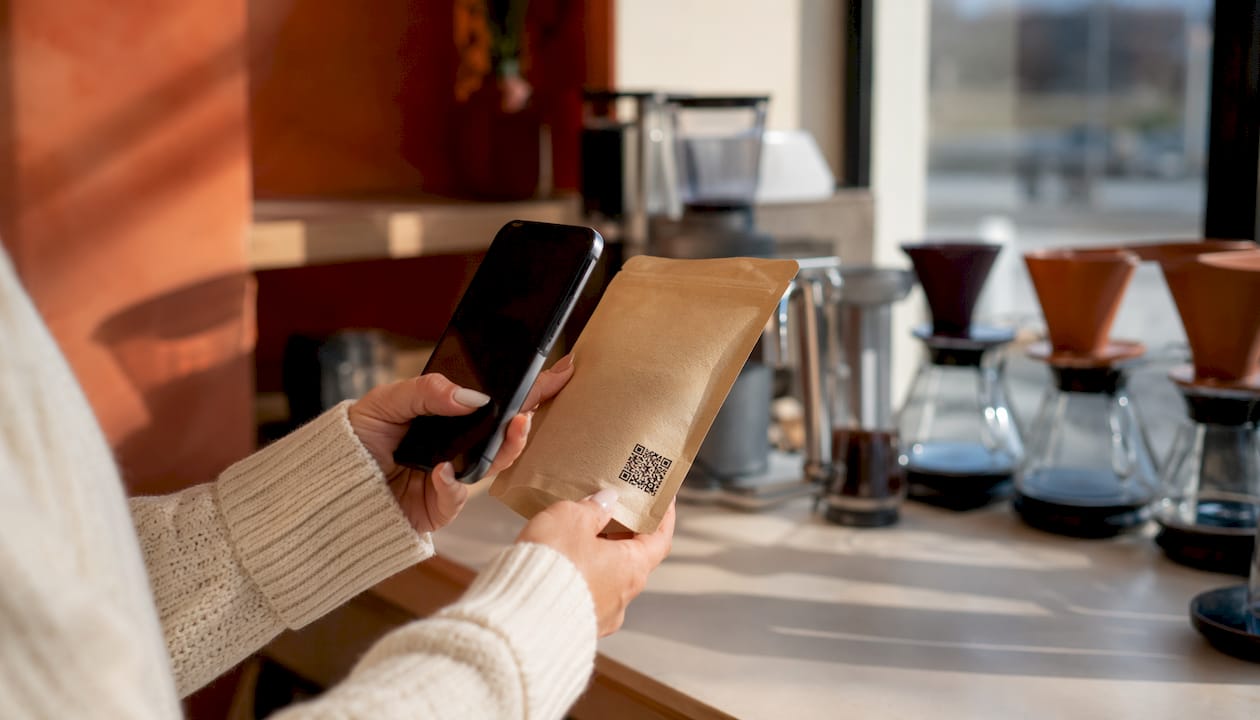
- Scan the QR code on the bag and look for specific data fields: producer name, lot ID, harvest date, processing method, and altitude. A QR that links to a generic “about our sourcing” page is not traceability.
- Request the spec sheet for the lot. A roaster with genuine traceability can produce a document showing the fields listed in step one, plus moisture content and chain-of-custody handlers.
- Ask for the lot ID and confirm it appears on both the spec sheet and the bag. If the roaster cannot connect the bag to a specific lot, the traceability chain is broken at the retail end.
- Check third-party certifications and verify them. Fair Trade USA, USDA Organic, and Rainforest Alliance all have public databases where certification status can be confirmed by certificate number.
- Ask how premiums reach producers. A roaster with genuine supply-chain relationships can describe the price paid above commodity and how it was communicated to the producer or cooperative.
- Look for origin reports or transparency reports published by the roaster. These documents, when detailed, show harvest data, producer names, and pricing — the kind of information that cannot be fabricated at scale without detection.
What to ask a roaster directly:
- “Can you tell me the lot ID for this coffee?”
- “Who processed this lot, and where?”
- “What was the harvest date?”
- “Do you have a spec sheet I can see?”
Pro Tip: The strongest signal on a traceability page is a lot ID that matches a document you can independently request. If the roaster can email you a spec sheet with the same lot number shown on the bag or website, that is a meaningful verification step — no technology required.
What do traceability projects cost, and how long do they take?
Timelines and costs vary enormously by scale and ambition. The good news is that meaningful traceability does not require a blockchain.
- Quick wins (days to weeks): standardizing lot IDs, creating a simple spec sheet template, and training staff to record harvest date and processing method consistently. Cost: near zero beyond staff time.
- Basic digital systems (1–3 months): moving records from paper to spreadsheets, assigning QR codes to bags, and linking codes to a simple web page or Google Sheet with lot data. Cost: low, often under a few hundred dollars in setup.
- Integrated QR and cloud platform (3–6 months): adopting a purpose-built traceability platform (such as inatrace.org, which is open-source and designed for agricultural cooperatives) to centralize records across multiple parties. Cost: platform fees or IT support, plus training time.
- IoT and blockchain integration (6–18+ months): adding real-time sensors for moisture and temperature, integrating GPS tracking, and writing records to a distributed ledger. Cost: significant, often requiring grant funding or development-finance support.
For smallholders and cooperatives, the staged adoption model is the most realistic path. A tiered approach — starting with paper, validating data quality, then digitizing — avoids the common failure mode of deploying expensive technology on top of unreliable records. Several development-finance institutions and NGOs offer grant funding specifically for traceability infrastructure in coffee-producing countries; the Global Coffee Platform and UNIDO have both published guidance on this.
The cost of not implementing traceability is also real: specialty buyers increasingly require documented provenance as a condition of purchase, and producers without it are limited to commodity markets.
Which certifications and standards support traceability in the U.S. market?
Certifications are not the same as traceability, but the best ones require chain-of-custody documentation that functions as a traceability system. U.S. buyers should understand what each attests to and what evidence it produces.
- Fair Trade USA: certifies that producers meet labor, pricing, and community standards. Requires chain-of-custody documentation from farm to roaster. Certificate numbers are verifiable through the Fair Trade USA public registry.
- USDA Organic: certifies that the coffee was grown without synthetic pesticides or fertilizers. Requires an organic system plan and annual third-party audit. Does not directly certify labor conditions or pricing.
- Rainforest Alliance: certifies environmental and social standards. Uses a chain-of-custody model and publishes audit summaries. The 2020 standard strengthened traceability requirements significantly.
- GS1 identifiers: the global standard for barcodes and product identification. GS1 Global Trade Item Numbers (GTINs) and GS1-128 barcodes are used by importers and retailers to link physical products to digital records. Not a certification, but a data infrastructure standard that underpins interoperability.
- ISO traceability references: ISO 22005 covers traceability in the food and feed chain and provides a framework for designing traceability systems. Relevant for roasters and importers building formal systems.
- Forensic origin verification: services like Oritain use chemical fingerprinting to verify geographic origin independent of the paper trail. A coffee’s elemental and isotopic profile can be matched to a specific growing region and, in some cases, an individual farm. This is the most fraud-resistant verification method available, though it is also the most expensive.
| Certification / Standard | What it attests to | Evidence produced |
|---|---|---|
| Fair Trade USA | Labor standards, minimum price, community premium | Certificate number, audit report, chain-of-custody records |
| USDA Organic | No synthetic inputs, annual audit | Organic certificate, system plan |
| Rainforest Alliance | Environmental and social standards | Audit summary, certificate, chain-of-custody |
| GS1 identifiers | Product identity and data interoperability | GTIN, barcode, linked digital record |
| ISO 22005 | Traceability system design framework | System documentation, internal audit records |
| Forensic verification (e.g., Oritain) | Physical geographic origin | Chemical fingerprint report |
For a deeper look at how certifications interact with sourcing decisions, Moustachecoffeeclub’s guide to specialty coffee certifications covers the major programs and what they actually verify.
How Moustachecoffeeclub documents origin in practice
Moustachecoffeeclub sources single-origin specialty lots from regions including Ethiopia and Colombia, roasting in the ultra-light, Nordic-inspired tradition that preserves the flavor characteristics tied to a specific origin. That style of roasting makes traceability more than a marketing asset: when a roast is designed to express terroir rather than mask it, the documented origin is the product.
The workflow starts at origin. For each lot, Moustachecoffeeclub collects producer or cooperative name, harvest date, processing method, altitude, and lot ID before the coffee ships. Those fields travel with the lot through import and into the roastery. When a batch is roasted, the roast log records the green lot ID, roast date, roast profile, and batch number. Subscribers receive origin reports that connect those fields to the cup.
What Moustachecoffeeclub publishes to support traceability:
- Origin reports: named producer or cooperative, region, varietal, processing method, and harvest date
- Lot IDs: unique identifiers that connect the bag to the green coffee record
- Roast logs: roast date and batch number linked to the origin lot
- Origin stories: narrative context about the producer and growing conditions, grounded in the documented spec sheet
The coffee origin story framework Moustachecoffeeclub uses treats the spec sheet as the foundation and the narrative as the layer on top — not the other way around. That sequence matters: story without documentation is marketing; documentation with story is traceability.
Pro Tip: When evaluating any subscription service’s traceability claims, ask whether the origin report is published per lot or per origin country. A lot-specific report with a harvest date and lot ID is meaningful. A country-level “we source from Ethiopia” statement is not.
Key Takeaways
Coffee traceability is a verifiable, lot-level record of every handoff from producer to cup, and its strength is measured by how many specific, independently checkable fields it contains.
| Point | Details |
|---|---|
| What traceability tracks | Producer name, harvest date, processing method, lot ID, and handler identity at each stage |
| Why it matters | Enables quality accountability, supports ethical sourcing claims, and unlocks specialty market premiums for producers |
| Two main system types | Internal (company-level) and end-to-end (chain-wide); lot/batch tracking is the practical standard in specialty coffee |
| How to verify claims | Scan QR codes for specific data fields, request spec sheets with lot IDs, and confirm certifications through public registries |
| Pragmatic next step | Ask your roaster for the lot ID and harvest date; if they can answer both, the traceability chain is intact |
Why traceability shapes every sourcing decision we make
The conventional framing of traceability is that it is a consumer-facing transparency tool. That undersells it. The more useful frame is that traceability is a quality-control infrastructure that happens to be visible to consumers.
When a roaster can trace a defect back to a specific drying lot or a specific washing station, they can fix it. When they can connect a standout cup to a named producer and a specific harvest, they can go back and buy more. That feedback loop is what separates a sourcing relationship from a commodity transaction. Traceability is the mechanism that makes the loop possible.
The sustainability practices that specialty roasters talk about — fair pay, environmental stewardship, long-term producer relationships — are only credible when they are documented. Without records, they are intentions. With records, they are commitments that can be audited, questioned, and improved.
For consumers, the practical implication is simple: a roaster who publishes lot IDs and harvest dates is showing their work. One who offers only a country name and a story is asking you to trust the marketing. The difference is worth caring about, because your buying choices reach further into the supply chain than most people realize.
If you want to experience what documented provenance actually tastes like, Moustachecoffeeclub’s single-origin subscription ships freshly roasted lots with origin reports included. The education hub has brewing guides and origin documentation for every coffee currently on offer.

Useful sources and further reading
For readers who want to go deeper on any of the topics covered here:
- TraceX Tech Coffee Traceability Glossary: plain-language definitions of traceability terms used across the specialty coffee industry
- Green Coffee Collective: Lot Traceability: practical explanation of what lot traceability means on a spec sheet and how to read one
- MDPI: Blockchain and Coffee Supply Chain: peer-reviewed systematic review of 42 studies on blockchain’s role in coffee traceability and its governance dependencies
- MDPI: Digital Traceability in the Ethiopian Coffee Supply Chain: detailed case study of tiered traceability implementation from paper records to fully digital systems
- Oritain: Coffee Origin Verification: overview of forensic chemical fingerprinting as an independent verification method
- Keyence: What Is Traceability?: accessible explainer of barcode and QR-based traceability systems
- UNIDO: Traceability in the Green Coffee Supply Chain: development-finance perspective on traceability infrastructure for producing countries
- inatrace.org: open-source traceability platform designed for agricultural cooperatives
- Moustachecoffeeclub Education Hub: origin reports, brewing guides, and sourcing documentation for every current lot
On the distinction between paperwork-based traceability and scientific verification: paperwork records the chain of custody as reported by the parties involved. Forensic verification, using elemental and isotopic analysis, tests the physical coffee against a geographic reference database. The two methods are complementary: paperwork tells you what was claimed; forensic analysis tells you whether the coffee in the bag is consistent with that claim.
FAQ
What does traceability mean in coffee?
Coffee traceability is the documented ability to track a lot from a named producer through every stage of the supply chain to the final sale. A traceable lot can be linked to a harvest date, processing method, and lot ID — not just a country of origin.
What are the two main types of traceability systems?
The two primary types are internal (company-level) traceability, which tracks a product within one organization, and end-to-end (chain-wide) traceability, which spans every party from producer to consumer. Within those, lot/batch tracking is the practical standard in specialty coffee.
What is traceability in simple words?
Traceability is a record of where something came from and who handled it along the way. For coffee, it means being able to answer: who grew it, how it was processed, and when each step happened.
How do QR codes on coffee bags relate to traceability?
A QR code links a physical bag to a digital record, but its value depends entirely on the data behind it. A code that opens a spec sheet with a lot ID, harvest date, and producer name is meaningful traceability; one that opens a generic brand page is not.
What is the 15-15-15 coffee rule?
The 15-15-15 rule is a brewing guideline, not a traceability standard. It refers to a ratio or timing framework used in some espresso preparation methods and is unrelated to supply-chain documentation or origin verification.
Recommended
- Why Consumer Choices Affect Coffee Farmers: 2026 Guide | Blog | The Moustache Coffee Club
- What Is Direct Trade Coffee? Your 2026 Buyer’s Guide | Blog | The Moustache Coffee Club
- How Single Origin Differs from Blends: A Coffee Guide | Blog | The Moustache Coffee Club
- How Coffee Brands Practice Sustainability in 2026 | Blog | The Moustache Coffee Club