What a Coffee Origin Map Shows and Why It Matters
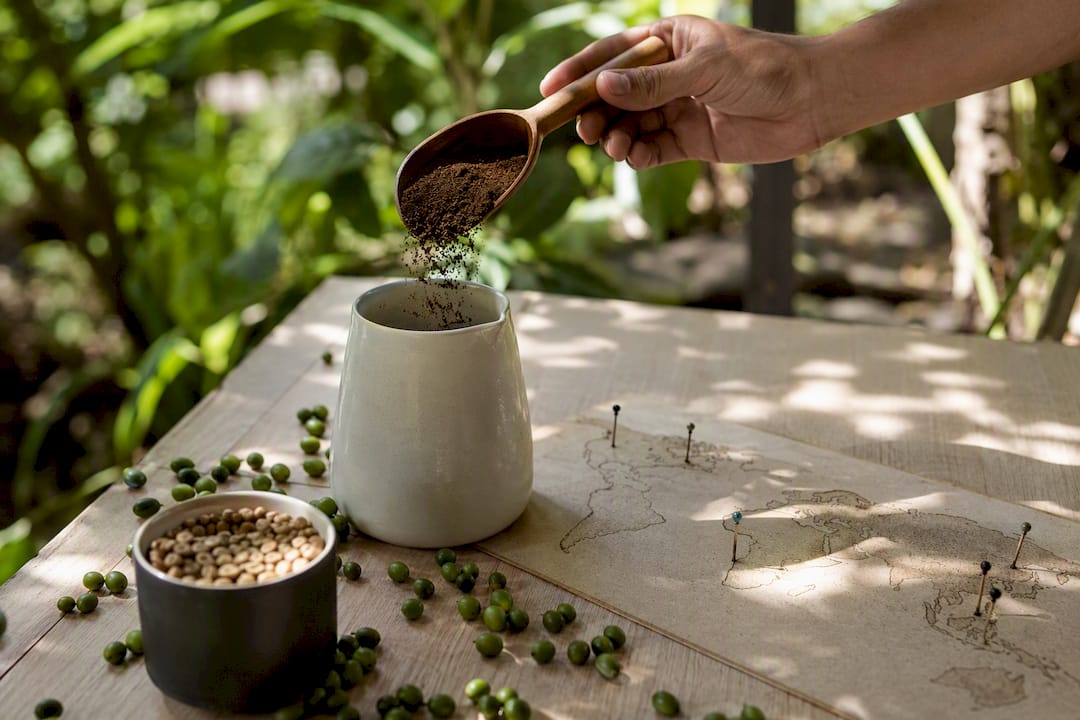
A coffee origin map is a visual resource that marks where coffee is grown worldwide, tracing the Coffee Belt between the Tropics of Cancer and Capricorn, and links those locations to provenance and flavor information. It is the fastest way to connect a bag of beans to the farm, altitude, and processing method behind its taste.
- What maps show: country and regional pins, elevation and topography, farm or cooperative names, and processing methods like washed or natural.
- Why specialty drinkers use them: they set flavor expectations before the first sip and confirm sourcing transparency claims from brands like Moustachecoffeeclub.
Most origin maps trace back to the same geographic logic: coffee needs the warmth, rainfall, and altitude found in that equatorial belt, and Arabica in particular thrives within a narrower slice of it.
Key Takeaways
Reading a coffee origin map well means treating altitude, processing, and variety labels as flavor predictors, not decoration, and cross-checking any pin against a current origin report before you buy.
| Point | Details |
|---|---|
| Altitude predicts flavor | Higher elevation slows cherry maturation, building denser beans with more complex acidity. |
| Maps age quickly | Importer and roaster maps update more often than static atlases, so cross-check sourcing claims. |
| Arabica needs mountains | Robusta tolerates heat and low elevation, which is why the two species cluster in different map zones. |
| U.S. origin is rare | Only Hawaii and California grow coffee commercially, making U.S. pins a novelty rather than a staple. |
| Climate is redrawing the belt | Warming pushes farms upslope, and some previously marginal zones like Yunnan are becoming newly viable. |
Where to Go Next for Map and Origin Research
- Cafe Imports’ world specialty-coffee maps for current importer sourcing relationships.
- CoffeeResearch’s origins map for production lists and harvest timing.
- World Coffee Research’s history of Arabica for varietal lineage and genetics.
- Encyclopaedia Britannica’s history of coffee for the cultural spread from Ethiopia to Yemen and beyond.
Table of Contents
- What Makes a Good Coffee Origin Map
- Coffee Growing Regions Around the World: A Cup-by-Cup Guide
- How Altitude, Soil, and Processing Shape What’s in the Cup
- How to Read a Coffee Origin Map Before You Buy Beans
- Historical Development of Coffee Cultivation Regions
- Major Coffee Producing Countries and Where They Rank
- Arabica Versus Robusta: Different Plants, Different Maps
- Climate Change Is Already Redrawing the Coffee Belt
- Notable Coffee Varietals and Where They Come From
- Why Coffee Origins Matter to the Communities That Grow It
- An Editorial Take on Map-First Coffee Discovery
- Sources
- FAQ
What Makes a Good Coffee Origin Map
Not all coffee growing regions maps are built the same. World maps give you the 30,000-foot view: country outlines, major producing zones, and rough harvest calendars. Regional zooms drop you into a single country, Ethiopia’s Sidama zone or Colombia’s Huila department, with roads, elevation bands, and washing station names. Importer maps and roaster origin maps go further still, tying pins to specific farms, cooperatives, or export lots tied to that season’s harvest.
The data layers separate a decent map from a genuinely useful one:
- Elevation and topography — shown as shading or contour overlays, this is often the single strongest predictor of cup quality.
- Political and regional boundaries — helps you tell a Yirgacheffe pin from a broader Sidama regional label.
- Farm or lot pins — specific to importer and roaster maps, these link a bag to an actual producer.
- Processing labels — washed, natural, honey, or anaerobic, often color coded by pin.
- Export windows — seasonal harvest and shipping timing, useful for judging freshness claims.
Map provenance matters as much as the map itself. Government and academic sources update slowly, sometimes only every few years. Importer maps like Cafe Imports’ world specialty-coffee maps tend to reflect current sourcing relationships because importers redraw them as contracts and partnerships shift season to season.
Pro Tip: Bookmark one importer map and one roaster’s origin page side by side. When a bag lists a lot number, cross-reference it against the importer’s current map before you buy. Stale maps quietly mislead buyers about who’s actually farming a region right now.
Coffee Growing Regions Around the World: A Cup-by-Cup Guide
Reading a map pin well means knowing what that dot has historically produced in the cup, region by region.
The Americas cluster around three signatures. Brazil’s lower-altitude, sprawling farms produce nutty, chocolatey coffees that dominate global supply. Colombia’s mountainous departments, Huila, Nariño, Tolima, produce bright, balanced cups with red fruit and caramel notes. Central America, Guatemala’s Huehuetenango, Costa Rica’s Tarrazú, Honduras’s Marcala, tends toward citrus acidity and floral high notes, largely a function of volcanic soil and altitude.
- Brazil: broad lowland pins, chocolate and nut notes
- Colombia: mountain-range pins, red fruit and caramel
- Central America: volcanic highland pins, citrus and floral notes
**Africa and the Arabian Peninsula hold coffee’s deepest roots. Ethiopia’s map pins split into heirloom-variety zones, Yirgacheffe and Guji chief among them, known for jasmine, bergamot, and stone fruit. Kenya’s pins cluster around Mount Kenya and the Nyeri and Kirinyaga counties, where volcanic soil and meticulous washed processing produce blackcurrant and tomato-like acidity. Yemen’s small, terraced mountain plots, some of the oldest cultivated coffee lands on earth, produce wild, wine-like, often naturally processed cups.
Asia and the Pacific read differently on a map because processing dominates the flavor story more than variety does. Indonesia’s Sumatra and Sulawesi pins signal wet-hulled processing and earthy, low-acid, heavy-bodied cups. Vietnam’s pins mark massive Robusta production feeding instant and blended coffee. India’s Monsooned Malabar carries a distinct label tied to a unique aging process, and Papua New Guinea’s remote highland pins produce clean, fruit-forward Arabica. Yunnan, China, is the newest name showing up on specialty maps, an emerging origin still building its flavor reputation.
Micro-regions worth knowing when you see them on a specialty map: Yirgacheffe (Ethiopia), Huehuetenango (Guatemala), and Geisha or Gesha lots grown at extreme altitude in Panama and parts of Colombia. Each name on a pin is shorthand for a specific taste profile before you’ve opened the bag. For a deeper look at how these regional flavor signatures actually form, Ethiopian coffee varieties offer one of the clearest case studies in origin-driven flavor diversity.
How Altitude, Soil, and Processing Shape What’s in the Cup
Altitude is the map layer that predicts flavor better than almost any other single data point. Specialty coffee professionals treat topography as the strongest signal for expected cup clarity, because higher elevation slows cherry maturation. That slower ripening lets sugars and acids develop more fully, producing denser beans with brighter, more complex flavor.
- Altitude: slower maturation at higher elevation builds density and acidity; topographic shading on a map is your shortcut to spotting this.
- Soil: volcanic terrain, common across Central America, Indonesia, and parts of East Africa, tends to correlate with mineral, syrupy body.
- Processing: washed coffees run cleaner and brighter; natural processing adds fruit and fermented sweetness; honey and anaerobic sit somewhere between, often with heavier body and unusual funk.
- Label cues: grades like SHB (Strictly Hard Bean) or SHG (Strictly High Grown) signal elevation thresholds, usually above roughly 1,200 to 1,600 meters depending on the country’s grading standard.
High-altitude terroir doesn’t just change intensity, it changes sugar structure inside the bean itself, which is part of why ultra-light roasting styles preserve those origin nuances rather than masking them with heavy roast development. For the fuller mechanism behind this, why coffee origin impacts flavor complexity breaks down how elevation and processing interact bean by bean. External research on terroir variables tells a similar story: elevation, rainfall, and soil composition consistently rank among the biggest flavor drivers coffee scientists study.
Where Coffee Grows in the United States
In the United States, coffee is commercially grown in only two states: Hawaii, home to the century-old Kona industry, and California, an emerging niche region planting hillside farms in San Diego and Santa Barbara counties.
- These U.S. pins are tiny on any global map, and that scarcity drives premium pricing.
- Treat a U.S. origin pin as a novelty or collector’s choice, and lean on the broader tropical Coffee Belt pins when you want everyday variety and value.
How to Read a Coffee Origin Map Before You Buy Beans
Turning a map pin into an actual purchase decision takes five quick steps.
- Zoom into the region or farm-level pin rather than stopping at the country view.
- Open the origin profile attached to that pin, if the map links to one.
- Note the altitude, processing method, and varietal listed.
- Check the roast level and roast date on the bag you’re considering.
- Confirm the seller publishes sourcing transparency, farm names, import partners, harvest year.
Cross-check whatever the map shows against the actual bag label and any published origin report. Maps can lag; a good origin report from the roaster usually reflects the current lot.
Pro Tip: Two warning signs mean skip the bag: no roast date printed anywhere, or no processing method listed at all. Both usually mean the seller isn’t tracking origin closely enough to back up the map pin they’re using in marketing.
How Moustachecoffeeclub Turns Map Research Into a Cup
Moustachecoffeeclub pairs origin reports, brewing guides, and detailed tasting notes with every single-origin release, giving map research somewhere concrete to land. Instead of stopping at a pin on a screen, you get the farm story, altitude, and processing behind it. The coffee education hub houses that material for anyone comparing a map find against what’s actually in the bag. Because roasts run ultra-light in the Nordic tradition, the subtle sugars that high-altitude terroir builds into the bean stay intact rather than getting roasted flat, which matters if you’re chasing the exact nuance a map pin promised. It’s a sourcing model built on transparency and reduced-plastic packaging, both aimed at keeping the link between origin and cup honest.
Historical Development of Coffee Cultivation Regions
Coffee’s cultivation map has shifted dramatically since its first documented use. A 2024 genome study traced Arabica’s prehistoric origins to Ethiopia’s highland forests, confirming what growers long believed: the plant is native, not introduced, to that region.
From Ethiopia, cultivation and consumption spread to Yemen by the 15th century, where Sufi monasteries were among the first to cultivate it deliberately rather than harvest it wild, according to Encyclopaedia Britannica’s history of coffee. Yemeni port cities, especially Mocha, became the trade’s first commercial hub, which is why “Mocha” still shows up as shorthand for coffee centuries later.
European colonial powers then carried seedlings across the tropics during the 17th and 18th centuries. The Dutch planted Java and other Indonesian islands. The French brought coffee to the Caribbean and later Latin America through a single seedling reportedly carried to Martinique. Portuguese colonists established Brazil’s plantations, which would eventually make it the largest producer on earth. Two historic varieties, Typica and Bourbon, rode along on these voyages and became the genetic backbone for nearly every Arabica variety grown today, including the ones labeled on modern origin maps.
Colonial-era planting decisions still explain a lot of what a modern map shows. Why Brazil grows at scale while Colombia grows on steep mountain plots comes down to land, labor systems, and terrain choices made two or three centuries ago, not just current climate.
Major Coffee Producing Countries and Where They Rank
A handful of countries account for the overwhelming majority of global coffee supply, and knowing the rough hierarchy helps you read any world production map correctly.
Brazil sits at the top, producing a significant portion of the world’s coffee in most seasons, split between Arabica and a smaller Robusta share, mostly grown across Minas Gerais and São Paulo states. Vietnam ranks second globally, almost entirely Robusta, concentrated in the Central Highlands region around Đắk Lắk province. Colombia holds the third spot among major producers, growing almost exclusively washed Arabica across its Andean departments.
Indonesia follows, mixing Robusta and Arabica across Sumatra, Java, and Sulawesi, with wet-hulled processing giving its coffee a signature earthy profile. Ethiopia rounds out the top tier of producers, notable because a large share of its crop still comes from smallholder farms and wild or semi-wild forest coffee rather than large plantations.
Behind these five, Honduras, Uganda, Mexico, Guatemala, and India all contribute meaningfully to global supply, each with a distinct map footprint. Uganda leans heavily Robusta; Honduras and Guatemala grow almost entirely washed Arabica across volcanic highlands. Production rankings shift modestly year to year with weather and disease pressure, but this top group has stayed largely consistent for decades, which is why most world coffee maps use the same core country set as their base layer.
Arabica Versus Robusta: Different Plants, Different Maps
Arabica and Robusta aren’t just two flavors of the same crop, they’re genetically distinct species with almost opposite growing requirements, and that difference shows up clearly once you know what to look for on a map.
Arabica (Coffea arabica) needs elevation, typically 1,000 to 2,000 meters, cooler temperatures, and consistent rainfall. It’s more disease-prone and lower yielding per plant, but produces the complex acidity and aromatic range specialty buyers chase. On a map, Arabica pins cluster in mountainous zones: Colombia’s Andes, Ethiopia’s highlands, Central America’s volcanic belts, and Kenya’s slopes around Mount Kenya.
Robusta (Coffea canephora) grows at lower elevations, tolerates heat and humidity better, resists leaf rust more effectively, and yields more cherries per plant. The tradeoff is flavor: Robusta tends toward heavier body, higher caffeine, and a blunter, sometimes rubbery or woody profile compared to Arabica’s brighter acidity. Robusta pins dominate lowland Vietnam, Uganda, and large sections of Indonesia and West Africa.
This split explains why a coffee origin map that only shows country-level dots misses something important. Brazil and Indonesia both grow substantial Robusta alongside Arabica, so a single pin covering “Brazil” or “Indonesia” without an elevation or variety layer tells you far less than it seems to. The best origin maps separate variety by region within a country, not just by national border.
Climate Change Is Already Redrawing the Coffee Belt
The tropical band that defines viable coffee cultivation isn’t fixed, and warming temperatures are actively pushing growing zones toward higher elevations and, in some regions, toward higher latitudes. Farms that produced reliable harvests at 1,200 meters a generation ago are increasingly marginal, pushing growers to plant further upslope where land is scarcer and often less suited to large-scale farming.
Industry mapping initiatives now treat coffee maps as living documents rather than static references, precisely because sourcing regions, deforestation risk, and climate exposure keep shifting underneath them. A static map printed five years ago may already misrepresent which farms in a given valley are still productive.
Ethiopia, Colombia, and parts of Central America face some of the most visible pressure, since their coffee economies already sit near the upper elevation limits Arabica tolerates. There’s simply less mountain left to climb in some regions once current elevations become too warm. Meanwhile, some higher-latitude or previously marginal zones, parts of Yunnan in China among them, are drawing fresh interest precisely because shifting conditions have made them newly viable. Understanding these shifts matters beyond academic interest: how coffee farming affects the environment also works in reverse, with land-use decisions in these vulnerable zones shaping deforestation and biodiversity outcomes well beyond the farm gate. Expect any origin map you consult to need more frequent updates over the next decade, not fewer.
Notable Coffee Varietals and Where They Come From
Behind every origin pin sits a specific plant variety, and those varieties carry their own flavor signatures independent of terroir.
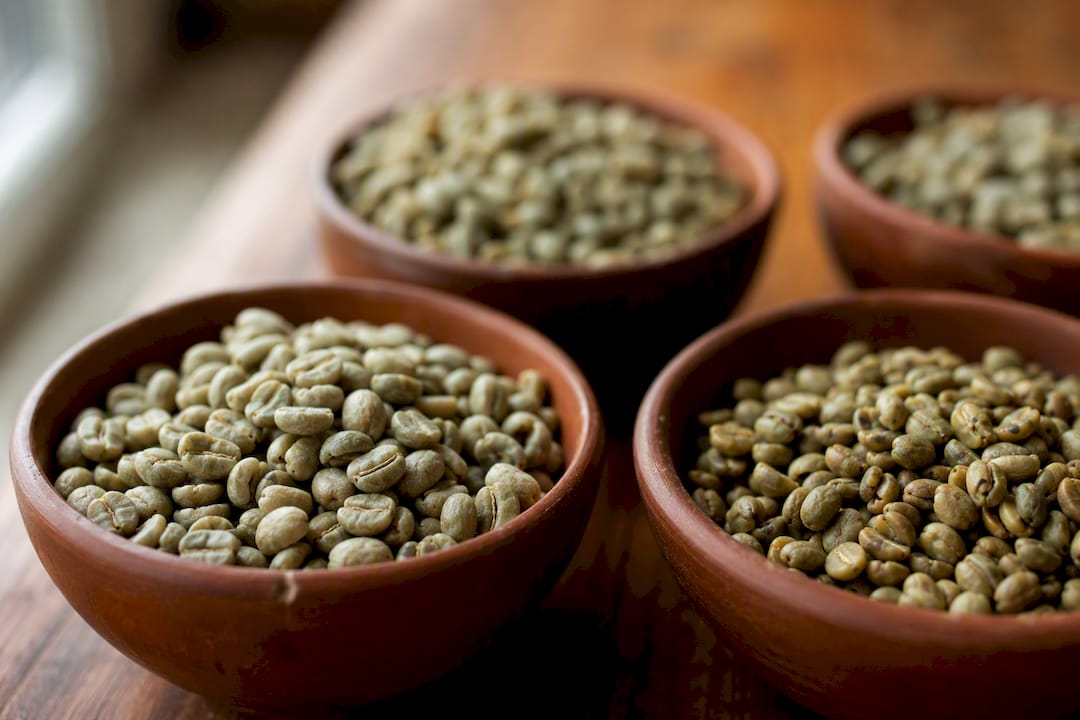
Typica and Bourbon are the two foundational Arabica varieties that spread globally during colonial expansion, and nearly every specialty variety grown today descends from one or both. Geisha (also spelled Gesha), originally from Ethiopian forests, became famous after Panamanian farms in the Boquete region started winning international competitions with its intensely floral, tea-like cup, and it now also grows in parts of Colombia at extreme altitude.
Caturra and Catuai, both Bourbon-derived mutations bred for shorter stature and higher yield, dominate much of Central America and Colombia’s commercial plantings. Bourbon Pointu, also called Laurina, produces naturally lower caffeine and grows in limited pockets including Réunion Island. Ethiopia’s heirloom varieties defy the usual naming conventions entirely, since thousands of genetically distinct landraces grow wild or semi-wild across its forests, which is part of why Ethiopian origin maps often label coffee simply as “heirloom” rather than a single varietal name.
On the Robusta side, varietal distinctions get far less attention commercially, though breeders have developed hybrid cultivars crossing Arabica and Robusta genetics, Catimor and Icatu among them, specifically to combine Robusta’s disease resistance with something closer to Arabica’s cup quality. When an origin map or bag label lists a specific varietal rather than just a country or region, that’s usually a signal the producer is farming for quality over yield.
Why Coffee Origins Matter to the Communities That Grow It
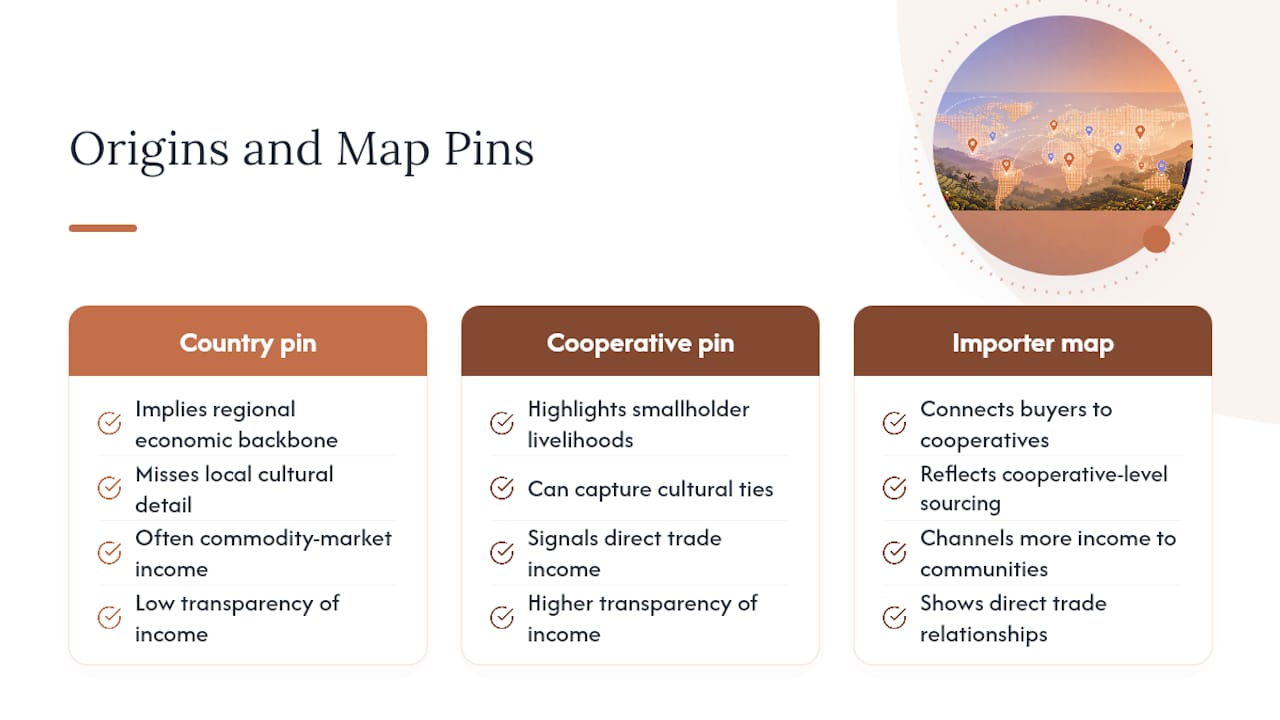
Coffee cultivation isn’t just an agricultural line item for the countries that grow it, it’s frequently the economic backbone of entire regions. In Ethiopia, coffee remains deeply tied to smallholder livelihoods, with a large share of the national crop still coming from family farms rather than industrial estates. In parts of Central America and Colombia, coffee income determines whether rural communities retain population or lose younger generations to urban migration.
The traditional Ethiopian coffee ceremony, still practiced across households and communities, reflects how coffee functions as cultural ritual as much as commodity there, a distinction that matters when a map reduces an entire region to a single pin. Yemen’s coffee culture, meanwhile, ties into some of the oldest continuously cultivated coffee land on earth, land now under significant strain from conflict and water scarcity.
Specialty buyers paying attention to origin increasingly care about this layer, not just the cup profile. Direct trade relationships and cooperative-level sourcing, the kind reflected in detailed importer and roaster maps, often channel more income directly to farming communities than commodity-market coffee does. A map pin that names a specific cooperative or farm rather than just a country is frequently a signal of that kind of more direct economic relationship. Understanding this context changes how a specialty drinker reads a map: it’s not just a flavor guide, it’s a rough proxy for how transparently that cup’s income reached the people who grew it.
An Editorial Take on Map-First Coffee Discovery
Most coffee content treats maps as trivia, a nice visual before you get to the “real” buying advice about roast level or brand reputation. That gets the order backwards. Altitude and processing data on a map predict cup quality more reliably than most marketing copy on a bag ever will, and treating the map as decoration rather than a decision tool is the biggest missed opportunity in how people currently shop for single-origin coffee.
The conventional advice, “find a roaster you trust and follow their recommendations,” isn’t wrong, but it skips a step that actually builds expertise: learning to read the terrain yourself. Once you know that a 1,800-meter pin in Huila behaves differently than a 1,200-meter pin in Brazil, you stop needing to fully outsource your palate to whoever wrote the bag copy.
What I’d prioritize first isn’t the prettiest interactive map, it’s finding one that actually links pins to processing and elevation data, then pairing that with a roast style that doesn’t bury what the map promised. Heavy roasting flattens exactly the nuance that altitude and terroir spent months building into the bean. Ultra-light roasting is the only style that keeps that promise intact from farm to cup.
— Sean
Sources
- Nordic Approach — Coffee belt
- WorldAtlas — Which states grow coffee?
- Reuters — Genome study reveals prehistoric Ethiopian origins of coffee
- Cafe Imports — Maps (World Specialty-Coffee Maps)
FAQ
Where Did Coffee Originally Come From?
Coffee originated in Ethiopia, where wild Arabica plants grow native to the highland forests. A 2024 genome study confirmed Ethiopia as Arabica’s genetic center of origin, though cultivation as a deliberate crop is believed to have started later in Yemen.
What Are the Only Two U.S. States That Grow Coffee?
Hawaii and California are the only U.S. states with commercial coffee production. Hawaii’s Kona region has grown coffee for over a century, while California’s coastal hillside farms are a newer, smaller-scale addition.
Where Does America Get Most of Its Coffee From?
The United States imports the vast majority of its coffee from Latin America, particularly Brazil, Colombia, and Central American countries, since domestic production from Hawaii and California is too small to meet national demand.
Is Coffee From Ethiopia or Yemen?
Both, depending on what you mean. Coffee the plant originated in Ethiopia, but Yemen is where it was first deliberately cultivated and traded as a commodity, making Yemen the birthplace of coffee as an agricultural and commercial practice rather than the plant’s native home.
How Is a Coffee Origin Map Different From a Regular World Map?
A coffee origin map adds specialty layers, elevation, processing method, farm or cooperative pins, that a standard political map doesn’t include, letting you connect a location directly to expected flavor.
Recommended
- What Is a Coffee Origin Story? A Complete Guide | Blog | The Moustache Coffee Club
- Why Coffee Origin Impacts Flavor Complexity | Blog | The Moustache Coffee Club
- Reading Coffee Origin Reports: A Home Barista’s Guide | Blog | The Moustache Coffee Club
- Coffee Traceability Explained: What Buyers Need to Know | Blog | The Moustache Coffee Club