What Is a Coffee Origin Story? A Complete Guide

A coffee origin story is the full account of where a coffee bean comes from, covering its geographic source, cultivation history, processing methods, and cultural context. This combination of place, people, and practice shapes every flavor note in your cup. Understanding what is a coffee origin story means recognizing that Ethiopia and Yemen are not just countries on a map. They are the biological and cultural birthplaces of the coffee you drink every morning.
What is a coffee origin story, exactly?
A coffee origin story is the layered narrative behind a single coffee’s identity. It answers four questions at once: where the plant grew, how farmers cultivated it, how the beans were processed, and what cultural traditions surrounded it. Together, those answers explain why an Ethiopian Yirgacheffe tastes nothing like a Colombian Huila, even though both are Arabica beans.

The term “origin story” is informal and widely used in specialty coffee marketing. The recognized industry term is provenance, though “single-origin” and “terroir” also appear in professional contexts. Provenance covers the same ground: the geographic and human factors that give a coffee its distinct character. Moustachecoffeeclub uses origin stories in exactly this way, pairing each shipment with detailed origin reports so you understand the full picture behind the beans.
Where does coffee come from: geographic and botanical roots
Coffee’s biological home is the montane forests of East Africa. Genetic studies date the first Coffea arabica tree to between 1.08 million and 543,000 years ago in Ethiopian highland forests. That is not a typo. The plant existed for hundreds of thousands of years before any human brewed it.
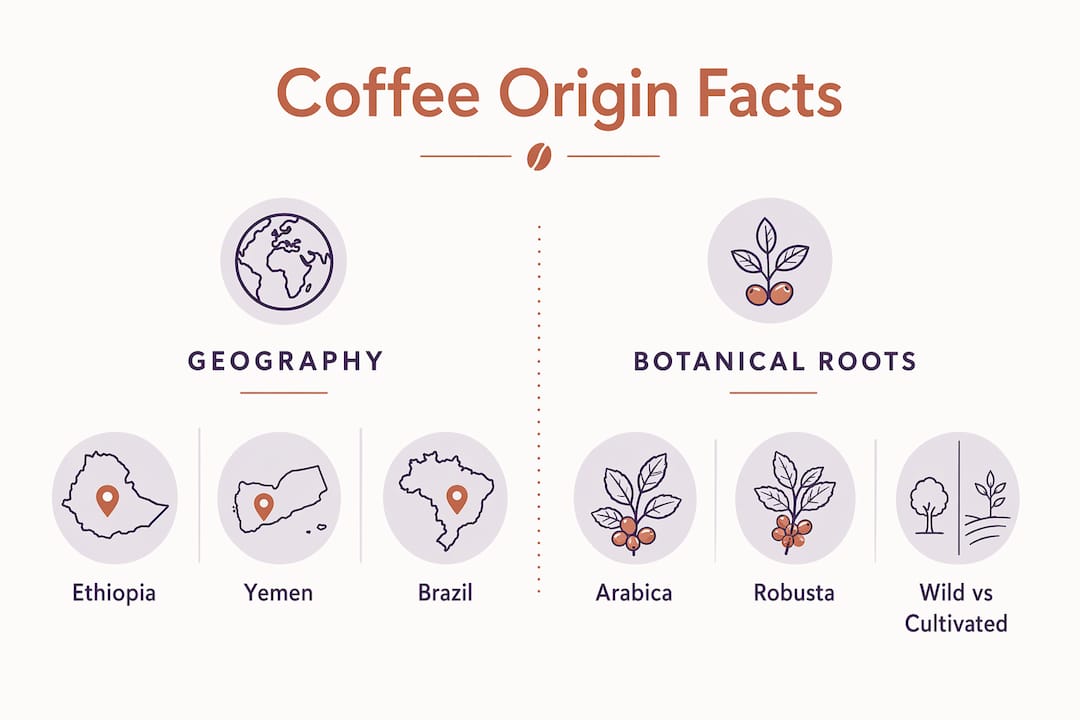
The distinction between wild origin and human cultivation matters enormously. Ethiopia is where coffee grew. Yemen is where humans first used it deliberately. First cultivation and brewing as a beverage happened in Yemen in the 15th century, primarily within Sufi religious communities who used it to sustain alertness during long prayer sessions. That shift from wild plant to intentional crop is the true beginning of coffee’s cultural history.
Key geographic facts at a glance
| Factor | Ethiopia | Yemen |
|---|---|---|
| Role in coffee history | Biological origin of wild Coffea arabica | First site of cultivation and brewing |
| Time period | 1.08 million to 543,000 years ago | 15th century CE |
| Context | Montane forest ecosystems | Sufi religious communities |
| Legacy | Genetic diversity of all Arabica | Foundation of global coffee trade |
The genetic picture is striking. Ethiopian wild coffee landraces carry enormous genetic variety. Every Arabica plant grown outside Ethiopia, from Colombia to Indonesia, descends from a few seeds exported to Yemen in the 15th century. That export created a genetic bottleneck. It means the world’s most popular coffee species is far less genetically diverse than it appears on café menus.
- Wild origin: Ethiopian montane forests, East Africa
- First cultivation: Yemen, 15th century, Sufi communities
- Genetic bottleneck: Nearly all global Arabica traces back to a handful of Yemeni seeds
- Botanical name: Coffea arabica, a natural hybrid that emerged in Ethiopian forests
What are the most famous legends about coffee’s discovery?
The most famous coffee origin legend stars Kaldi, an Ethiopian goat herder who noticed his goats dancing energetically after eating red berries from a particular tree. He reportedly brought the berries to a monastery, monks brewed them, and coffee culture was born. It is a great story. Historians do not believe it.
The Kaldi legend first appeared in writing in 1671, in a Latin treatise by Antoine Faustus Nairon titled De Saluberrima potione Cahue seu Cafe nuncupata Discursus. That is roughly 200 years after coffee cultivation actually began in Yemen. The gap alone signals that this is folklore, not eyewitness history.
“Origin legends are less literal history and more metaphorical meaning, reflecting human curiosity and the transformation of a wild plant into a global social phenomenon.” — coffeeexpert.com
A second legend involves Sheik Omar, a Sufi mystic exiled to the desert near Mocha, Yemen. Starving, he chewed berries from a nearby tree and found renewed energy. He brewed them into a drink, survived, and returned to Mocha as a celebrated healer. This story connects more directly to the documented Sufi cultivation history and carries more plausible geographic grounding.
Both legends function as metaphors for human curiosity and coffee’s power to connect people. They are not meant to be taken as fact. They are meant to be felt. That distinction is worth holding onto when you read origin stories on specialty coffee packaging.
How do origin stories shape coffee flavor and your experience?
Altitude, climate, soil, and processing profoundly influence a coffee’s flavor. These are not marketing claims. They are measurable variables that specialty roasters track for every lot they buy. A coffee grown at 2,000 meters in Ethiopia’s Sidama region develops different sugars and acids than the same species grown at 800 meters in Brazil’s Cerrado.
Processing method is where origin story meets chemistry. Washed processing yields a fruitier, cleaner taste because the fruit is removed before fermentation. Natural processing, where the fruit dries on the bean, intensifies acidity and adds heavier body. The same bean from the same farm can taste dramatically different depending on which method the producer uses.
Washed vs. natural processing: what changes in your cup
| Processing method | Fruit contact | Typical flavor result | Common origins |
|---|---|---|---|
| Washed | Removed before drying | Bright, fruity, clean | Ethiopia, Colombia, Kenya |
| Natural | Dried with fruit intact | Heavy body, intense acidity | Ethiopia, Brazil, Yemen |
The Maillard reaction during roasting transforms green beans, which have no coffee smell at all, into the aromatic cup you recognize. This chemical reaction between sugars and amino acids is why roast level matters. An ultra-light roast, like those Moustachecoffeeclub uses in its Nordic-style approach, preserves more of the origin’s natural flavor compounds. A darker roast pushes those compounds toward roast-driven bitterness.
Single-origin coffees carry a complete origin story. Blends deliberately combine origins to achieve consistency. Neither is superior, but they serve different purposes. If you want to taste what a specific place, season, and farmer produced, single-origin differs from blends in ways that matter deeply to that experience.
Pro Tip: When reading a coffee bag, look for altitude, processing method, and variety alongside the country name. Those three details tell you more about the flavor than the country alone.
How did coffee travel from its origin to your cup?
Coffee’s global spread followed trade routes that reshaped economies and cultures. From Yemen, coffee moved through the Ottoman Empire and reached Cairo, Istanbul, and Mecca by the early 16th century. Coffeehouses became centers of intellectual and political life. European traders encountered coffee in Ottoman ports and carried it west. By the 17th century, coffeehouses operated in London, Paris, and Vienna.
The Americas received coffee through colonial trade in the early 18th century. Brazil became the world’s largest producer within a century of its first coffee planting. Colombia, Guatemala, and Costa Rica followed. Each new growing region added its own terroir to the coffee bean history, creating the geographic diversity that specialty coffee celebrates today.
Modern consumption reflects how deeply coffee has embedded itself in daily life. American adults drinking coffee daily increased by 37% between 2004 and 2025, reaching the highest consumption level in over 20 years. That growth tracks directly with the rise of specialty coffee culture and the consumer appetite for origin transparency.
The coffee production process today involves multiple countries and hands before a bean reaches your grinder:
- Cultivation: Farmers grow coffee cherries, often at high altitude, over several years before a plant produces its first full harvest.
- Harvesting: Cherries are picked by hand in most specialty-grade farms, selecting only ripe fruit.
- Processing: Washed, natural, or honey methods separate the bean from the fruit and begin fermentation.
- Milling and export: Dried beans are hulled, sorted, graded, and shipped as green coffee.
- Roasting: Green beans are roasted to order, triggering the Maillard reaction that creates aroma and flavor.
- Brewing: Water extracts soluble compounds from ground coffee, completing the journey from origin to cup.
Understanding how a coffee cherry becomes a roasted bean at each stage makes origin stories more than marketing. They become a map of every decision that shaped your cup.
Key Takeaways
A coffee origin story is the combination of geography, cultivation, processing, and culture that defines a coffee’s flavor and identity, with Ethiopia as its biological birthplace and Yemen as its first human home.
| Point | Details |
|---|---|
| Origin story definition | Covers geographic source, cultivation, processing method, and cultural context behind a coffee. |
| Biological vs. cultivated origin | Ethiopia is coffee’s wild birthplace; Yemen is where humans first cultivated and brewed it in the 15th century. |
| Legends are metaphors | The Kaldi story first appeared in 1671, centuries after cultivation began, confirming it as folklore, not history. |
| Processing shapes flavor | Washed processing produces fruitier notes; natural processing intensifies body and acidity from the same bean. |
| Origin drives single-origin value | Altitude, climate, soil, and processing define what makes a single-origin coffee distinct from a blend. |
Why origin stories are worth taking seriously
Sean here. I have tasted a lot of coffee over the years, and the single biggest shift in how I experience a cup came from reading origin reports rather than just tasting notes. Knowing that a Yirgacheffe was grown at 1,900 meters, processed using the washed method, and harvested by a cooperative of 400 smallholder farmers changes how I pay attention to what is in the cup.
The Kaldi legend used to frustrate me because it felt like a distraction from the real science. I have come around on that. Myths do not compete with facts. They carry emotional weight that facts alone cannot. When a brand tells you the story of a Sufi monk in Yemen discovering coffee’s alertness-giving properties, it is not lying to you. It is giving you a way to feel connected to something ancient. The science of the Maillard reaction and the legend of Kaldi serve different parts of your brain, and both are worth having.
Where I draw a hard line is on ethical sourcing practices. An origin story that romanticizes a place without paying farmers fairly is just marketing. The best origin stories include the people, not just the geography. When you know a farmer’s name, the cooperative’s practices, and whether the price paid was above the commodity market rate, the origin story becomes accountability, not just atmosphere. That is the version worth seeking out.
— Sean
Single-origin subscriptions that bring origin stories to your door
Moustachecoffeeclub was built around the idea that knowing where your coffee comes from makes it taste better.

Every subscription shipment from Moustachecoffeeclub includes a detailed origin report covering the farm, altitude, processing method, and flavor profile for that specific lot. The ultra-light, Nordic-style roast preserves the origin’s natural character instead of covering it with roast-driven flavors. You taste the place, not just the roast. If you want to put what you have read here into practice, the best coffee subscription from Moustachecoffeeclub is the most direct way to experience single-origin provenance in your own cup, freshly roasted and shipped to order.
FAQ
What is a coffee origin story in simple terms?
A coffee origin story is the account of where a coffee bean comes from, including its country, farm, altitude, and processing method. These factors combine to explain why that coffee tastes the way it does.
Where does coffee originally come from?
Coffee originated in the montane forests of Ethiopia, where wild Coffea arabica trees grew for hundreds of thousands of years before humans cultivated the plant. The first documented cultivation and brewing as a beverage occurred in Yemen in the 15th century.
Is the Kaldi goat herder story true?
Historians consider the Kaldi legend apocryphal. It first appeared in a written text in 1671, roughly 200 years after coffee cultivation began in Yemen, making it folklore rather than documented history.
How does a coffee’s origin affect its flavor?
Altitude, climate, soil type, and processing method all shape a coffee’s flavor profile. A washed Ethiopian coffee typically tastes bright and fruity, while a naturally processed coffee from the same region often carries heavier body and more intense acidity.
What is the difference between single-origin coffee and a blend?
Single-origin coffee comes from one specific farm, region, or country, preserving the distinct flavor of that place. A blend combines beans from multiple origins to achieve a consistent, balanced flavor profile across batches.
Recommended
- How Single Origin Differs from Blends: A Coffee Guide | Blog | The Moustache Coffee Club
- Coffee Education Hub | Ultra-Light Nordic-Style Brewing Guides & Origins | Moustache Coffee Club
- How a Coffee Cherry Becomes a Roasted Bean | Blog | The Moustache Coffee Club
- Why Colombian coffee is widely loved: a complete guide | Blog | The Moustache Coffee Club