French Press for Light Roasts: A Practical Brewing Guide
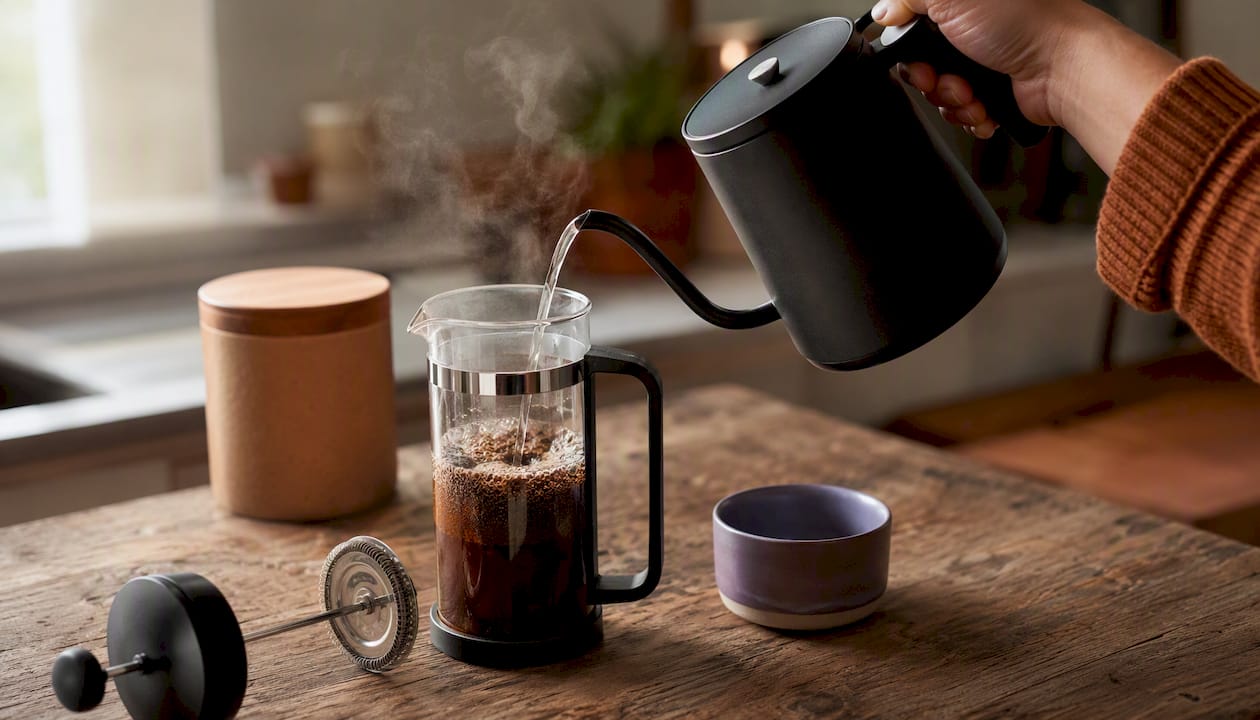
Use coffee and water in a ratio stronger than the classical 1:18, aiming for a more body-enhancing proportion suitable for French press. Grind medium-coarse, a grind size comparable to coarse sea salt, heat your water to a higher temperature recommended for light roasts, around 205°F, and steep for 4 minutes. That’s your starting recipe for a French press guide for light roasts that actually works. Light roasts are denser than dark ones, so they need hotter water and slightly more contact time to pull out sweetness and body without leaving you with a sour, thin cup. Brew it now, then use the sections below to tune it to your specific beans.
Key Takeaways
Brewing light roast coffee well in a French press comes down to three non-negotiable variables: hotter water (205°F), a coffee-to-water ratio slightly stronger than the classical 1:18, typically about 1:15, and immediate decanting after pressing.
| Point | Details |
|---|---|
| Temperature first | Start at 205°F. It’s the most impactful variable for dense light roasts. |
| Use a coffee-to-water ratio slightly stronger than the classical 1:18, typically about 1:15 | 30g coffee to 450g water delivers the body French press is built for. |
| Decant immediately | Leaving brew in the carafe continues extraction and turns the cup bitter. |
| Upgrade your grinder | A burr grinder is the single biggest clarity improvement you can make. |
| Moustachecoffeeclub beans | Fresh-roasted ultra-light single origins arrive at peak freshness for dialing in this recipe. |
Table of Contents
- How to brew light roast coffee in a French press, step by step
- Why light roasts need hotter water and more time
- How to choose your grind and dial in any light roast
- Which French press design actually helps with light roasts?
- Troubleshooting: what went wrong and how to fix it
- Tips for ultra-light and Nordic-style beans
- What French press actually does for ultra-light beans
- Fresh ultra-light beans make every parameter work harder
- Sources
- FAQ
How to brew light roast coffee in a French press, step by step
Recipe parameters at a glance
These numbers come from tested French press frameworks built specifically around light-roast extraction. The 1:15 ratio is stronger than the classical 1:18 many guides default to, and that extra coffee weight is what gives you body and punch through the natural oils in the brew.
The full brewing sequence
- Preheat the carafe. Fill your French press with hot water, swirl, and discard. This keeps your brew temperature from dropping the moment grounds hit the vessel.
- Add your grounds. Measure 30g of medium-coarse ground coffee directly into the warmed carafe.
- Bloom. Pour just enough 205°F water to saturate all the grounds (roughly 60g). Start your timer. Wait 30–45 seconds while CO2 escapes and the grounds swell. Fresh beans will bubble noticeably here.
- Add the remaining water. Pour the rest of your 450g slowly and evenly over the grounds.
- Stir. Give the slurry two or three gentle stirs to make sure every particle is wet. This step alone reduces uneven extraction.
- Place the lid on, plunger up. Don’t press yet. Let the coffee steep undisturbed.
- Press slowly at 4 minutes. Apply steady, even downward pressure over about 20–30 seconds. Stop just above the grounds rather than forcing the plunger all the way to the bottom, which pushes fines through the mesh.
- Pour out immediately. Don’t leave brewed coffee sitting in the carafe. Decanting right away stops extraction and prevents the cup from turning bitter or muddy as it cools.
Pro Tip: Pour the last 20ml of the carafe into a separate cup or discard it. The bottom of a French press holds the highest concentration of suspended fines, and skipping it noticeably cleans up the final sip.
Why light roasts need hotter water and more time
Light roasts are physically denser than dark roasts. The roasting process breaks down cell walls and drives off moisture; the less time a bean spends in the roaster, the more intact its structure remains. That density slows extraction. Water has to work harder to dissolve the soluble compounds that create sweetness, body, and the bright acidity light roasts are prized for.
At standard parameters (around 195°F, 3:30 steep), a light roast often under-extracts. The result is sour, thin, and hollow. Raising water temperature toward 205°F gives the water more energy to penetrate dense cell walls and pull out those compounds before time runs out. Extending steep time to 4 minutes adds contact time without requiring you to grind finer, which would increase sediment.
The practical rule: treat a light roast like a denser coffee. Add extraction energy through temperature first, then time, and only touch grind size last. That sequence keeps your troubleshooting logical and your changes easy to reverse. For a deeper look at the chemistry behind this, the science of ultra-light roast flavor preservation explains why roast level affects solubility so dramatically.
How to choose your grind and dial in any light roast
Where to start
Medium-coarse is the right entry point, similar in texture to coarse sea salt, or a setting around 25–30 on a Baratza Encore. That particle size gives you enough surface area for a 4-minute immersion without generating so many fines that every cup is gritty. Tested light-roast recipes consistently land here as a starting point, with adjustments made by taste.
Ratio rules
Start at a coffee-to-water ratio around 1:15. If the cup feels thin or watery after adjustments, slightly increase the coffee dose to strengthen the brew. If it’s too heavy or bitter, reduce the coffee dose slightly to lighten the brew. Change one variable at a time and taste before changing another.
A numbered tuning sequence
- Taste the cup as-is. Note whether it’s sour, bitter, thin, or gritty before changing anything.
- Adjust temperature first. If sour, raise water temp by 2–3°F. If bitter, lower by 2–3°F.
- Adjust grind next. Still sour after raising temp? Grind one step finer. Bitter after lowering temp? Go one step coarser.
- Adjust time last. Add 30 seconds if still under-extracted; subtract 30 seconds if over-extracted.
- Record every change. A simple notes app entry (date, bean, ratio, temp, grind, time, result) means you never repeat a mistake or lose a great cup.
Pro Tip: Hold a pinch of your ground coffee between two fingers and rub. If you feel a lot of powder (fines), your grinder is producing too much dust. Fines pass through the mesh and create grit. A quality burr grinder set one step coarser will reduce them faster than any other fix.
For a complete dialing framework beyond French press, the light roast dialing guide for home baristas covers the full variable sequence across multiple brew methods.
Which French press design actually helps with light roasts?
Material and heat retention
Glass looks great but loses heat fast. A glass carafe can drop 10°F or more during a 4-minute steep, which matters for light roasts that need sustained temperature to extract properly. Stainless-steel, double-walled presses retain heat far better and produce more even extraction, especially if you’re brewing a second cup or steeping longer. Ceramic sits between the two: better insulation than glass, heavier, and more fragile than steel.
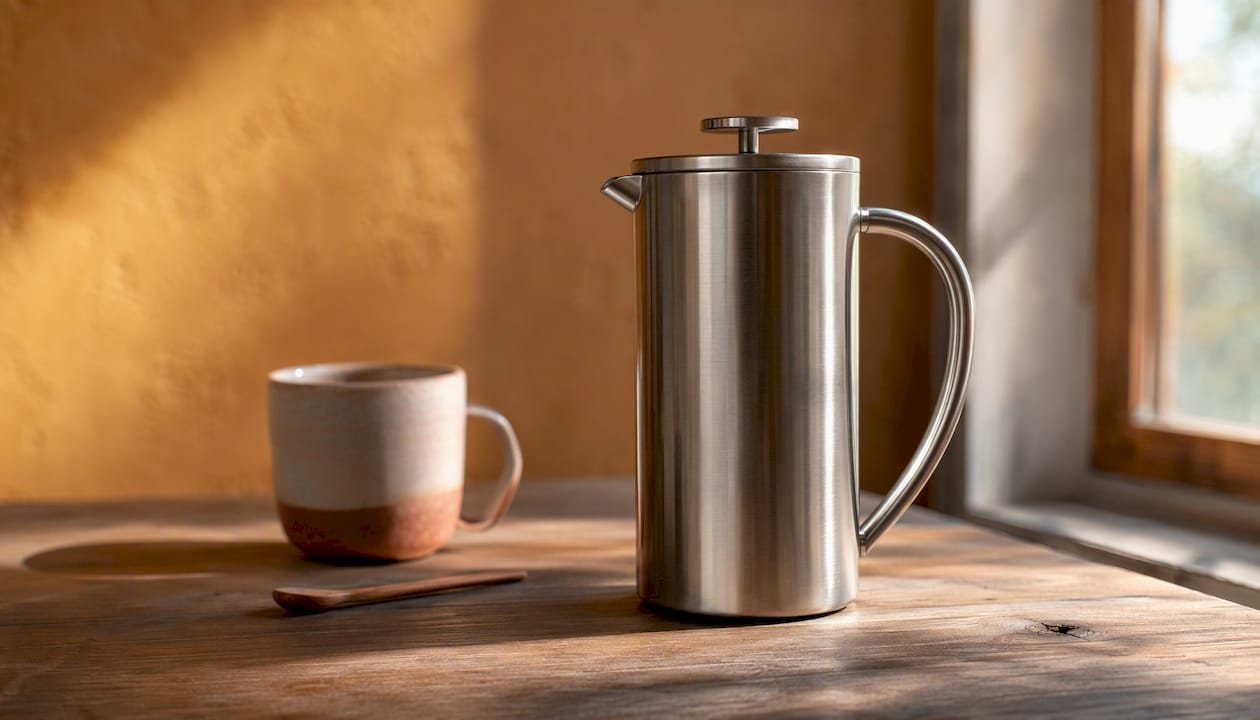
If you already own a glass press, preheating it thoroughly (as described in the recipe above) closes most of that gap. But if you’re buying new, double-wall stainless is the clear choice for light-roast consistency.
Filter quality and sediment
Standard single-mesh filters let a fair amount of fines through, which muddies the cup and adds bitterness. Dual micro-filter systems, such as those found on some premium models like the Espro P3, reduce grit significantly while keeping the full-bodied immersion character. Wirecutter’s testing found that models with these designs produced the cleanest cups among all presses tested, and that stopping extraction right after pressing improved consistency. For single-origin light roasts where clarity matters, the upgrade is worth it.
Accessories that move the needle
- Burr grinder: Even particle size is the single biggest variable you control. A blade grinder produces wildly inconsistent particle sizes that make every cup unpredictable.
- Kitchen scale: Eyeballing scoops introduces 20–30% dose variation. A scale removes that entirely.
- Variable-temperature kettle: Hitting 205°F consistently without a thermometer is guesswork. A gooseneck kettle with a built-in thermometer (like a Fellow Stagg EKG) solves both temperature accuracy and pour control.
- Serving decanter: Pour your finished brew into a separate vessel immediately. It stops extraction cold and keeps the cup clean as it cools.
Pro Tip: Filtered water makes a real difference for light roasts. Tap water with high mineral content or chlorine competes with the delicate floral and citrus notes these beans carry. A simple Brita pitcher is enough.
Troubleshooting: what went wrong and how to fix it
| Symptom | Likely cause | Immediate fix |
|---|---|---|
| Sour, sharp, thin | Under-extraction (water too cool, grind too coarse, steep too short) | Raise water temp to 205°F; if already there, grind one step finer |
| Bitter, harsh | Over-extraction (water too hot, grind too fine, steep too long) | Lower temp by 3°F or shorten steep by 30 seconds |
| Thin body, watery | Ratio too low | Increase dose toward 1:15 (30g per 450g water) |
| Excessive grit | Fines through mesh, plunged too fast | Press slower; stop 1cm above grounds; decant immediately; consider a dual-filter press |
| Flat, no brightness | Stale beans or no bloom | Check roast date (use within 4 weeks); always bloom 30–45 seconds |
Water quality deserves a specific mention here. Hard water with high calcium can actually help extraction, but water with heavy chlorine or off-flavors will suppress the bright, floral notes that make a good light roast worth brewing. If your cup tastes flat regardless of parameters, try filtered water before changing anything else.
Tips for ultra-light and Nordic-style beans
Ultra-light and Nordic-style single-origin beans, the kind Moustachecoffeeclub roasts to order, come with a specific handling consideration: rest time. Beans roasted within the last 48 hours are still actively degassing CO2. That gas creates resistance during extraction and can produce an uneven, slightly sour cup even with perfect parameters. A rest window of 5–10 days post-roast tends to hit the sweet spot for French press: enough degassing for even extraction, fresh enough to preserve the volatile aromatics that carry floral and citrus notes.
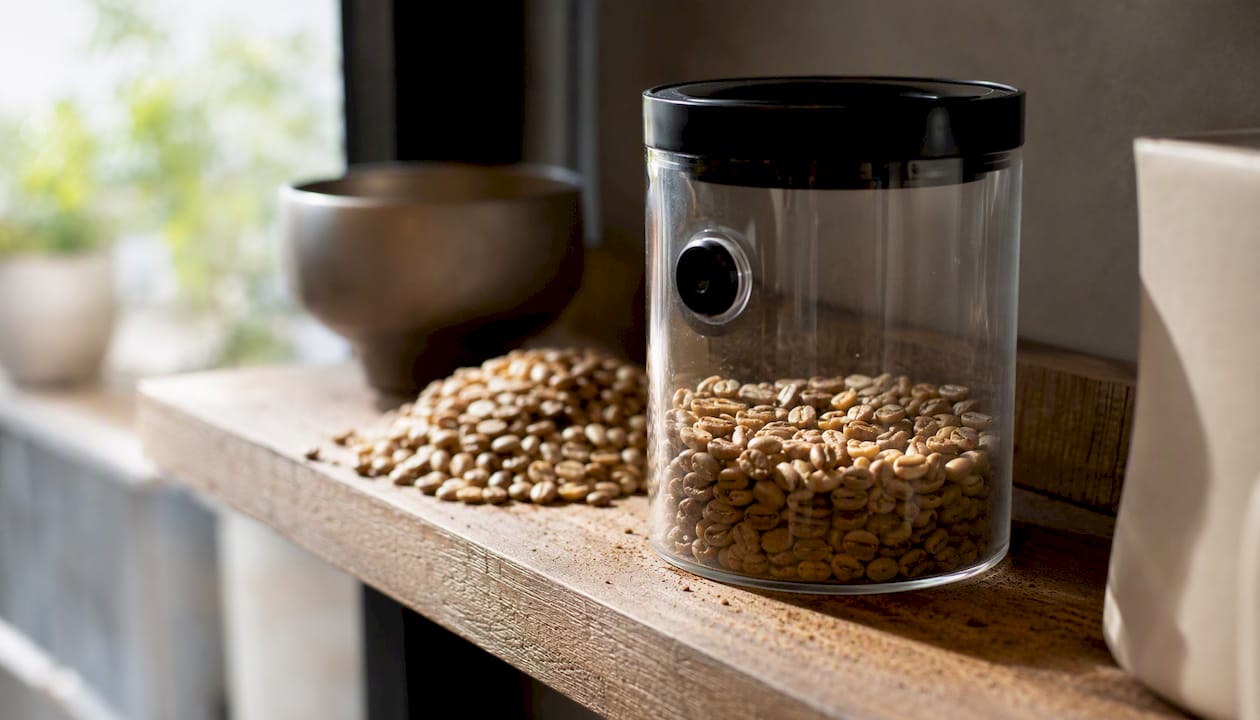
Store beans in an airtight container, away from light and heat. A ceramic canister with a one-way valve works well. Avoid the freezer unless you’re storing a large quantity for more than a month, and never refrigerate, since moisture is the enemy of bright flavor.
When brewing an Ethiopian natural or a Colombian washed with prominent fruit notes, the bloom step is especially important. Those beans often carry more CO2 from their processing, and a 45-second bloom rather than 30 seconds gives them more time to off-gas before the main pour. The result is a cleaner, more even extraction that lets the origin character come through. For more on how to approach Nordic-style ultra-light beans at home, the dialing guide covers roast-specific adjustments in detail.
What French press actually does for ultra-light beans
Most guides treat French press as a forgiving, low-precision method. That framing undersells it. For ultra-light single-origin beans, French press is one of the few methods that preserves the oils responsible for mouthfeel and body, which pour-over strips away through paper filtration. The trade-off is sediment and the need for more precise temperature control, but both are solvable with the right gear and technique.
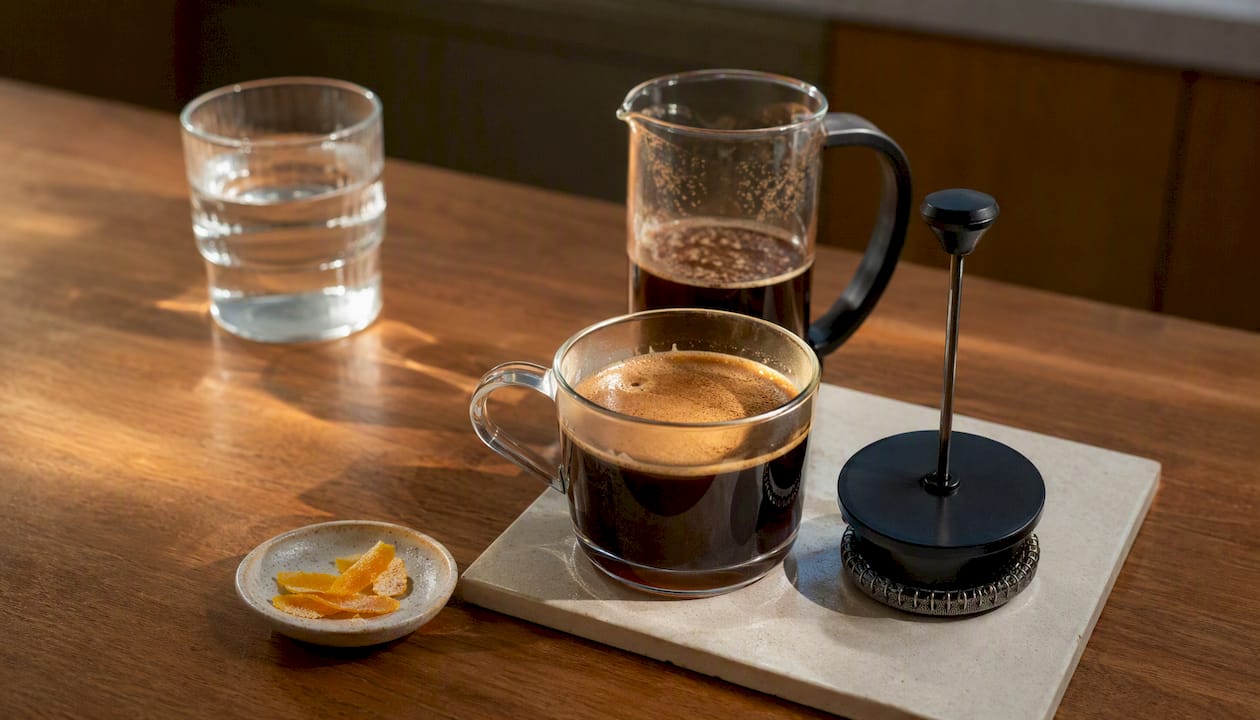
The conventional wisdom says “French press is easy.” What it misses is that easy and forgiving are not the same thing for light roasts. A dark roast hides extraction errors behind roast flavor. A light roast shows every mistake. That’s actually the point: when you dial it in correctly, a French press with a fresh ultra-light Ethiopian or Colombian bean produces a cup with body, brightness, and complexity that a paper-filtered method can’t replicate. The oils stay in. The origin character stays in. You just have to earn it with a scale, a thermometer, and a willingness to adjust one variable at a time.
Fresh ultra-light beans make every parameter work harder
The recipe in this guide works best when the beans are worth brewing carefully. Moustachecoffeeclub ships ultra-light, Nordic-style single-origin coffees roasted to order, so the beans arrive at peak freshness, typically within days of roasting. That means the bloom step actually blooms, the floral and citrus notes the recipe is designed to highlight are still intact, and the rest window guidance above applies from day one.

Each subscription is personalized based on your flavor preferences, and the beans rotate through origins like Ethiopia and Colombia, giving you new material to dial in every cycle. If you’ve been working through this guide with stale supermarket beans, the difference a fresh roast makes is immediate. Start your subscription and put the recipe to a real test.
Sources
- French press coffee makers: testing and recommendations
- The 4 Best French Presses of 2026 | Reviews by Wirecutter
- Homebaristaguide
- French Press with Indian Coffees: Body, Sediment, and Roast Behaviour
FAQ
What water temperature works best for light roast French press?
Start at 205°F. Light roasts are denser than dark roasts and need hotter water to extract sweetness and body without sourness.
What grind size should I use for light roast French press?
Medium-coarse, roughly the texture of coarse sea salt. If the cup tastes sour, grind one step finer; if bitter, go one step coarser.
Why does my light roast French press taste sour?
Sourness signals under-extraction. Raise your water temperature to 205°F first, then extend steep time to 4 minutes, and grind slightly finer if the problem persists.
Should I decant my French press coffee right after pressing?
Yes. Leaving brewed coffee in the carafe continues extraction and turns the cup bitter and muddy. Pour it out immediately into a serving vessel.
What’s the best ratio for French press with light roast coffee?
A 1:15 ratio (30g coffee to 450g water) is the recommended starting point. It delivers more body than the standard 1:18 and compensates for the lighter roast’s lower solubility.
Recommended
- Light Roast Brewing Methods List for Home Baristas | Blog | The Moustache Coffee Club
- How to Dial In Light Roast Coffee for Home Baristas | Blog | The Moustache Coffee Club
- French Press Brew Guide | How to Make French Press Coffee | Moustache Coffee Club
- Dialing in Nordic Style Coffee at Home | Blog | The Moustache Coffee Club