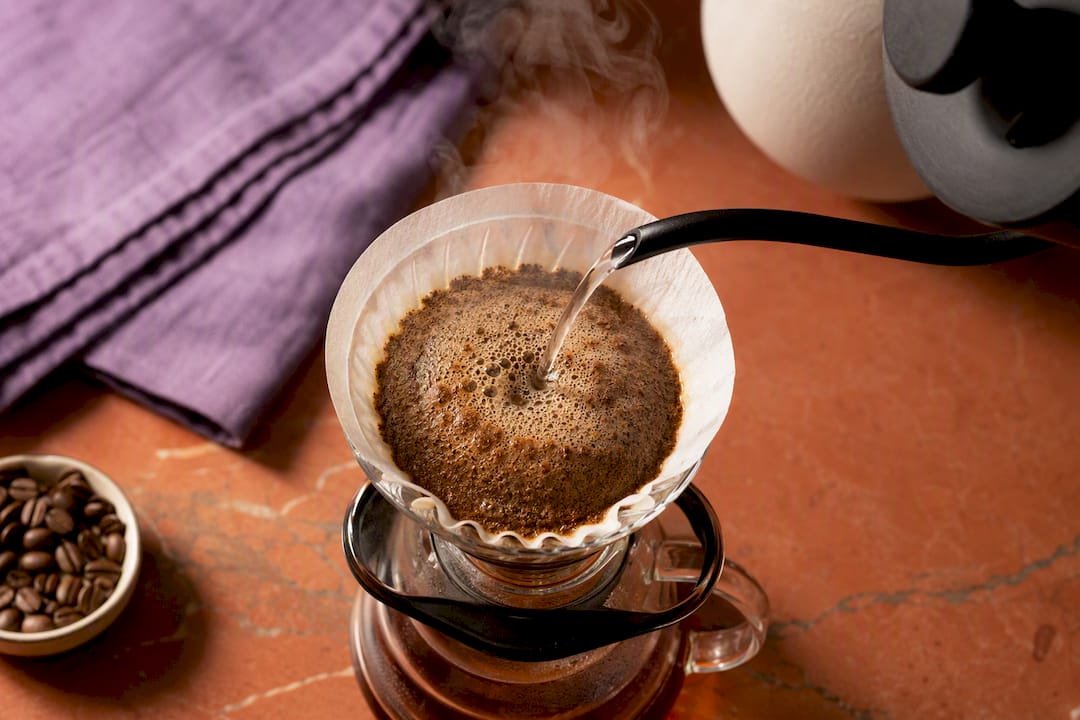
Flash Brew Coffee: How to Make It at Home

Flash brew coffee is hot, concentrated coffee brewed directly onto ice, so it chills in seconds and keeps the bright aroma that slow cooling strips away. It is also called Japanese iced coffee. You need a pour-over dripper, a scale, a kettle and about ten minutes. No overnight steeping, no waiting.
This guide covers what flash brew is, how it differs from cold brew, a step-by-step V60 recipe, how to handle ratios and ice, what to change in a Chemex, and which beans make the best cup.
TL;DR
- Flash brew means brewing hot, double-strength coffee over ice with a pour-over, so the ice melts into the brew and dilutes it to drinking strength.
- It takes roughly 10 minutes start to finish, against at least four hours for traditional cold brew.
- A good starting point is 20 g of coffee, 200 g of 205°F water and 120 g of ice in a V60. If it tastes sharp and sour, grind finer.
- Light, fruity, floral single origins shine here, because rapid chilling holds on to their aromatics.
- The same method works in a Chemex, with a slightly coarser grind and a little more patience.
Table of Contents
- What flash brew coffee is
- Flash brew vs cold brew
- What you need
- How to make flash brew coffee with a V60
- Ratios: coffee, water and ice
- Making iced filter coffee in a Chemex
- Choosing beans for flash brew
- Common mistakes
- Our perspective
- Bring flash brew into your routine
- FAQ
- Sources
What flash brew coffee is
Flash brew uses pour-over equipment to make a hot concentrate directly over ice. The ice melts, chills the coffee and brings it to a drinkable strength in one move. Breville describes it as hot coffee made over ice and ready without waiting hours, unlike traditional cold brew.
The point is flavor. When you brew hot coffee and let it cool on the counter or in the fridge, it sits through a slow drop in temperature. Serious Eats notes that brewing straight onto ice chills it quickly and keeps the clean, just-made character rather than the flatter taste of coffee cooled slowly. USA Today explains that flash-chilled coffee does not have time to cool naturally, which is when lactone breakdown happens, so it generally avoids those chemical changes.
Gota puts it in terms of aroma: brewing a hot V60 onto ice locks in volatile aromatics before they evaporate. That is why a good flash brew smells like the coffee it started as, whether that is blueberry, jasmine or citrus.
Flash brew, Japanese iced coffee and flash-brewed coffee
These are the same thing. “Japanese iced coffee” is the older name for the technique. “Flash brew” and “flash-brewed” describe the chilling step. If you see “iced pour over” or “iced filter coffee” on a menu, it usually means the same method: a filter brew made over ice.
It is not the same as the other iced coffees you may know:
- Chilled leftover coffee. Hot coffee brewed at normal strength, cooled, then poured over ice. It is easy but tends to taste flat and dilute.
- Cold brew. Coffee steeped in cold or room-temperature water for hours.
- Iced espresso drinks. Espresso poured over ice and milk. Different extraction, different balance.
Flash brew vs cold brew
Traditional cold brew combines coarsely ground coffee with cold or room-temperature water and steeps for at least four hours and up to 24, according to Breville. Flash brew makes hot concentrated coffee over ice, instantly chilled.
| Flash brew | Cold brew | |
|---|---|---|
| Water temperature | Hot (around 205°F) | Cold or room temperature |
| Time | About 10 minutes in total | At least 4 hours, up to 24 |
| Grind | Medium-fine, like hot pour-over | Coarse |
| Typical taste | Bright, aromatic, crisp, tea-like | Smooth, mellow, lower perceived acidity |
| Best with | Light roast, washed and floral coffees | Chocolatey, nutty, sweeter profiles, or milk |
| Planning | Make one glass on demand | Make a batch the night before |
Neither is better in every situation. In a tasting by Serious Eats, Japanese-style iced coffee was preferred black, while cold brew came out on top when mixed with milk. So if you drink your iced coffee black and love tasting origin character, flash brew is the one to learn first. If you want a batch in the fridge for the week, our guides to making cold brew and why cold brew uses a coarse grind cover that side.
What you need
You probably own most of it already.
- A pour-over dripper: a V60, a Kalita-style dripper or a Chemex all work.
- Paper filters, rinsed before use.
- A carafe, server or heat-safe pitcher that holds the ice. A glass jug works if you pour carefully.
- A scale. Flash brew is about balance between coffee, hot water and ice, and weighing all three removes guesswork.
- A gooseneck kettle, ideally with a thermometer.
- A burr grinder.
- Fresh ice. Larger, clear cubes melt more slowly in the serving glass.
Freshness matters more than gear. Because the brew is chilled instantly, you taste what is in the bean. Stale coffee tastes stale over ice too. That is why we ship beans on the day they are roasted, and why we suggest brewing within the first weeks after roasting.
How to make flash brew coffee with a V60
This is a single-cup method based on a recipe from Kennard Cooks, which uses a Fellow Ode 2 grinder. Grinders differ, so treat the grind setting as a starting point.
- Prepare the ice. Put 120 g of ice in the carafe.
- Heat the water. Bring it to about 205°F (96°C). Just One Cookbook uses the same temperature and says flash-chilling locks in aroma and taste.
- Rinse the filter. Wet it with hot water, then discard the water. Do not discard the ice you already placed in the carafe: rinse the filter over the sink before setting the dripper on the carafe.
- Add 20 g of ground coffee. The recipe grinds at setting 3.0 on a Fellow Ode 2, which is a medium-fine grind. Level the bed.
- Bloom. Pour 45 g of water and wait 30 seconds. If you want to understand why this step matters, read our note on coffee bloom time.
- Pour slowly in circles up to 130 g total.
- Pour again up to 200 g total, and aim to finish by about 2:30.
- Swirl the carafe until the ice has melted.
- Serve over fresh ice.
The extraction itself is quick. Bon Appétit reports about 3 minutes for the pour-over and roughly 10 minutes for the whole preparation.
For a longer walk-through of the dripper itself, see our step-by-step pour-over guide, and our V60 grind size guide if you want to dial in your grinder. We also wrote a dedicated Japanese iced coffee recipe built around a 1:15 ratio.
Ratios: coffee, water and ice
The trick of flash brew is that the ice is part of your recipe. Hot water extracts the coffee, then the ice dilutes it. If you brew at normal strength and add ice, the result is watery. So you brew a stronger concentrate.

Serious Eats advises accounting for melt by brewing a double-strength batch and chilling it with enough ice to reach the final strength you want. Perfect Daily Grind suggests keeping ice to no more than 30 to 40 percent of the total water weight so the coffee can extract properly.
Here is how to turn that guidance into numbers. Say you want about 300 g of total liquid in the glass:
- Ice at 30 percent: 90 g. Hot water: 210 g.
- Ice at 40 percent: 120 g. Hot water: 180 g.
Then choose your coffee dose against the hot water. A stronger brew ratio, with more coffee per gram of hot water than you would use for hot coffee, makes up for the dilution. The V60 recipe above is a good starting point: it puts 20 g of coffee through 200 g of hot water onto 120 g of ice.
How to adjust
- Sharp, sour, thin? Grind finer, or pour a little slower. The Kennard Cooks recipe gives this same fix for a sour cup.
- Bitter, dry or heavy? Grind slightly coarser or lower the water temperature a few degrees.
- Watery? Use less ice, or add coffee.
- Too strong? Add a splash of cold water or more ice in the glass, not in the brew.
Change one variable at a time and write it down. Our V60 light roast recipe shows how we approach dialing in a light roast faster.
Making iced filter coffee in a Chemex
A Chemex makes a clean, bright flash brew, and its large chamber holds the ice easily. The paper is thicker than a V60 filter, so flow is slower and the cup comes out very clear. Light roasts suit it well, since the filter removes fine particles and lets delicate flavors come through.
Here is how we would adapt the recipe, as a starting point rather than a fixed rule:
- Put the ice in the bottom of the Chemex before brewing, and fold the filter with the triple layer against the spout.
- Rinse the filter with hot water, then pour the rinse out through the spout and replace the ice if it melted.
- Grind a touch coarser than you would for a V60, because the thick paper slows drainage and a very fine grind can stall.
- Use the same hot-water temperature as above and bloom for 30 seconds.
- Pour in slow circles, in two or three stages, keeping the bed level.
- Swirl until the ice melts and serve over fresh ice.
If the brew drains slowly and tastes bitter or heavy, coarsen the grind. If it tastes sharp and sour, grind finer in small steps.
Choosing beans for flash brew
Iced coffee mutes some sweetness, because cold temperatures dull our perception of sugars. That is why a roast with lively acidity and aroma works better than a dark, heavy one. Just One Cookbook recommends light to medium roast beans for a bright flavor in Japanese iced coffee.
Our favorites for flash brew:
- Ethiopian and other washed or natural coffees with floral, citrus and berry notes.
- Colombian coffees with stone fruit and caramel sweetness, which hold up well to ice.
- Ultra-light Nordic-style roasts, which are developed gently to preserve a coffee’s own flavor rather than roast flavor.
We pair this with a snack-and-sip habit as well. If you like testing flavor matches with your iced coffee, take a look at why matcha popcorn works as a way to think about contrasts in flavor.
If you are still weighing brew styles, our post on how brewing method affects specialty coffee flavor explains what changes in the cup from one method to another. For a cold-steeped alternative using the same kinds of beans, try our light roast cold brew.
Common mistakes
- Pouring hot coffee into a glass of ice from a separate pot. This works, but a pour-over directly onto ice is what keeps the aroma. Brew directly into the carafe holding the ice.
- Brewing at hot-coffee strength. The ice will dilute it. Use the concentrate ratio.
- Using too much ice in the carafe. Past roughly 40 percent of total water weight, extraction suffers, per Perfect Daily Grind.
- Using old beans. Iced coffee shows flaws clearly.
- Changing everything at once. Adjust grind first, then ratio, then temperature.
- Skipping the swirl. Unmixed coffee layers into a strong bottom and weak top.
Our perspective
We roast ultra-light, Nordic style, and flash brew is the method we reach for when we want to taste exactly why. The roast is developed to protect the character of the origin, and pouring hot water over ice protects the same thing from the other side: the aromatics reach your glass before they can fade.
That is also why we ship on the day of roasting. Flash brew is honest. It makes fresh, carefully sourced coffee taste vivid, and it rewards a bean that was roasted recently and grown with care.
Our advice is simple: start with a single origin you are curious about, weigh everything, change one thing at a time and trust your palate. Tell us what you taste, and we will use your feedback to choose the next coffees for you.
Sean
Bring flash brew into your routine
If you want a steady supply of beans that suit flash brewing, our subscriptions deliver freshly roasted single-origin coffee, roasted to order and shipped on the day of roast. You choose a plan, then give feedback so future selections match your taste. As published on our plans page, the Duet is $24 per week per bag and the Northern Duet is $32.99 per week per bag, and there are further plans for different volumes and coffee styles.

Buying for someone who loves iced coffee? Our gift subscriptions are an easy way to send them fresh beans.
FAQ
What is a flash brew coffee?
It is coffee brewed hot and strong over ice, using a pour-over dripper. The ice chills the coffee instantly and dilutes it to drinking strength. It is also called Japanese iced coffee.
Is flash brew stronger than cold brew?
Not necessarily. Strength depends on your recipe and final dilution. Flash brew usually tastes brighter and more aromatic, while cold brew tastes rounder and mellower. Cold brew is a long, cold steep of at least four hours, per Breville, so the character differs even at the same strength.
What is the ideal brew ratio for flash brew coffee?
There is no single number, because the ice changes the math. A practical rule is to keep ice at 30 to 40 percent of total water weight and brew a concentrate. For a V60 starting point, try 20 g of coffee, 200 g of hot water and 120 g of ice, then adjust the grind and dose to taste.
Can I use a Chemex or other dripper?
Yes. Any pour-over device works. In a Chemex, grind slightly coarser than for a V60 and expect a slower, cleaner brew. Keep the same concentrate approach and melt the ice by swirling.
Which roast is best for iced pour over coffee?
Light to medium roasts. They keep the fruity, floral notes that cold temperatures can otherwise mute. A fresh single origin gives you the clearest difference in the cup.
Sources
- What are the different types of cold brew? (Breville)
- Japanese iced (flash brew) (Gota)
- Japanese-Style Iced Coffee Recipe (Serious Eats)
- Why does iced coffee taste different than hot coffee that has cooled (USA Today)
- Flash Brew, Japanese Iced V60 Single Cup (Kennard Cooks)
- Japanese Iced Coffee (Just One Cookbook)
- Japanese Iced Coffee is the Fastest, Easiest Way to Make Iced Coffee (Bon Appétit)
- What is flash brew coffee? (Perfect Daily Grind)
- Why matcha popcorn works (PopCornaa)