How Coffee Brands Practice Sustainability in 2026
Sustainability in coffee brands is defined by their commitment to ethical sourcing, environmental stewardship, and transparency across every link in the supply chain. The coffee industry touches more than 125 million people worldwide, from smallholder farmers in Ethiopia and Colombia to roasters and retailers in Europe and North America. How coffee brands practice sustainability today goes far beyond a single certification label. It spans regenerative farming, supply chain traceability, operational emissions reductions, and packaging innovation. Brands like Starbucks, Lavazza, and Löfbergs have each built multi-layered programs that show what genuine commitment looks like in practice.
How coffee brands practice sustainability on farms
Farm-level practices form the foundation of any credible sustainability program. Without meaningful change at the point of cultivation, downstream claims about eco-friendly coffee brands carry little weight.
Starbucks’ C.A.F.E. Practices (Coffee and Farmer Equity) set measurable requirements for fertilizer and energy use, organic residue management, and shade tree planting across its supply base. These practices have been adopted by almost all of Starbucks’ 440,000-plus suppliers, making it one of the most scaled farm-level sustainability programs in the industry. Scale matters here because it means the standards are not limited to a premium niche. They apply to the bulk of the coffee Starbucks sources globally.

Lavazza has taken a different route by certifying its ‘La Reserva de ¡Tierra!’ line under the Rainforest Alliance Regenerative Agriculture Standard, which measures verified progress across soil health, biodiversity, climate resilience, water stewardship, and farmer livelihoods. Independent audits back every claim, which separates this from self-reported sustainability narratives. The multi-impact focus of the standard means a single certification covers several dimensions at once, giving consumers a more complete picture.
Löfbergs, the Swedish roaster, has invested in agroforestry programs and paid 42 million SEK in Fairtrade premiums to farming communities, directly supporting smallholder resilience. Agroforestry, which integrates trees into coffee-growing land, improves soil structure, reduces erosion, and provides habitat for pollinators. These are not cosmetic changes. They alter the ecological function of the farm over time.
One honest caveat: regenerative transitions take years. Soil fauna and biodiversity improvements typically stabilize over two to five years, meaning short-term results vary. Brands that communicate this timeline honestly are more credible than those promising immediate transformation.
Pro Tip: When evaluating a brand’s farm-level claims, look for independent third-party audits rather than self-reported data. Certification bodies like Rainforest Alliance publish audit summaries that you can verify directly on their website.
How do coffee brands manage sustainability beyond the farm?
Farm practices alone do not determine a brand’s total environmental footprint. Roasting facilities, retail operations, packaging, and supply chain logistics all contribute to the impact of coffee production.
Starbucks’ Greener Stores initiative targets energy efficiency and waste reduction across its café network. At the same time, the company has confronted a harder problem: methane from dairy represents 13% of its total emissions, and Starbucks has committed $20 million to test reduction measures including feed additives and manure management. This is a useful example of how operational sustainability requires confronting uncomfortable trade-offs, not just optimizing the easy wins.
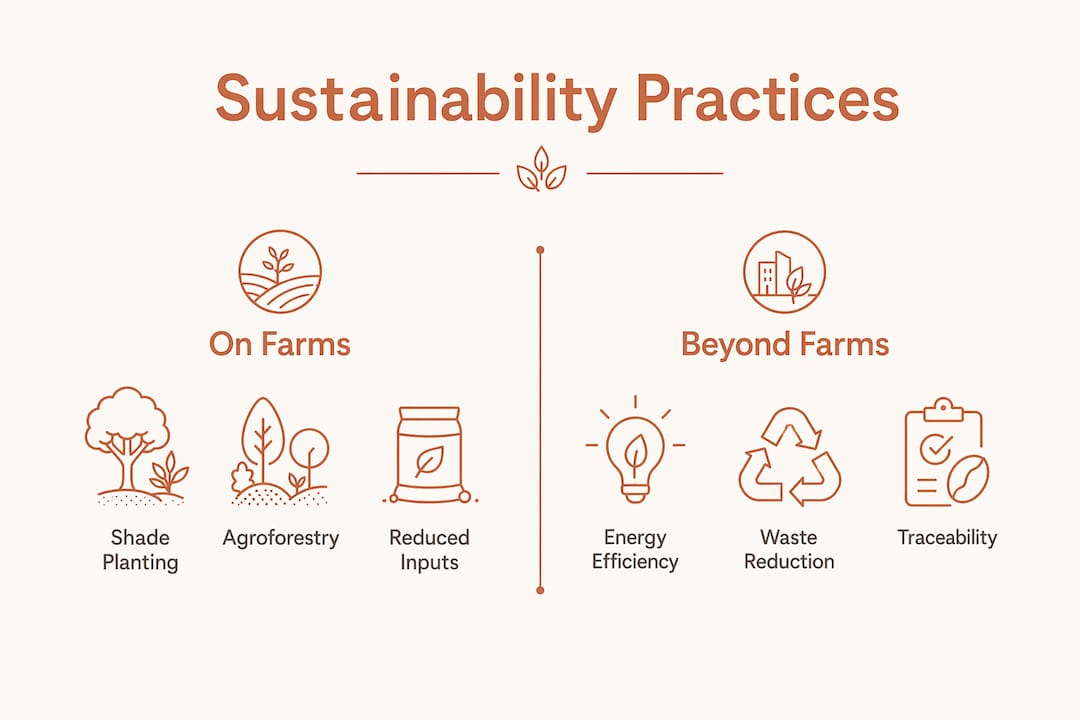
Löfbergs has made measurable progress on the logistics side, shifting to fossil-free sea transport and reducing production waste to 0.28% of total output. Its packaging now uses recyclable monomaterials, which are easier to process in standard recycling streams than multi-layer laminates. These operational choices reflect a supply chain sustainability mindset that extends well past the farm gate.
Traceability is another critical dimension. The EU Deforestation Regulation (EUDR) now requires farm-level geolocation data for all coffee imported into the EU, enabling satellite verification that supply chains are deforestation-free. Enforcement for medium and large enterprises begins in December 2026. Brands that cannot provide verified geo-coordinates for their supply base risk losing EU market access entirely.
| Sustainability area | What leading brands are doing |
|---|---|
| Farm inputs | Starbucks C.A.F.E. Practices reduce fertilizer and energy use across 440,000+ suppliers |
| Certification | Lavazza’s Rainforest Alliance certification covers soil, water, biodiversity, and livelihoods |
| Logistics | Löfbergs uses fossil-free sea transport and recyclable monomaterial packaging |
| Traceability | EUDR mandates farm-level geolocation for all EU coffee imports by December 2026 |
| Emissions | Starbucks investing $20 million to reduce methane from dairy supply chain |
Pro Tip: Check whether a brand publishes an annual sustainability report with specific, measurable targets. Vague commitments like “we care about the planet” are not the same as reporting actual emissions data or supplier audit results.
How do certifications and standards ensure credibility?
Certifications are the primary mechanism consumers and regulators use to verify sustainability claims. Without them, a brand’s environmental messaging is essentially unverifiable marketing.
The Rainforest Alliance Regenerative Agriculture Standard is currently the most rigorous multi-impact certification available for coffee. It uses science-based guidance to translate broad regenerative goals into verified farm-level outcomes, covering biodiversity, soil health, climate resilience, water stewardship, and livelihoods in a single framework. Independent audits are required, not optional. This structure makes it significantly harder for brands to cherry-pick favorable metrics while ignoring others.
Fairtrade certification focuses more directly on farmer livelihoods, setting minimum price floors and requiring social premiums that farming communities control. Löfbergs’ 42 million SEK in Fairtrade premiums is a concrete example of how this translates into real income for growers. Fairtrade and Rainforest Alliance address different parts of the sustainability equation, which is why the most credible brands often hold both.
Here is what to look for when assessing certification quality:
- Independent audits: Certifications verified by third parties carry more weight than self-assessed programs.
- Multi-dimensional scope: Standards that cover environment, livelihoods, and governance simultaneously are harder to game than single-issue certifications.
- Continuous improvement requirements: The best standards require farms to demonstrate progress over time, not just pass a one-time threshold.
- Public reporting: Certification bodies that publish audit summaries and farm-level data enable consumer verification.
One honest limitation: certifications measure compliance at a point in time. Because regenerative agriculture transitions take multiple years to show stable ecological benefits, a newly certified farm may still be in an early transitional phase. Certification is a floor, not a ceiling.
How to identify truly sustainable coffee brands
Identifying genuinely sustainable coffee brands requires looking past marketing language and into the specific systems a brand has built. Here is a practical framework for doing that.
-
Check for named certifications. Rainforest Alliance, Fairtrade, and Starbucks’ C.A.F.E. Practices each have public databases where you can verify a brand’s status. If a brand claims sustainability without naming a certification body, that is a red flag.
-
Look for traceability information. Brands committed to ethical coffee sourcing publish origin details at the farm or cooperative level. Single-origin coffees with named farms or regions are easier to trace than blends with vague sourcing descriptions.
-
Read the sustainability report. Credible brands publish annual reports with specific metrics: emissions data, water use, supplier audit results, and progress against stated targets. A report that contains only aspirational language and stock photography is not a sustainability report.
-
Evaluate packaging honestly. Recyclable monomaterials and compostable packaging represent genuine progress. Multi-layer foil bags with no recycling pathway are a sign that operational sustainability has not been prioritized.
-
Consider the full supply chain. A brand that sources certified beans but ships via high-emission freight, uses non-recyclable packaging, and has no emissions reporting is not practicing sustainability across the board. Look for evidence of effort at multiple points in the chain.
-
Watch for EUDR compliance signals. For brands selling into the EU market, compliance with the EU Deforestation Regulation requires farm-level geo-data and due diligence declarations. Brands that can demonstrate EUDR compliance have built the traceability infrastructure that genuine sustainability requires.
The ethical drinker’s guide to specialty coffee sourcing is a useful starting point for understanding how farm-level relationships translate into the cup you drink.
Key takeaways
Genuine coffee sustainability requires verified certifications, farm-level traceability, and operational accountability across the entire supply chain, not just at the point of harvest.
| Point | Details |
|---|---|
| Farm practices matter most | Shade planting, agroforestry, and reduced inputs form the ecological foundation of sustainable coffee. |
| Certifications require verification | Rainforest Alliance and Fairtrade use independent audits; always confirm a brand’s status in the certification body’s public database. |
| Traceability is now regulatory | EUDR enforcement begins December 2026, requiring farm-level geolocation for all EU coffee imports. |
| Operational footprint counts | Packaging, logistics, and emissions from dairy or energy use can offset farm-level gains if left unaddressed. |
| Consumers drive accountability | Brands that publish specific, measurable sustainability reports respond to consumer demand for transparency. |
Why sustainability in coffee is harder than it looks
I have spent years tasting and sourcing specialty coffee, and the single most common mistake I see consumers make is treating a certification label as a complete answer. It is not. It is a starting point.
The uncomfortable reality is that sustainability improvements are often constrained by upstream farm practices and downstream operational choices simultaneously. Starbucks is a useful case study here. The company has made genuine progress on farm inputs through C.A.F.E. Practices, but operational footprint growth from store expansion and dairy emissions has offset some of those gains. That is not a reason to dismiss the effort. It is a reason to read sustainability claims with more precision.
What gives me genuine confidence in a brand is not the presence of a certification logo. It is the specificity of their reporting. Löfbergs publishing a production waste figure of 0.28% tells me they are measuring the right things. Lavazza commissioning independent audits under the Rainforest Alliance Regenerative Agriculture Standard tells me they are willing to be held accountable. Those details are harder to fake than a tagline.
Regulatory pressure from the EUDR is, in my view, the most significant structural shift in coffee sustainability accountability in a decade. When missing geo-data blocks EU market access, brands can no longer rely on narrative alone. That is good for consumers, good for farmers, and good for the long-term credibility of the industry.
My honest advice: ask harder questions. Request the sustainability report. Check the certification database. Look at the packaging. The brands doing the real work will have real answers.
— Sean
Taste the difference that ethical sourcing makes

At Moustachecoffeeclub, every coffee in the subscription is a single-origin bean sourced from farms where traceability and ethical relationships are non-negotiable. The ultra-light, Nordic-style roasting approach preserves the flavor characteristics that only come from well-farmed, carefully harvested coffee. You can explore origin reports, brewing guides, and sourcing details in the coffee education hub before you ever commit to a subscription. If you are ready to drink coffee that reflects the values you have been researching, the single-origin subscription is the most direct way to put those values into practice, one freshly roasted bag at a time.
FAQ
What certifications should I look for in sustainable coffee?
Rainforest Alliance and Fairtrade are the two most credible certifications for sustainable coffee production. Rainforest Alliance covers environmental and social dimensions with independent audits; Fairtrade focuses on farmer income and community premiums.
What is the EU Deforestation Regulation and why does it matter?
The EUDR requires farm-level geolocation data for all coffee imported into the EU, with enforcement for large and medium enterprises beginning December 2026. It creates a legal obligation for brands to prove their supply chains are deforestation-free, making traceability a compliance requirement rather than a marketing choice.
How long does regenerative agriculture take to show results?
Soil fauna and biodiversity improvements from regenerative agriculture typically stabilize over two to five years. Brands that claim immediate regenerative benefits from newly transitioned farms are overstating what the science supports.
How can I tell if a brand is greenwashing?
Look for specific, measurable data in their sustainability reports rather than general claims. Brands with genuine programs name their certification bodies, publish supplier audit results, and report actual emissions or waste figures. Vague language like “sustainably sourced” without supporting evidence is a reliable greenwashing signal.
Does single-origin coffee mean it is more sustainable?
Single-origin coffee is easier to trace to a specific farm or cooperative, which supports accountability and ethical sourcing verification. It does not automatically guarantee sustainability, but it creates the traceability foundation that credible sustainability programs require.
Recommended
- Why Ethical Coffee Matters as a Gift in 2026 | Blog | The Moustache Coffee Club
- How to source single origin beans sustainably and ethically | Blog | The Moustache Coffee Club
- Last-Minute Specialty Coffee Gift Guide for 2026 | Blog | The Moustache Coffee Club
- How specialty coffee supports farmers: The ethical drinker’s guide | Blog | The Moustache Coffee Club