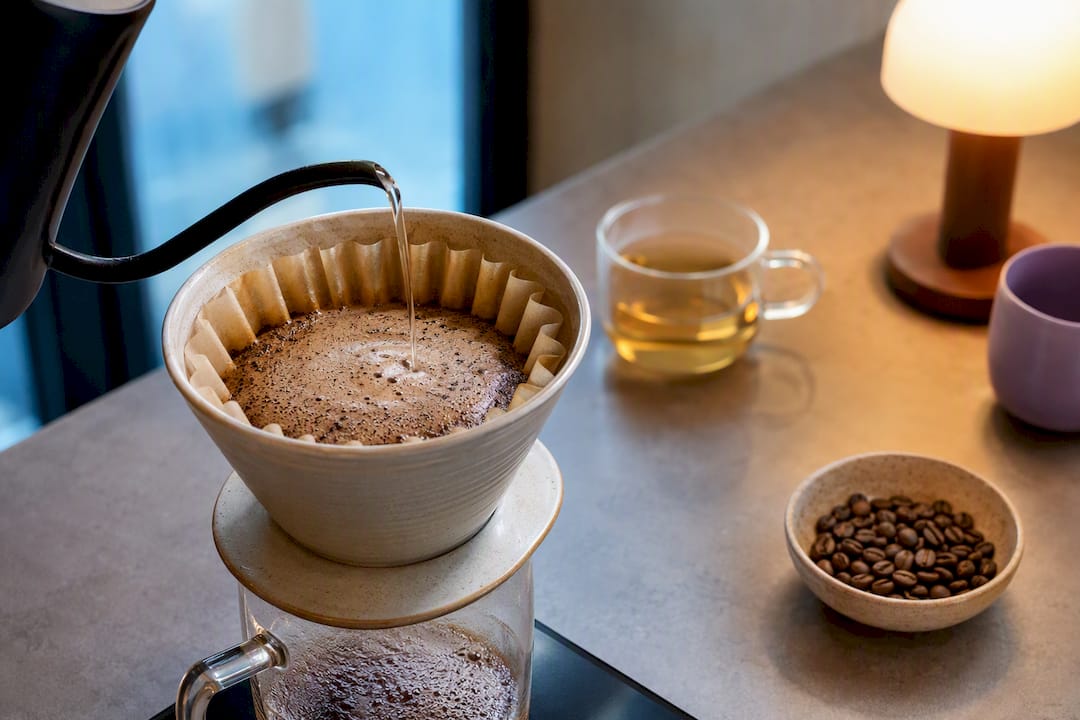
Roasted Same Day: Nordic Coffee Culture for Home Baristas
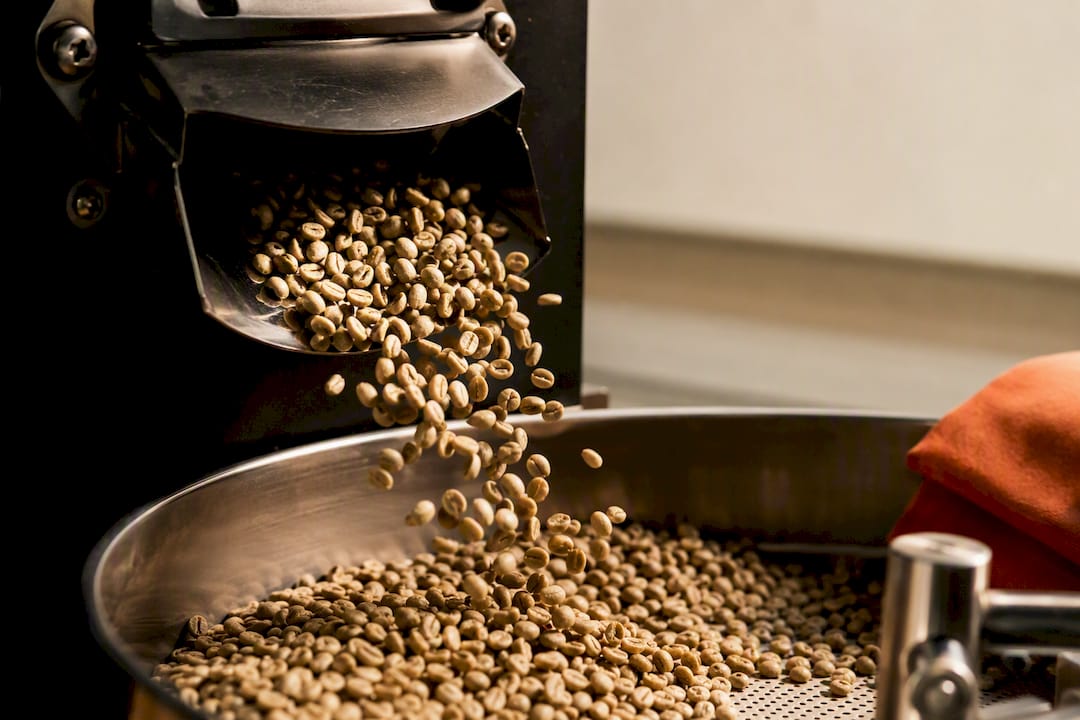
Nordic coffee culture, in the way this guide uses it, means one thing: roasting so light that the bean’s origin does the talking instead of the fire. It’s a technical approach built on short roast times, high-quality green coffee, and subscription delivery that gets beans to your cup within days of roasting. Read on and you’ll learn the actual roast parameters, brewing recipes for pour-over and immersion, and how to pick a subscription that keeps that clarity intact. As Wise Nose notes, the lighter roast profile also means higher acidity, brighter fruit notes, and a cup that tastes nothing like what most people expect from “coffee.”
TL;DR:
- Nordic-style coffee relies on very short roast times of 8 to 10 minutes, with beans pulled at 210 to 218°C to preserve origin flavors.
- The light roast profile emphasizes high acidity, fruity and floral notes, and delicate sweetness, demanding top-quality green beans and origin transparency.
- Brewing requires a precise burr grinder, controlled temperature, and careful timing, with methods like pour-over and immersion to optimize flavor clarity.
- Freshness is critical, so small, frequent subscription deliveries of whole beans roasted within days are recommended for maximum clarity.
- The culture values unhurried social rituals and direct relationships with producers, with a focus on transparency, sustainability, and minimal intervention in brewing.
Table of Contents
- What Makes a Nordic-Style Roast Different?
- How Do You Brew Nordic-Style Coffee at Home?
- What Should You Look For in a Coffee Subscription?
- Why Sustainability Is Baked Into the Nordic Approach
- Where Did This Ultra-Light Roasting Style Come From?
- How Do Nordic Countries Treat Coffee as a Shared Ritual?
- How Does Nordic Coffee Culture Compare to Other Coffee Traditions?
- What Coffee Drinks Are Most Associated With Nordic Coffee Culture?
- What Role Do Cafes Play in Nordic Coffee Culture?
- Does Nordic Weather Affect How People Drink Coffee?
- A Note on Patience and Learning to Taste
- Start Tasting Origin-Forward Coffee at Home
- Sources
- FAQ
What Makes a Nordic-Style Roast Different?
Most roasters develop flavor by cooking sugars deep into the bean. Nordic-style roasters do the opposite: they stop the roast almost as soon as it starts, treating their job as revealing what’s already in the bean rather than building something new on top of it. That “reveal, not transform” philosophy is the single idea that explains every other quirk of this roasting style, from the color of the beans to the sourcing decisions behind them.
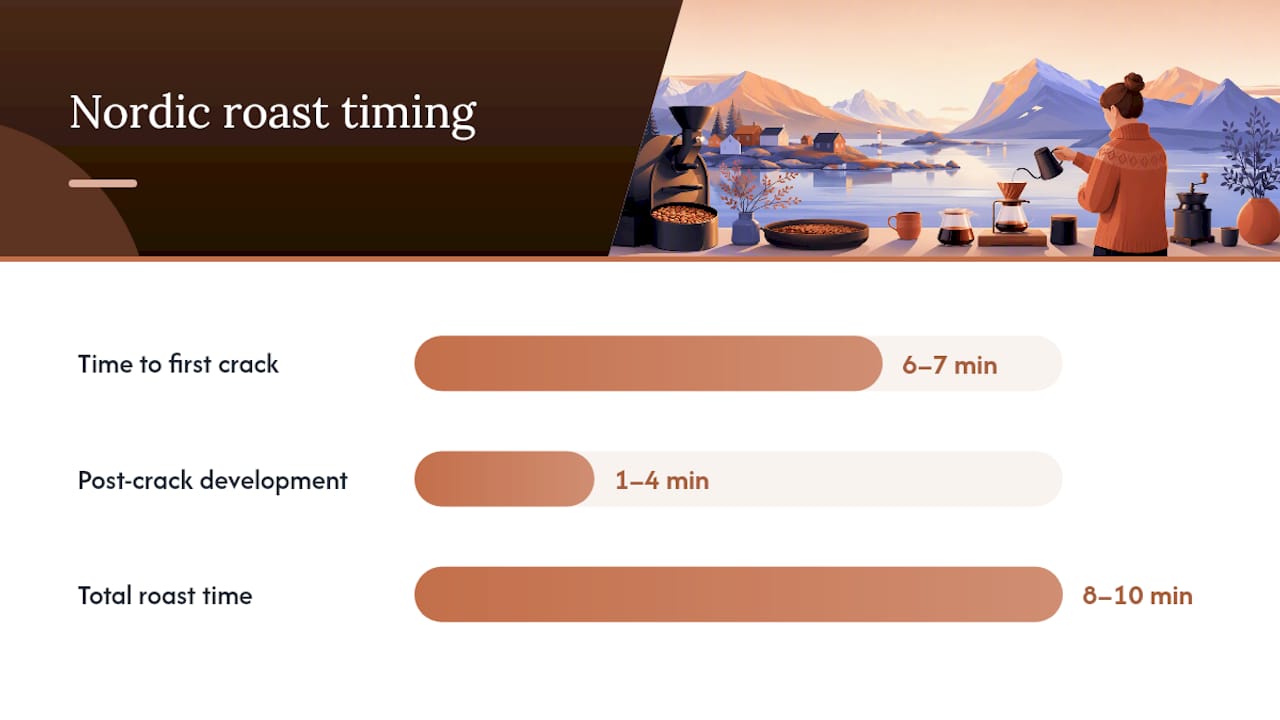
The numbers back this up. Nordic roasters typically run total roast times of 8 to 10 minutes, hit first crack around the 6 to 7 minute mark, and pull the beans off heat at drop temperatures of about 210 to 218°C, according to Coffeedant’s breakdown of the style. The development time ratio, or percentage of the roast spent after first crack, is kept relatively short compared to medium roasts, emphasizing origin characteristics. That’s a fraction of what a medium roast might use.
Pro Tip: If you’re evaluating whole beans at home, look for a pale, almost cinnamon-tan color. Agtron readings for Nordic-style roasts often sit between 70 and 95+, well lighter than the mid-40s to mid-60s range typical of medium roasts.
That short development window changes what you taste:
- Higher perceived acidity, often described as citrus, berry, or stone fruit rather than “sour”
- Floral or tea-like aromatics that get roasted away at darker levels
- A lighter body with more textural clarity between sips
- Sweetness that reads as delicate rather than caramelized
None of this works with mediocre beans. Because a light roast doesn’t mask defects the way a dark roast can, Nordic roasters lean hard on green coffee scoring 86 or higher on the Specialty Coffee Association scale, and many built direct relationships with producers specifically to lock in that quality. Coffeedant reports that several pioneering roasters paid above-market premiums and even purchased farms outright to secure the lots this roasting style demands. Origin transparency isn’t a marketing angle here. It’s a structural requirement, because a flawed bean has nowhere to hide.
How Do You Brew Nordic-Style Coffee at Home?
The grinder matters more than almost anything else in your setup. Ultra-light roasts are dense and hold onto their cell structure longer than darker beans, so an inconsistent grind produces a muddy, unevenly extracted cup that tastes thin in some sips and harsh in others. A quality burr grinder from the mid-price range or higher resolves this by producing uniform particle sizes, which is the difference between tasting “acidic” and tasting “sour.”
Baseline equipment checklist:
- A burr grinder, ideally $250+, since blade grinders and cheap burrs can’t hold the consistency ultra-light roasts demand
- A scale accurate to 0.1 grams, because these recipes reward precision
- A gooseneck kettle for controlled, slow pours
- Fast-flow paper filters, such as Cafec Abaca, which help avoid over-extraction from the fine particles light roasts tend to produce
V60 or Kalita pour-over baseline: Use 15 grams of coffee to 250 grams of water, a 1:16.7 ratio, at 96 to 99°C. Bloom with about 45 grams of water for 30 to 45 seconds, then pour in two or three stages, aiming for a total brew time of 2:30 to 3:00.
AeroPress long-steep variant: Use a similar 1:16 ratio, medium-fine grind, water at 96°C, and steep for 2 minutes before a gentle press. This method is forgiving on beans that taste thin in a quick pour-over.
Immersion method: Full immersion brewers benefit from steep times of 5 minutes or longer. Coffeedant explains that longer contact time helps extract low-solubility compounds that ultra-light roasts hold onto, which is exactly what a rushed pour-over misses.
If your cup tastes sour or hollow, the fix is almost always one of three things: your grind is too coarse, your water isn’t hot enough, or your contact time is too short. Adjust one variable at a time. Go finer on the grind first, then check water temperature, then extend brew time. Changing everything at once tells you nothing about what actually fixed the problem. For a deeper walkthrough, the step-by-step dial-in guide covers troubleshooting scenarios specific to this roast style.
What Should You Look For in a Coffee Subscription?
Freshness matters more with ultra-light roasts than with any other roast level. Because the roast barely develops the bean’s oils and sugars, staling happens faster and shows up as flatness rather than rancidity, which means the gap between “roasted three days ago” and “roasted three weeks ago” is obvious in the cup. Roast-on-demand shipping, where beans go out the same day they’re roasted, matters more here than for a medium or dark roast that can coast on a wider freshness window.
A few settings make the biggest difference:
- Bag size: Start small. A smaller bag that you finish in 10 to 14 days beats a large bag that sits on your counter losing clarity.
- Whole bean vs. ground: Whole bean, always, if you own a grinder. Pre-ground coffee loses aromatic compounds within hours, not days.
- Frequency: Biweekly or monthly deliveries work best while you’re learning your preferences, according to guidance from the BrewFYI subscription guide, which also notes that origin-specific rotating subscriptions help you explore flavor depth even if they limit variety in any given shipment.
- Feedback loops: A subscription that adjusts future selections based on what you rate highly will get you to your preferred flavor profile faster than static, one-size-fits-all boxes.
The tradeoff is usually price per ounce versus freshness. A slightly higher cost per bag buys you beans that were roasted within days rather than weeks, which for this roast style is not a small difference. If you’re new to Nordic-style coffee, start with a small whole-bean bag on a biweekly cadence, and lean on brewing guides while you calibrate your grinder and recipe.
Why Sustainability Is Baked Into the Nordic Approach
Sustainability in Nordic coffee culture isn’t a separate initiative bolted onto the roasting philosophy. It grows directly out of it. Because ultra-light roasts demand exceptional green coffee, roasters have to build long-term relationships with producers rather than buying anonymous lots on the spot market. That relationship structure naturally pushes toward paying fair, often above-market prices, since a producer who can’t sustain their farm can’t keep delivering the quality this roasting style requires.
Packaging is the other half of the equation. Light roasts are more sensitive to oxygen and light exposure than dark roasts, so freshness-focused roasters tend to invest in better one-way valve bags and reduced plastic use, treating packaging as part of flavor preservation rather than just branding. Reduced plastic packaging and thoughtful sourcing aren’t add-ons to the Nordic approach. They’re consequences of taking origin flavor seriously enough to protect it at every step, from farm to cup.
Traceability follows the same logic. When a roaster tells you a coffee came from a specific farm or cooperative, that transparency lets you as a drinker connect quality directly to the people who grew it, and it gives producers a reason to keep improving their process instead of blending into a commodity market where quality differences go unrewarded.
Where Did This Ultra-Light Roasting Style Come From?
Nordic-style roasting emerged from Scandinavian roasters who broke from the American and European third-wave conventions of the 1990s and 2000s, pushing roast levels lighter than what most specialty roasters considered acceptable at the time. Where third-wave coffee culture already valued single-origin transparency, Nordic roasters took it a step further by treating any amount of roast development beyond first crack as something to minimize rather than embrace.
This wasn’t roasting for its own sake. It reflected a broader food culture in the region that already prized minimal processing and ingredient-forward presentation, the same instinct you see in Nordic cuisine more broadly. Coffee simply became another ingredient treated with that logic: don’t cook away what makes it distinct.
The approach spread because it worked on competition floors. Nordic roasters and baristas began winning international cupping and brewing competitions with coffees that tasted dramatically different from the darker, heavier profiles that had dominated specialty coffee. Wise Nose points out that this success turned Nordic roasters into reference points for quality, and their roast curves started showing up in training programs and roasting courses well outside Scandinavia. What started as a regional preference became a technical standard that specialty roasters worldwide now reference, whether or not they roast this light themselves.
How Do Nordic Countries Treat Coffee as a Shared Ritual?
Coffee in Scandinavian countries functions less like a caffeine delivery system and more like a scheduled pause built into the day. The tradition of taking a deliberate coffee break with colleagues, friends, or family, often paired with a pastry, is less about the coffee itself and more about the shared act of stepping away from work or obligations together.
What makes this pattern distinct from a quick coffee run elsewhere is the expectation of presence. The break is meant to be unhurried, and skipping it or rushing through it tends to be viewed as a minor social lapse rather than simply a personal choice. Coffee, in this context, acts as the reason to sit down together rather than the point of the gathering.
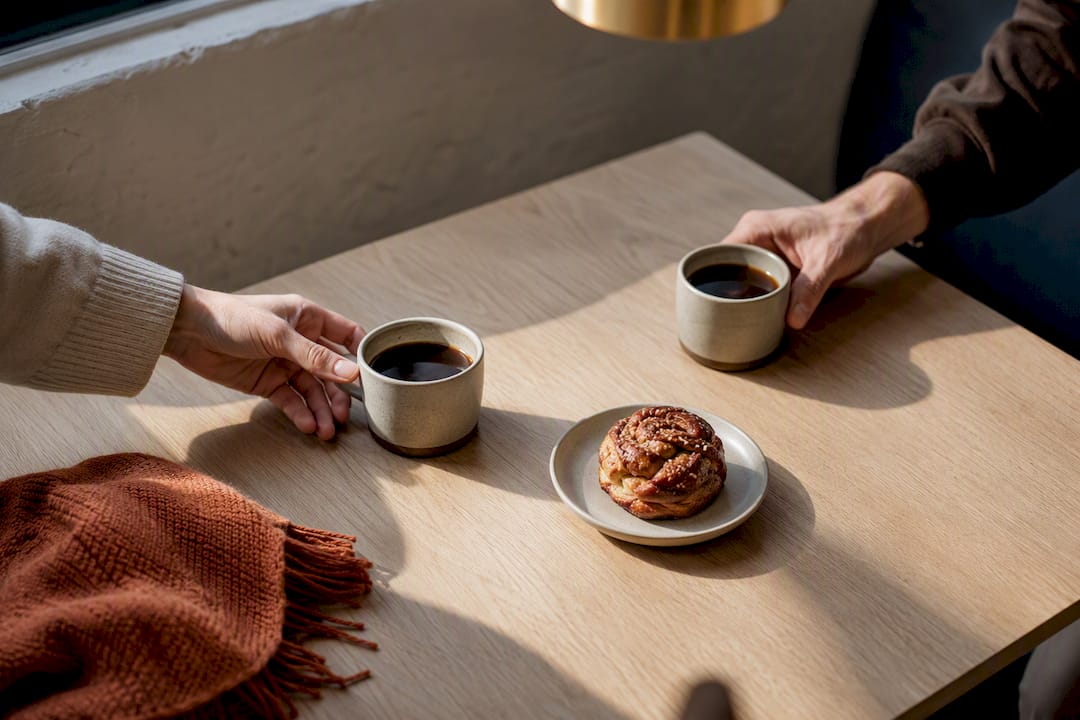
This communal framing also explains why quality matters so much to Nordic coffee drinkers. When coffee is the centerpiece of a recurring social ritual rather than a grab-and-go habit, people notice and care about whether it’s actually good. That expectation of quality is part of why Nordic countries produce roasters obsessive enough to chase ultra-light profiles and direct-trade relationships in the first place. The social ritual and the technical roasting philosophy reinforce each other rather than existing separately.
How Does Nordic Coffee Culture Compare to Other Coffee Traditions?
Italian espresso culture prizes intensity and speed: a shot pulled fast, drunk standing at a counter, roasted dark enough to deliver a consistent, syrupy body regardless of the bean’s origin. Nordic coffee culture inverts nearly every part of that equation. The roast is light instead of dark, the brew method favors filter coffee over espresso, and the goal is distinguishing one farm’s coffee from another rather than achieving a uniform house flavor.
American third-wave coffee culture sits somewhere in between, and it actually absorbed a lot of Nordic influence over the past two decades. Where American specialty roasters once roasted medium-light and called it progressive, many now push toward the lighter end of that range specifically because Nordic competition results and training programs normalized it.
Traditional Middle Eastern and Turkish coffee cultures take yet another path, emphasizing fine grinds, unfiltered brewing, and spice additions like cardamom, where the brewing method itself becomes the flavor signature rather than the origin of the bean. Nordic coffee culture is nearly the opposite: the brewing method exists to get out of the bean’s way, not to add its own character. None of these traditions is more valid than another. They’re just optimizing for different things, whether that’s ritual, efficiency, or origin transparency.
What Coffee Drinks Are Most Associated With Nordic Coffee Culture?
Filter coffee, brewed simply and often in large batches, remains the backbone of daily Nordic coffee consumption rather than espresso-based drinks. The emphasis on clean extraction and lighter roasts pairs naturally with pour-over and batch brew methods that let those bright, high-acidity flavors come through without milk or sugar covering them up.
Black coffee, taken without additions, is the default rather than the exception. That’s partly a taste preference and partly practical: a coffee roasted to highlight delicate citrus or floral notes loses most of that character under milk. When milk drinks do appear, they tend toward simpler constructions, a straightforward latte or cortado, rather than the elaborate flavored drinks common in some other coffee markets.
Cold brew and iced filter coffee have also grown in Nordic coffee culture, particularly during warmer months, using the same light-roast beans but relying on longer contact time to compensate for cooler brewing temperatures. The throughline across every popular Nordic coffee drink is the same principle covered earlier in this guide: minimal intervention between the roasted bean and the cup, letting origin character carry the drink rather than technique or additives.
What Role Do Cafes Play in Nordic Coffee Culture?
Nordic cafes function as training grounds for a level of barista skill that’s difficult to find in markets where speed matters more than precision. Because the coffee itself is unforgiving of bad extraction, baristas in these markets tend to develop a granular understanding of grind size, water temperature, and pour technique that goes well beyond pulling a consistent espresso shot.
Many Nordic cafes also operate with direct ties to specific roasters, sometimes housed in the same space as the roasting operation itself. That proximity means the person serving your coffee often knows the exact roast date, origin details, and recommended brew parameters for what’s in your cup, rather than reciting generic tasting notes from a bag.
This barista culture also functions as informal public education. Regulars who ask questions about why their pour-over tastes different one week to the next get real answers about crop seasonality or roast batch variation, which has helped normalize a level of coffee literacy among everyday drinkers that’s less common in markets where coffee is treated as interchangeable.
Does Nordic Weather Affect How People Drink Coffee?
Long, dark winters and correspondingly long summer daylight hours shape Nordic coffee consumption in ways that go beyond simple mood. During winter months, when daylight might last only a few hours, coffee breaks often shift toward serving as a structured source of light and warmth indoors, frequently centered around candles or lamps alongside the coffee itself.
Consumption patterns also shift with the seasons. Hot filter coffee dominates through the darker months, while the short but intense Nordic summer brings a noticeable uptick in cold brew and iced coffee, mirroring the general shift toward outdoor social time when daylight is abundant.
There’s also a psychological angle worth noting: in a climate where seasonal affective patterns are well documented, a reliable daily ritual like a scheduled coffee break provides structure that some Nordic countries’ work cultures have formalized into actual break policies. Coffee didn’t create that structure, but it became one of the more visible ways people mark it, season after season, year after year.
A Note on Patience and Learning to Taste
Getting good at brewing ultra-light roasts takes longer than most people expect, and that’s fine. Rest new beans for 7 to 10 days after the roast date before brewing. That short window lets carbon dioxide escape and lets the flavors settle into something more coherent than what you’d taste on day one or two.
Keep a simple log of what you brewed, what you changed, and what it tasted like. Adjust one variable at a time. It’s slower than tweaking three things at once, but it’s the only way to actually learn what your grinder, water, and technique are doing to the cup.
If your subscription lets you leave feedback, use it honestly. That input is what lets a personalized selection actually improve over time rather than repeating the same origin you already know you like. And if you’re on the fence about upgrading gear, spend the money on the grinder before anything else. Nothing else in your setup will move the needle on clarity the way a better burr will.
— Sean
Start Tasting Origin-Forward Coffee at Home
This subscription service is built around the roasting philosophy described in this guide: ultra-light, Nordic-style single-origin coffee, roasted on demand and shipped the day it comes off the roaster. That timing matters more for these roast levels than almost any other purchase decision you’ll make, since flatness sets in faster on beans this lightly developed. Every selection ships with origin details and sourcing information, and the education hub gives you the brewing guides and origin reports to actually dial in what you’re tasting.
If you’re just starting out, pick a small whole-bean bag, set delivery to biweekly or monthly, and leave feedback on what you liked so future selections improve. The plans page lays out the options, including the Duet plan at $24 per week per bag for those who want a manageable entry point, and the subscription page walks through how the roast-on-demand rotation works. Pick a plan, tell it what you’re tasting, and let the feedback loop do the rest.
Sources
- Nordic-Style Coffee: The Light Roast Revolution That Changed Specialty Coffee Forever - Coffeedant
- The Nordic Coffee Wave: Why Scandinavia Leads Specialty Coffee — Wise Nose
- Coffee Subscription Guide — Coffee Guide — BrewFYI
FAQ
What Roast Level Counts as Nordic-Style?
Nordic-style roasts are pulled shortly after first crack, typically with drop temperatures around 210 to 218°C and development time ratios of 15% to 22%. The result is a pale bean with high acidity and pronounced fruit or floral notes rather than caramelized sweetness.
Why Does Light Roast Coffee Taste Sour Sometimes?
Sourness usually points to underextraction, caused by a grind that’s too coarse, water that’s too cool, or brew time that’s too short. Fix one variable at a time, starting with a finer grind, before touching water temperature or contact time.
How Fresh Should Ultra-Light Roast Coffee Be?
Ultra-light roasts lose clarity faster than darker roasts, so beans roasted within the past week or two brew noticeably better than beans sitting for a month. Roast-on-demand subscriptions that ship the same day beans are roasted solve this directly.
What Grinder Do I Need for Nordic-Style Coffee?
A quality burr grinder from the mid-price range or higher is worth the investment because ultra-light roasts punish inconsistent grind particles more than darker roasts do. Cheaper grinders tend to produce a muddy cup that reads as sour rather than bright.
Does Moustachecoffeeclub Offer Nordic-Style Coffee Subscriptions?
Yes. Moustachecoffeeclub roasts single-origin coffee in the ultra-light, Nordic-inspired style and ships it the same day it’s roasted, with plans like the Northern Duet at $32.99 per week per bag. Current pricing across all plans is listed on the plans page.