What Does a Balanced Coffee Profile Mean?
A balanced coffee profile is when acidity, sweetness, body, and flavor work together so no single attribute overwhelms the cup. Think of it less as a flavor and more as a relationship between flavors. The Specialty Coffee Association treats balance as a formal cupping attribute precisely because it describes the cup’s overall coherence, not any one note. A balanced cup can be vibrant and fruit-forward or quiet and chocolatey, but it stays coherent from the first hot sip to the last cool one. Moustachecoffeeclub builds its entire roasting philosophy around this idea: ultra-light, Nordic-style roasts that preserve origin clarity while keeping sweetness and body in proportion.
Table of Contents
- What sensory attributes actually create a balanced coffee profile?
- How do professional cuppers judge whether a coffee is balanced?
- How does roast level shift the balance of a coffee?
- Which brewing variables move a cup toward or away from balance?
- Starter recipes for a balanced cup
- Why does your cup taste unbalanced, and what are the common myths?
- Key Takeaways
- Why balance is the hardest thing to fake in coffee
- Fresh-roasted single-origin coffees, shipped the day they are roasted
- Useful sources
- FAQ
What sensory attributes actually create a balanced coffee profile?
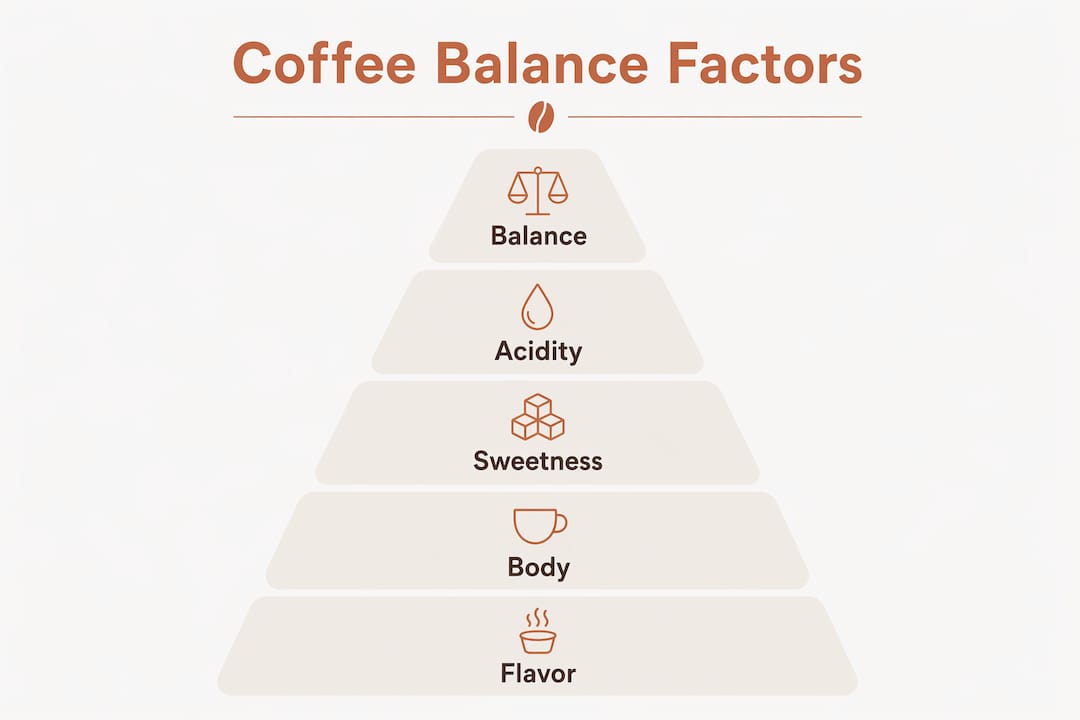
Balance in specialty coffee is a holistic property. It describes how acidity, sweetness, body, aroma/flavor, and aftertaste interact rather than what any single one of them tastes like in isolation.
- Acidity is the brightness you feel on the sides of your tongue. In a balanced cup it reads as clean and pleasant, like citrus or stone fruit, not sharp or aggressive.
- Sweetness is the perception of natural sugars from the bean. It softens acidity and rounds out bitterness. A truly balanced coffee carries enough natural sweetness that you do not need added sugar.
- Body is mouthfeel, the weight and texture of the liquid. A syrupy body can anchor a bright, acidic coffee; a thin body under high acidity makes a cup feel hollow.
- Aroma and flavor are the aromatic compounds you perceive through your nose and on your palate. They give the cup its character, whether floral, fruity, nutty, or spiced.
- Aftertaste/finish is what lingers after you swallow. A balanced finish is clean and pleasant, not bitter or astringent.
The interaction is the key point. Strong acidity needs matching sweetness and enough body to carry it. If the body is thin and sweetness is low, even moderate acidity reads as harsh. Coffee processing plays a role here too: washed coffees tend toward acidity clarity, while natural-processed coffees often add integrated sweetness and body that help balance a brighter origin.
Pro Tip: Taste your coffee black as it cools from hot to warm. Natural sweetness becomes more apparent as the cup cools to a warm temperature. If the cup tastes sour or flat as it cools, it signals an imbalance, and you have a clear signal to adjust.
How do professional cuppers judge whether a coffee is balanced?
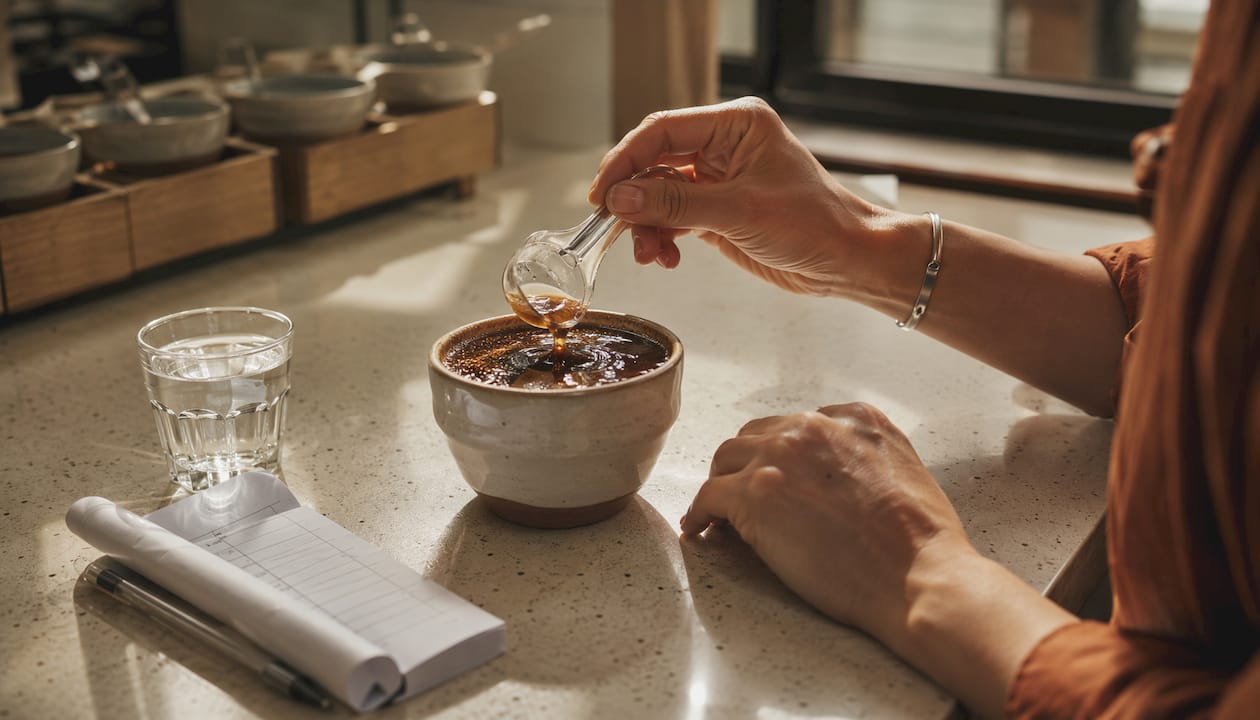
Professional cuppers do not just take one sip and decide. The SCA cupping protocol moves through a sequence: dry fragrance, wet aroma, a break of the crust, then multiple sips as the cup cools. Each stage reveals something different.
The “flavor arc” is the progression of sensory impressions from the first hot sip to the cooled cup. At high temperatures, acidity and aroma dominate. As the cup cools, sweetness and body become more prominent. A coffee that tastes bright and pleasant at 160°F but turns sour and thin at 120°F has a broken arc. A balanced coffee holds its shape across that range.
Cuppers score balance alongside flavor, aftertaste, acidity, body, and uniformity. The SCA Flavor Wheel and the World Coffee Research Sensory Lexicon give tasters a shared vocabulary to describe exactly where the arc breaks down, whether the acidity turns harsh, the sweetness drops out, or the finish turns astringent. You can apply the same logic at home by simply tasting your cup at three points: just brewed, five minutes later, and fully cooled. Log what changes. That habit alone will sharpen your sense of what balance feels like. For a deeper dive into tasting vocabulary, Moustachecoffeeclub’s specialty coffee tasting notes guide is a practical starting point.
Pro Tip: At your next cupping session, score each attribute separately before giving an overall balance score. You will often find that a cup you instinctively called “balanced” actually has one weak link, usually body or finish, that you were compensating for mentally.
How does roast level shift the balance of a coffee?
Roast level is one of the most powerful levers a roaster has for targeting balance. Here is how the three broad categories behave:
| Roast Level | Acidity | Sweetness | Body | Typical Notes |
|---|---|---|---|---|
| Light | High | Moderate | Light to medium | Floral, citrus, stone fruit, tea-like |
| Medium | Moderate | High | Medium to full | Caramel, stone fruit, milk chocolate |
| Dark | Low | Low | Heavy | Roast, smoke, dark chocolate, bittersweet |
Light roasts preserve origin clarity. A well-roasted Ethiopian light roast can show jasmine, bergamot, and bright citrus acidity, all in proportion. The risk is that underdevelopment leaves a sharp, sour acidity with no sweetness to anchor it. Medium roasts trade some of that origin brightness for more developed sweetness and body, which is why they are often described as the most approachable. Dark roasts push the cup toward roast-driven notes; origin character largely disappears, and balance depends on whether the roast notes are clean or harsh.
What actually controls this at the roastery level is the rate of rise (RoR) and development time ratio. A steadily declining RoR through the roast creates even flavor development. An unstable RoR or a development time that is too short produces underdeveloped, sour notes; too long produces flat, baked flavors. Neither can be fixed at the brew stage.
- Roasters targeting balance for a light single-origin will often extend development time slightly to build sweetness without losing acidity clarity.
- A coffee meant for espresso may be taken slightly darker to add body and reduce acidity, since espresso’s high concentration amplifies every attribute.
- Processing matters too: a natural-processed coffee already carries more sweetness and body, so a roaster may use a shorter development time to keep it from tipping into heavy or jammy territory.
Moustachecoffeeclub’s ultra-light Nordic approach sits at the lighter end of this spectrum, deliberately, to preserve the origin notes that make single-origin coffees worth drinking. For practical tips on dialing in light roasts at home, the brand’s brewing guides walk through the adjustments step by step.
Which brewing variables move a cup toward or away from balance?
A well-roasted bean can still brew unbalanced if extraction is off. Balance is dynamic, and the same bag of coffee can produce a bright, harmonious cup or a sour, thin one depending on how you brew it.
The core principle: under-extraction pulls sour, sharp, and thin. Over-extraction pulls bitter, dry, and heavy. Balance lives in the middle, and you get there by tuning these levers:
- Grind size: Finer increases extraction (more surface area, more contact). Coarser decreases it. If the cup is sour, grind finer before touching anything else.
- Water temperature: Higher temperature extracts more, faster. A practical target range for most methods is 92–94°C (197–201°F). Light roasts often benefit from the higher end of that range.
- Dose and ratio: More coffee relative to water increases body and intensity. A standard starting ratio for pour-over is 1:15 to 1:17 (coffee to water by weight).
- Brew time: Longer contact time increases extraction. If your pour-over is running long and tasting bitter, grind coarser rather than pouring faster.
- Water composition: Soft water under-extracts; very hard water can suppress acidity. Filtered water with moderate mineral content is recommended to support extraction and balance.
A coffee extraction chart is useful for visualizing where your brew falls on the extraction spectrum and which direction to move.
Pro Tip: Keep a simple brew log: dose, grind setting, water temperature, brew time, and a one-line tasting note. Change only one variable per session. After three brews you will have a clear picture of which lever is moving balance in your cup. This is exactly how brewing method affects flavor at the sensory level.
Starter recipes for a balanced cup
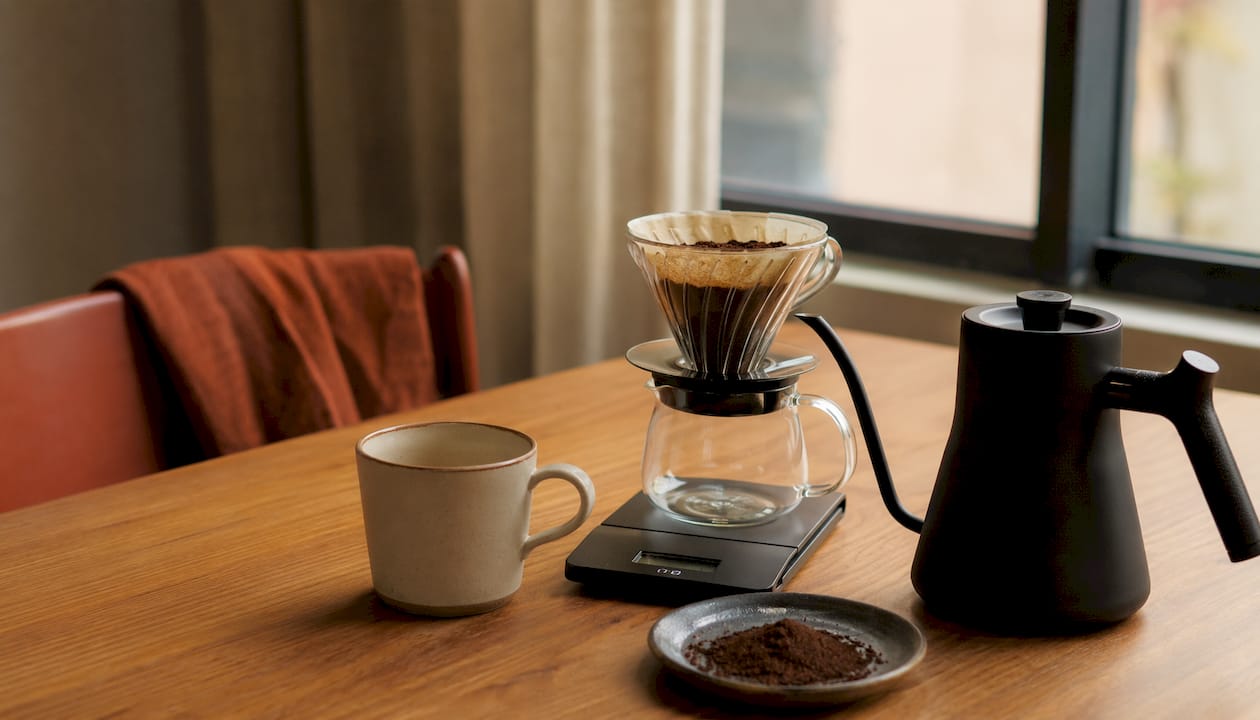
These are baselines, not rules. Start here, taste, and make one adjustment at a time.
| Method | Ratio | Grind | Water Temp | Time | Expected Result |
|---|---|---|---|---|---|
| Pour-over | 1:15 to 1:17 | Medium-fine | 93°C / 200°F | 3 to 3.5 min | Clean, bright, sweet finish |
| French press | 1:15 | Coarse | 93°C / 200°F | 4 min steep | Full body, low acidity, round |
| Espresso | 1:2 (dose:yield) | Fine | 93°C / 200°F | 25 to 30 sec | Concentrated, sweet, balanced bitterness |
A few notes on water: aim for filtered water in the 75–150 ppm TDS range. Below 50 ppm, the water is too soft and extraction suffers. Above 200 ppm, minerals compete with flavor compounds and acidity gets suppressed. For light roasts specifically, the higher end of the temperature range (93–94°C) helps develop sweetness that would otherwise stay locked in the bean.
Use the recipe as a baseline, then make one change. If the pour-over tastes sour, grind finer. If it tastes bitter, grind coarser or lower the temperature by 1–2°C. For a full step-by-step pour-over walkthrough, Moustachecoffeeclub’s pour-over guide covers technique in detail. For broader method options with light roasts, the light roast brewing methods list is worth bookmarking.
Why does your cup taste unbalanced, and what are the common myths?
Diagnosing imbalance
| Symptom | Likely Cause | Quick Fix |
|---|---|---|
| Sour, sharp, thin | Under-extraction | Grind finer, raise temp, or extend brew time |
| Bitter, dry, heavy | Over-extraction | Grind coarser, lower temp, or shorten brew time |
| Flat, no brightness | Stale beans or over-roast | Use fresher beans; try a lighter roast |
| Watery, no body | Too coarse or too low dose | Grind finer or increase dose slightly |
| Cloying, syrupy | Over-dose or very dark roast | Reduce dose; try a lighter roast |
Common myths, corrected
- “Balanced means boring.” A balanced specialty coffee retains distinct origin notes. Balance is not the absence of character; it is the presence of support. A bright Ethiopian Yirgacheffe can be fully balanced while still tasting unmistakably of bergamot and blueberry.
- “Only medium roast can be balanced.” Light roasts can be beautifully balanced when developed correctly. Dark roasts can be balanced when the roast notes are clean and the body is full enough to carry them. Roast level sets the playing field; balance is what happens within it.
- “If it needs sugar, it is not specialty coffee.” Sweetness perception varies by palate and by cup temperature. Taste black at 130°F before deciding. Many people add sugar out of habit, not necessity.
Pro Tip: When troubleshooting, fix one variable and brew again before changing a second. Changing grind and temperature simultaneously makes it impossible to know which adjustment actually moved the cup.
Key Takeaways
A balanced coffee profile means acidity, sweetness, body, and flavor work together in proportion, with no single attribute dominating the cup across its full temperature range.
| Point | Details |
|---|---|
| Balance is a relationship, not a flavor | No single attribute should dominate; acidity, sweetness, body, and finish must support each other. |
| Roast level sets the starting point | Light roasts favor acidity clarity; medium roasts add sweetness and body; dark roasts shift toward roast-driven weight. |
| Brewing variables are the final dial | Grind, temperature (92–94°C), dose, and brew time all move extraction and shift the balance of the cup. |
| Taste as the cup cools | A truly balanced coffee holds its harmony from hot to warm; a broken flavor arc reveals imbalance. |
| Moustachecoffeeclub targets designed balance | Ultra-light, Nordic-style single-origin roasts preserve origin clarity while keeping sweetness and body in proportion. |
Why balance is the hardest thing to fake in coffee
Most coffee writing treats balance as a middle-ground concept, the safe, crowd-pleasing option between a punchy light roast and a heavy dark one. That framing misses the point entirely.
Balance is actually the most demanding target in specialty coffee because it requires every stage of the supply chain to do its job well. A coffee that is picked too early, processed carelessly, or roasted with an unstable RoR cannot be brewed into balance, no matter how carefully you dial in your pour-over. The brew stage can only reveal what the roaster built in. And the roaster can only work with what the farmer and processor delivered.
This is why the Nordic roasting tradition, which Moustachecoffeeclub follows, is so unforgiving. Ultra-light roasts strip away the roast-driven notes that can mask defects in darker profiles. There is nowhere to hide. A light-roasted Ethiopian or Colombian single-origin either has the sweetness and body to support its acidity, or it does not. That transparency is the point. It is also why tasting as the cup cools is not just a pro tip but a genuine quality check: a coffee that falls apart at 120°F was never truly balanced to begin with.
The practical takeaway is this: if you want to train your palate for balance, start with well-sourced single-origins roasted light, taste them black, and pay attention to what happens as they cool. That exercise will teach you more about coffee flavor profiles in a month than years of drinking the same comfortable blend.
Fresh-roasted single-origin coffees, shipped the day they are roasted
If you want to taste what a deliberately balanced coffee profile feels like across different origins and roast approaches, Moustachecoffeeclub’s subscription is built for exactly that.

Every bag ships the day it is roasted, so you are tasting the coffee at peak flavor development, not weeks later. Each delivery includes:
- Freshly roasted single-origin beans, roasted to order in the ultra-light Nordic style
- Detailed tasting notes and origin reports so you know what attributes to look for
- Brewing guides calibrated to the specific coffee in your bag
The subscription adjusts to your feedback, so the coffees you receive get progressively closer to your palate preferences over time. Start your subscription and taste the difference that designed balance makes in the cup.
Useful sources
The following sources informed this article and are worth consulting for deeper study on cupping protocols, roast profiling, and flavor lexicons:
- Balanced Coffee Flavor: 5 Ultra Important Secrets for Harmony in the Cup — Practical guide to what “round taste” means in specialty coffee, with tasting checkpoints for acidity, sweetness, and body.
- What is Coffee Balance? Understanding Specialty Coffee Descriptors — Nordic Approach’s glossary entry on balance as a formal sensory descriptor, covering processing effects and the distinction between balance and uniformity.
- Achieving the Perfect Coffee Balance — Covers the cupping flow and how cooling evaluation reveals the flavor arc.
- Coffee Flavor Profiles Explained — Overview of the SCA Flavor Wheel and WCR Sensory Lexicon as tools for articulating balance.
- What is a Coffee Roasting Profile? — Explains RoR, development time ratio, and airflow as the roasting controls that determine flavor balance.
- Roast Profiles 101: Everything You Need to Know — Head roaster perspective on profiling decisions and how they target specific flavor outcomes.
- Best Coffee Brewing Techniques for Home Baristas — Practical brewing technique overview for home baristas looking to apply balance principles.
- Moustachecoffeeclub Education Hub — Brewing guides, origin reports, and tasting resources from Moustachecoffeeclub.
FAQ
What does a balanced coffee mean?
A balanced coffee is one where acidity, sweetness, body, and flavor are in proportion so no single attribute dominates the cup. The Specialty Coffee Association treats balance as a formal cupping attribute evaluated across the full flavor arc as the cup cools.
What are the four main coffee flavor profiles?
Coffee flavor profiles are typically grouped around four sensory axes: acidity (brightness), sweetness (natural sugar perception), body (mouthfeel and weight), and flavor/aroma (the aromatic complexity from origin and roast). Balance describes how well those four interact.
Does balanced coffee mean it has no strong flavors?
No. A balanced specialty coffee retains distinct origin character; balance means those notes are supported by sweetness and body rather than left exposed. A bright Ethiopian with bergamot and blueberry notes can be fully balanced while still tasting unmistakably of its origin.
How do brewing parameters affect coffee balance?
Water temperature, grind size, dose, and brew time all shift extraction, which directly changes the ratio of acidity, sweetness, and body in the cup. A practical starting temperature for most methods is 92–94°C (197–201°F); under-extraction reads sour and thin, over-extraction reads bitter and dry.
What is the best way to taste for balance at home?
Taste your coffee black at three points: just brewed, five minutes in, and fully cooled. A balanced cup holds its harmony across that range. If it turns sour or flat as it cools, the extraction or roast development needs adjustment.
Recommended
- How Single Origin Differs from Blends: A Coffee Guide | Blog | The Moustache Coffee Club
- How Brewing Method Affects Specialty Coffee Flavor | Blog | The Moustache Coffee Club
- Natural Process Coffee Flavor: What It Is and Why It Matters | Blog | The Moustache Coffee Club
- What Is a Tasting Note in Coffee? A 2026 Guide | Blog | The Moustache Coffee Club