What Is Degassing in Coffee Beans: A Fresh Roast Guide
What is degassing in coffee beans?
Coffee degassing is the natural release of carbon dioxide (CO2) from roasted beans, and it starts the moment roasting ends. During roasting, heat-driven chemical reactions produce CO2 that gets locked inside the bean’s porous cellular structure. That gas has to escape before you brew, or it will physically push water away from the grounds and wreck your extraction.
Here is what you need to know upfront:
- CO2 accounts for about 1–2% of the bean’s mass after roasting and makes up more than 80% of the volatile fraction
- Roughly 40% of that CO2 escapes within the first 24 hours
- Brewing too early produces harsh, metallic, or sour notes; brewing too late means flat, lifeless coffee
- The ideal rest period is 2–12 days depending on roast level and bean type
- One-way valve bags let CO2 out without letting oxygen in, protecting freshness during this window
Understanding the coffee bean degassing process is the difference between a cup that sings and one that just sits there.
How does CO2 get trapped inside roasted coffee beans?
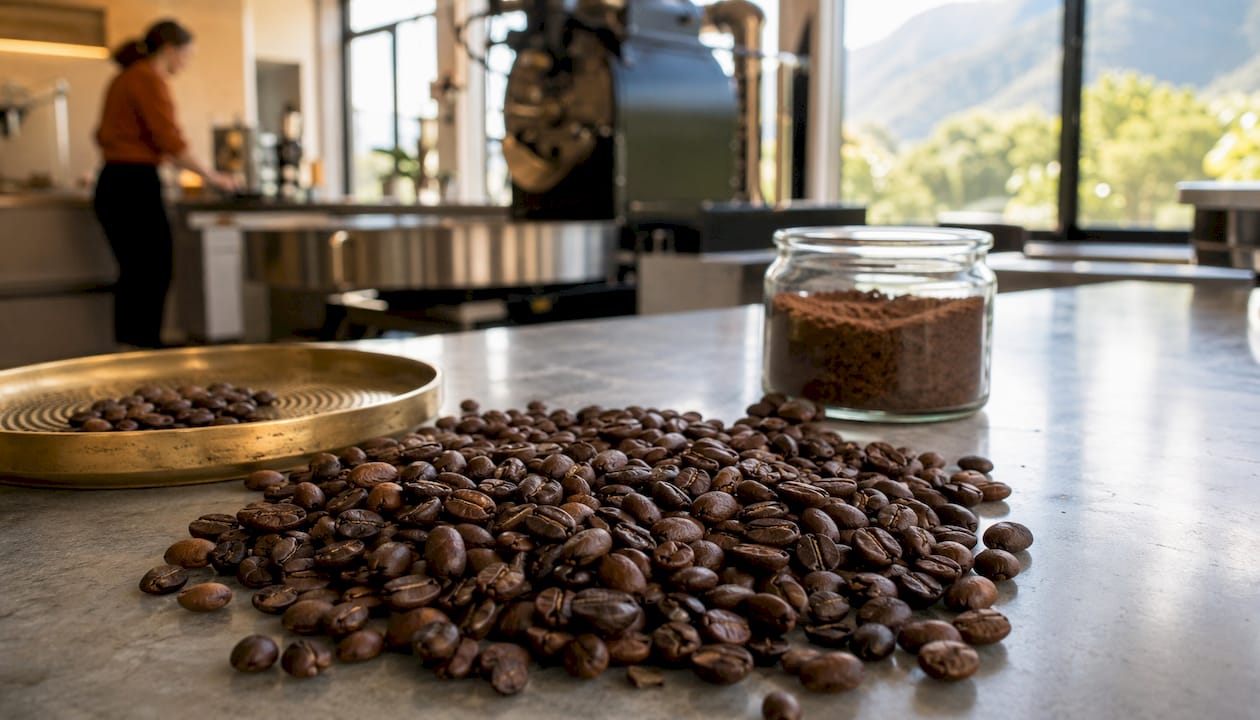
Roasting triggers a cascade of thermally driven chemical reactions, including the Maillard reaction and caramelization, that break down carbohydrates and produce CO2 as a byproduct. That CO2 forms inside the bean’s microscopic, honeycomb-like cellular structure and stays trapped there under pressure.
The amount of CO2 retained depends heavily on roast degree and bean density. Darker roasts crack the cellular walls more aggressively, which actually speeds up degassing because more exit points open up. Lighter roasts and denser beans, often grown at higher altitudes, hold CO2 longer because their structure stays more intact. This is why a dense Ethiopian single-origin roasted ultra-light needs more rest than a darker, lower-grown bean.
The gas does not sit passively. It exists in equilibrium between the bean’s pores, its oils, and its polysaccharides, which is part of why release is gradual rather than immediate.
How long does degassing take after roasting?
The timeline breaks into three distinct stages, and knowing them helps you time your brew correctly.
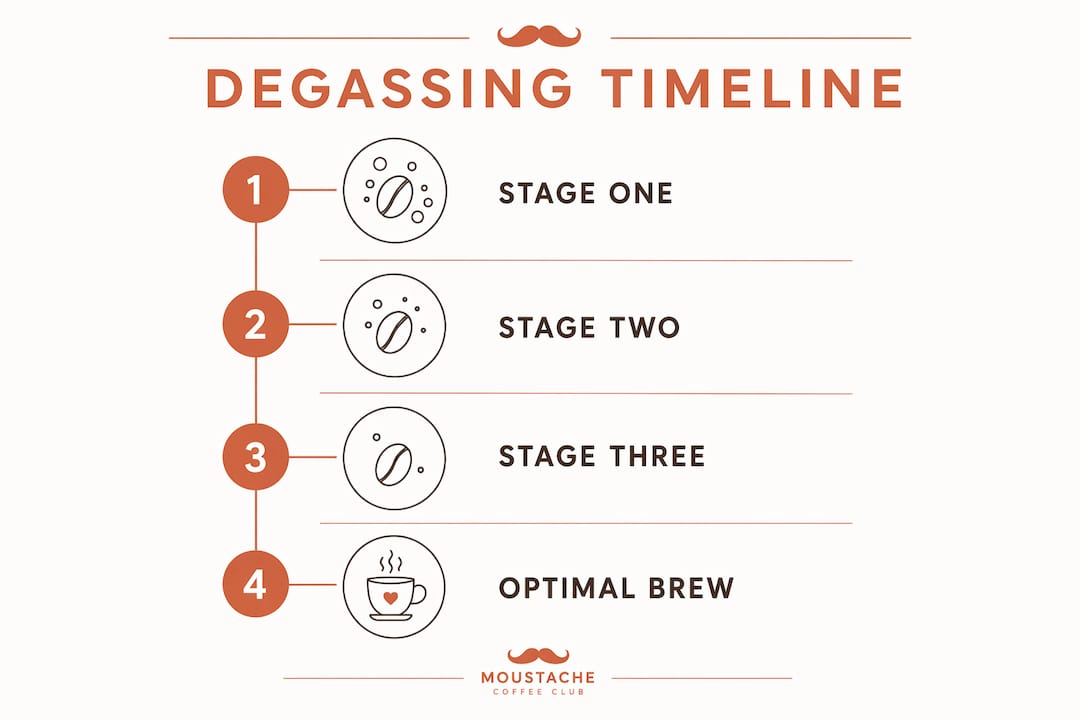
Stage one: The first 24 hours. This is the most volatile phase. Approximately 40% of total CO2 leaves the bean during this window. Freshly roasted beans at this stage are too unstable for quality brewing and often produce a dry, metallic sensation in the cup.
Stage two: Days 2–7. Release slows but continues steadily. Aromas begin integrating with the bean’s natural oils, and flavor profiles round out. Most filter coffees hit their peak somewhere in this window.
Stage three: Long-term stabilization. CO2 continues leaving at a slow rate, sometimes for up to three weeks for certain roast styles.
Roast-specific rest times to keep in mind:
- Lighter roasts: rest 4–7 days before brewing
- Darker roasts: rest 2–5 days before brewing
- Espresso: many roasters prefer 7–14 days for cleaner crema formation
- Pre-ground coffee: releases most CO2 within 15–30 minutes of grinding
Pro Tip: If you’re brewing a light roast and the cup tastes sharp or hollow, give the beans two more days. The difference is often dramatic.
Why degassing matters for flavor and brewing quality
Excess CO2 physically repels water from coffee grounds. The result is uneven saturation, which means some grounds over-extract while others barely extract at all. Brewing within 24 hours of roasting consistently produces this kind of uneven extraction, and no amount of technique fixes it when the gas load is that high.
The effects of degassing on coffee flavor work in both directions:
- Too fresh: CO2 escaping during brewing creates air pockets, leading to sour, metallic, or harsh notes
- Just right: enough CO2 remains to protect aromatics from oxidation while allowing even water contact
- Over-degassed: oxygen has moved in, lipids and aromatic compounds have started degrading, and the cup tastes flat
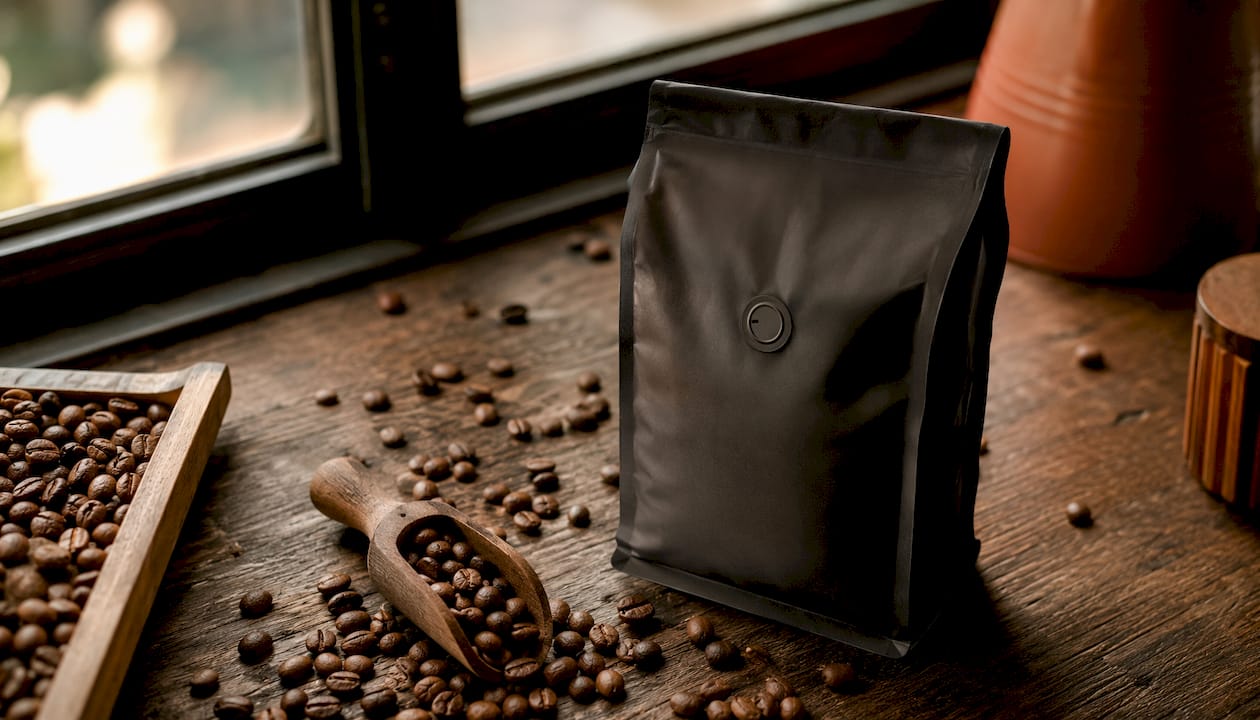
Packaging plays a direct role here. One-way valve bags allow CO2 to vent while blocking oxygen, which is why specialty roasters use them. Puffed packaging00432-6) is not a sign of spoilage. It means active, healthy degassing is happening exactly as it should.
Pro Tip: A bag that feels slightly inflated when you receive it is a good sign. It means the beans are fresh and still releasing CO2 actively. Store them in the right conditions and brew within the recommended window.
As Juan Mario Carvajal, Co-Founder of the Latam SCA, puts it: “The gas still being released is an indicator of freshness, but when it is too fresh it prevents the coffee grounds from being fully extracted.”
Degassing is a freshness spectrum, not a binary state. The goal is to catch beans at the point where CO2 has dissipated enough for clean extraction but not so much that oxidation has taken hold.
What happens after beans finish degassing?
Once CO2 levels drop low enough, the gas is no longer acting as a protective barrier. Oxygen moves in, and oxidation begins. This is the primary driver of coffee staleness, and it accelerates quickly once degassing is complete.
For whole beans stored at room temperature without a valve bag, oxidation begins in earnest around 4–8 weeks post-roast. Pre-ground coffee reaches this point within 24–48 hours of grinding, which is why grinding immediately before brewing matters so much. The lipids and aromatic compounds that give specialty coffee its character are the first to degrade.
Storage choices at this stage have a real impact. Airtight containers slow oxygen exposure. Keeping beans away from heat, light, and moisture preserves what CO2 remains. You can find detailed guidance on evaluating freshness at home to know when your beans are still in their prime.
What research tells us about degassing mechanisms
The science behind degassing is more layered than most brewing guides acknowledge. CO2 release from roasted beans follows Fick’s law of diffusion for unsteady-state conditions, but the actual mechanisms are a combination of processes: molecular diffusion, Knudsen diffusion, surface diffusion, and pressure-driven viscous flow. The calculated effective diffusivity ranges from 0.5 to 10×10⁻¹³ m²/s, which explains why whole beans degas slowly while ground coffee releases gas almost immediately.
Grinding shatters the bean’s cellular structure and exponentially increases surface area. A freshly ground dose can release most of its remaining CO2 within 15–30 minutes, which is why grinding right before brewing is the standard in specialty coffee. Waiting even an hour after grinding can produce noticeably flat results.
| Factor | Effect on degassing rate |
|---|---|
| Dark roast | Faster; more cellular damage creates more exit points |
| Light roast | Slower; intact structure holds CO2 longer |
| High-altitude bean | Slower; denser structure retains gas |
| Grinding | Dramatically faster; surface area multiplies instantly |
| Higher storage temperature | Faster release rate |
| Airtight valve bag | Controlled; CO2 exits, oxygen stays out |
Bean density and altitude interact with roast profile in ways that make every coffee slightly different. A high-altitude Ethiopian Yirgacheffe roasted ultra-light will need more rest than a lower-grown Brazilian natural at medium roast, even if both were roasted on the same day.
Key Takeaways
Degassing is the essential rest period between roasting and brewing, and skipping it costs you flavor clarity and extraction consistency.
| Point | Details |
|---|---|
| CO2 forms during roasting | Chemical reactions trap CO2 inside bean pores, accounting for about 1–2% of bean mass. |
| First 24 hours are most volatile | Roughly 40% of total CO2 escapes in the first day; beans are not ready to brew yet. |
| Rest times vary by roast | Lighter roasts need 4–7 days; darker roasts need 2–5 days before brewing. |
| Grinding accelerates degassing | Ground coffee releases most CO2 within 15–30 minutes, so grind immediately before brewing. |
| Oxidation follows full degassing | Once CO2 is gone, oxygen degrades flavor fast; store beans properly to extend the window. |
FAQ
How long should you degas coffee beans?
Most coffee needs 2–12 days after roasting before it’s ready to brew. Lighter roasts benefit from 4–7 days of rest; darker roasts are typically ready in 2–5 days.
Do you need to degas coffee beans before brewing?
Yes. Brewing too soon after roasting causes uneven extraction because excess CO2 physically repels water from the grounds, producing sour or harsh flavors regardless of technique.
How do you speed up degassing safely?
The safest method is storing beans at a slightly warmer room temperature, which accelerates CO2 release. Do not pre-grind to speed things up; grinding causes rapid oxidation that stales the coffee within hours.
What are the biggest threats to coffee freshness?
Oxygen, heat, light, and moisture are the four main enemies of roasted coffee. Oxygen drives oxidation and staleness; heat and light accelerate chemical degradation; moisture can trigger mold and flavor loss.
How does grinding affect the degassing process?
Grinding shatters the bean’s cellular structure and releases most remaining CO2 within 15–30 minutes. This is why specialty coffee practice calls for grinding immediately before brewing, not hours ahead.
Moustachecoffeeclub roasts every order fresh and ships beans at the ideal point in the degassing window, so you receive them ready to brew. If you want single-origin specialty coffee that arrives at peak freshness every time, start your subscription and taste what proper timing actually does to a cup.

Recommended
- Why freshly roasted beans taste better: a guide | Blog | The Moustache Coffee Club
- Evaluating Coffee Freshness After Roasting at Home | Blog | The Moustache Coffee Club
- How Roasting Changes Coffee Chemistry: A Science Guide | Blog | The Moustache Coffee Club
- How a Coffee Cherry Becomes a Roasted Bean | Blog | The Moustache Coffee Club