How Roasting Changes Coffee Chemistry: A Science Guide
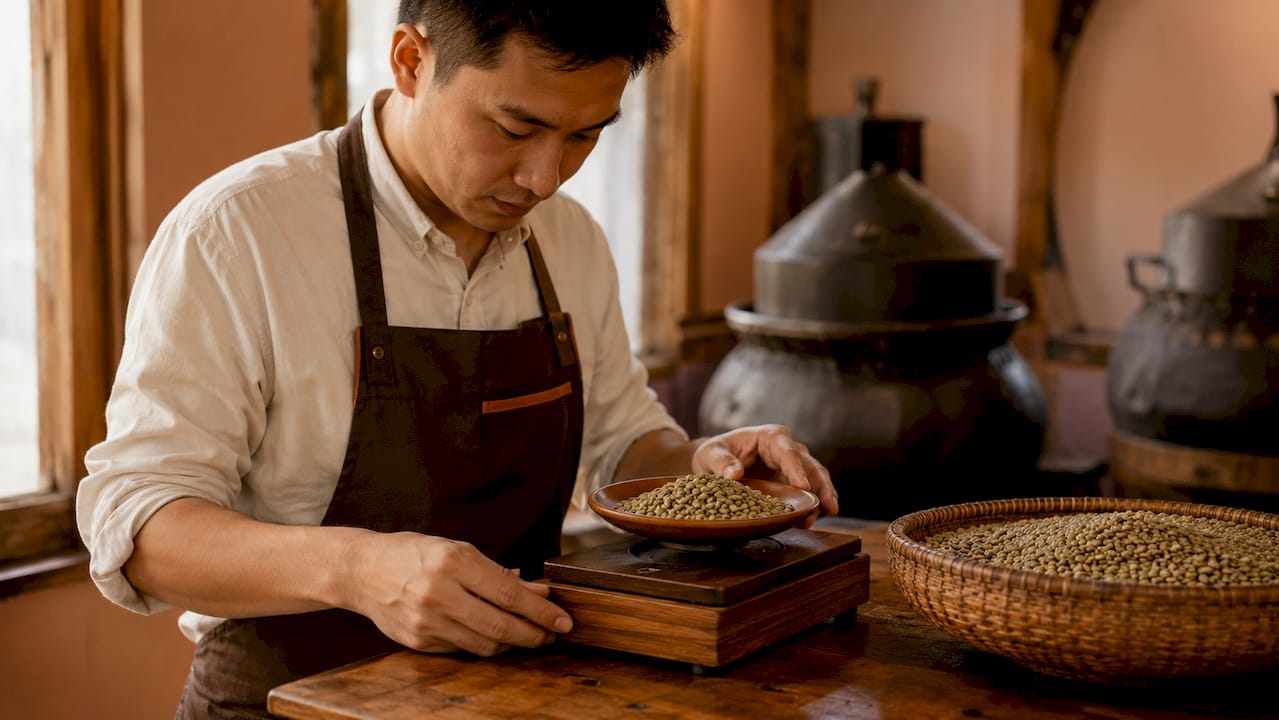
Roasting is defined as the heat-driven process that transforms green coffee beans into the aromatic, flavorful beans you grind every morning. Understanding how roasting changes coffee chemistry means understanding why an Ethiopian natural tastes of blueberry at a light roast but turns bitter and flat when pushed too dark. The core transformations are moisture loss, Maillard reactions, caramelization, Strecker degradation, and volatile compound formation. Each of these reactions builds the flavor compounds in your cup. Knowing what they do gives you a sharper lens for choosing the right roast and appreciating what a skilled roaster actually controls.
What are the main chemical reactions during coffee roasting?
Three browning reactions drive coffee flavor development: the Maillard reaction, caramelization, and Strecker degradation. They overlap in time but produce chemically distinct results.
The Maillard reaction requires reducing sugars and amino acids. Heat causes them to combine, producing nitrogen-containing aroma compounds such as pyrazines, along with brown pigments called melanoidins. Maillard and caramelization are simultaneous but chemically distinct, creating different aroma compounds. Pyrazines deliver the toasted, nutty, and malty notes you associate with a well-developed roast.
Caramelization is thermal sugar decomposition. It does not require amino acids. Instead, heat alone breaks down sucrose and other sugars into sweet furanones and other volatile compounds. These contribute the caramel, butterscotch, and brown sugar notes found especially in medium roasts.
Strecker degradation is less discussed but equally important. It converts amino acids into aldehydes and ketones through oxidative reactions with Maillard intermediates. These aldehydes contribute malty, chocolate, and green-apple notes depending on which amino acids are present in the green bean.
Pro Tip: The Maillard reaction begins around 150°C and accelerates through the development phase. Caramelization kicks in closer to 170°C. Both reactions need adequate time at temperature to complete. Rushing either one by applying too much heat too fast produces a chemically underdeveloped cup.
Pyrazines account for up to 20% of the total volatile fraction in roasted coffee, peaking in medium roasts before declining in darker roasts due to excessive pyrolysis. That peak is why medium roasts often smell the most intensely “coffee-like” straight out of the bag.
How do physical changes in beans signal chemistry shifts?
The physical changes you see during roasting are direct markers of the chemical reactions happening inside the bean. They are not cosmetic. They tell you exactly where you are in the reaction sequence.
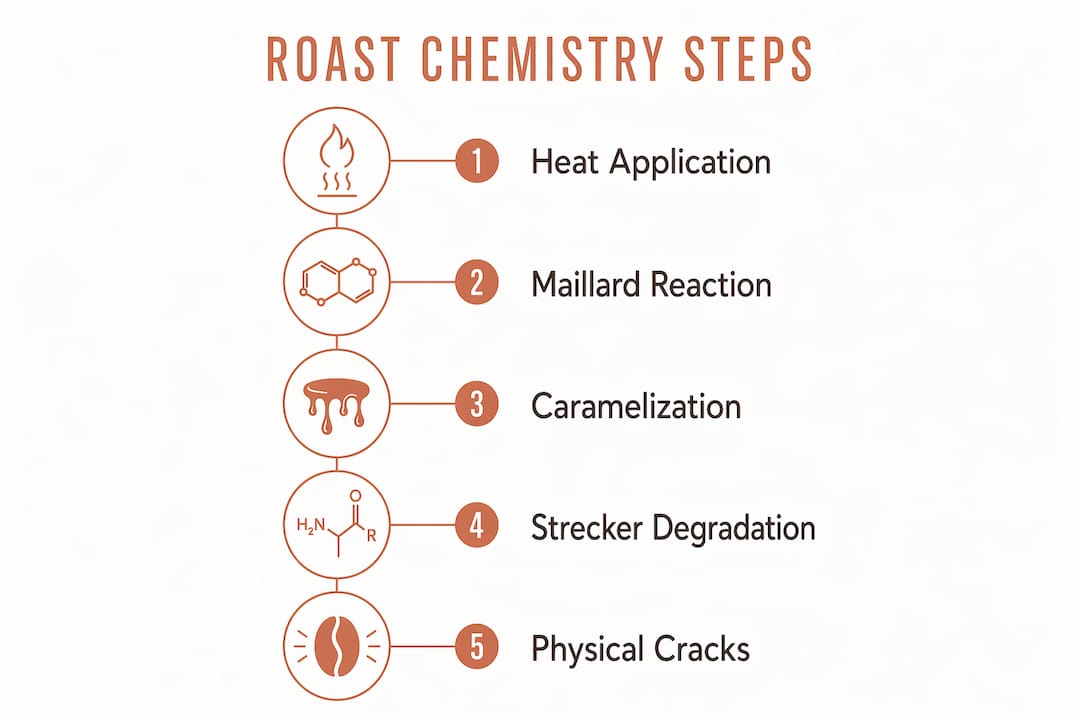
Roasting causes a 15–18% mass loss mostly from moisture evaporation, while bean volume roughly doubles due to internal pressure buildup. That volume increase is not just expansion. It reflects the CO2 and steam generated by chemical reactions forcing the cellular structure apart.
The roasting cycle follows three defined phases:
- Drying phase (40–50% of total roast time): The bean loses free moisture. Little flavor chemistry occurs yet. The bean turns from green to yellow as chlorophyll degrades.
- Maillard phase (30–40% of total roast time): The coffee roasting process enters active browning. Amino acids and sugars react. The bean turns tan, then light brown. Aroma compounds begin forming rapidly.
- Development phase (18–25% of total roast time): This is the Development Time Ratio, or DTR. The roaster controls how long the bean stays in this phase after first crack. DTR determines flavor complexity and balance.
First crack is the most important physical event in the roast. First crack at 196–213°C is a physical breakdown of bean structure driven by steam and CO2 pressure, marking the transition from dehydration to flavor development. It is also an exothermic event, meaning the bean releases heat on its own. A roaster who misses first crack loses their primary anchor point for controlling the development phase.
Second crack occurs at higher temperatures and signals the start of carbonization. Cell walls fracture more aggressively. Oils migrate to the surface. The chemistry shifts from flavor development to flavor destruction.
How do different roast levels change the chemical profile?
Roast level is the single biggest variable in how heat affects coffee. Light, medium, and dark roasts are not just color categories. They represent fundamentally different chemical profiles.
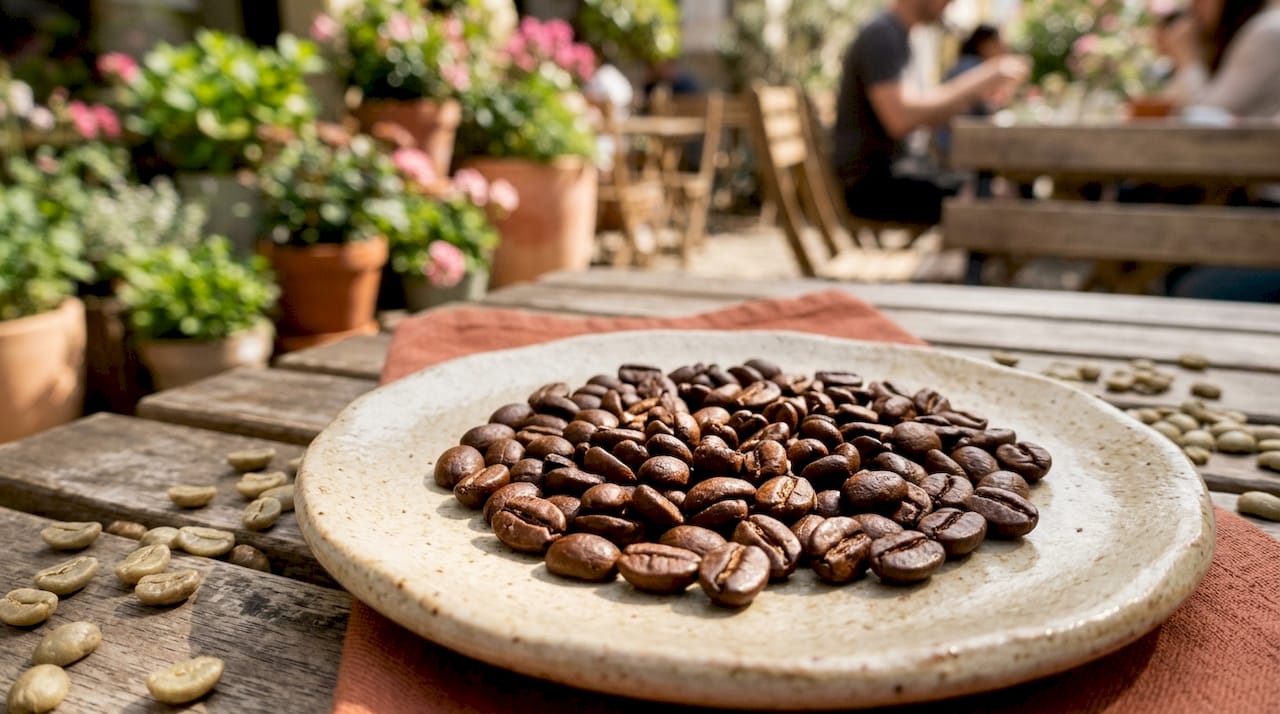
Light roasts stop development early, typically just after first crack. Origin character flavors are strongest in light roasts because the Maillard and caramelization reactions have not yet masked the bean’s native compounds. A light-roasted Ethiopian coffee retains its floral and fruit-forward volatile compounds because those compounds have not been pyrolyzed away. This is why Moustachecoffeeclub roasts in the ultra-light, Nordic tradition: to preserve the terroir of each single-origin bean rather than replace it with roast-derived flavors.
Medium roasts push the development phase further. Pyrazines and other nitrogenous heterocyclic compounds reach their peak concentration. The cup gains body and toasted complexity without losing all origin character. This is the sweet spot for many enthusiasts who want both terroir and roast flavor.
Dark roasts develop high concentrations of melanoidins and carbonization byproducts. These compounds mask the original bean flavor entirely. The cup tastes of the roast, not the origin. That is not inherently bad, but it means the coffee’s geographic story is gone.
One persistent myth deserves correction: caffeine does not burn off during roasting. Caffeine remains stable up to 200°C and is not significantly reduced by roasting. The perception that dark roast has more caffeine comes from volume measurement. Dark roast beans are less dense, so a scoop by volume contains fewer beans and therefore slightly less caffeine than the same scoop of light roast.
Pro Tip: If you want to taste what a specific origin actually grows, choose a light roast coffee and brew it with a clean method like pour-over. The chemistry of the bean, not the roaster, will dominate your cup.
| Roast level | Key chemical compounds | Flavor character |
|---|---|---|
| Light | Preserved origin volatiles, low melanoidins | Floral, fruity, high acidity |
| Medium | Peak pyrazines, balanced melanoidins | Nutty, toasted, caramel, moderate acidity |
| Dark | High melanoidins, carbonization products | Bitter, smoky, roast-forward, low acidity |
What expert practices optimize roasting chemistry?
Experienced roasters treat a roast profile as an engineered chemical reaction, not a timer. Every decision about heat input and airflow affects which reactions complete and which get cut short.
The two most common errors in roasting are crash-roasting and baking. Crash-roasting limits Maillard reactions by applying too much heat too fast, forcing the bean through temperature milestones before the chemistry can complete. Baking stalls caramelization by dropping heat input too early, leaving the bean in a low-temperature plateau where reactions slow to a crawl. Both errors produce flat, underdeveloped cups.
Rate of Rise, or RoR, is the metric roasters use to track how quickly bean temperature increases per minute. Managing RoR through each phase keeps reactions on schedule:
- Drying phase: High RoR is acceptable. The goal is moisture removal, not flavor development.
- Maillard phase: RoR should be declining but still positive. A sudden RoR crash here truncates browning reactions.
- Development phase: RoR continues to decline gently. A flat or rising RoR at this stage risks scorching.
Monitoring first crack anchors the entire development calculation. A roaster who knows exactly when first crack begins can calculate DTR precisely and pull the roast at the right moment for the target flavor profile.
Post-roast chemistry matters too. Melanoidins compose up to 18% of dry coffee weight and scavenge key aroma thiols, causing rapid aroma staling after brewing. This explains why freshly brewed coffee loses its aroma within an hour. The melanoidins bind the volatile compounds that carry the most aromatic intensity. Understanding why freshly roasted beans taste better is partly about this post-roast chemical degradation.
Pro Tip: Grind just before brewing and drink within 20 minutes of brewing. Melanoidins work fast once water releases the volatile compounds from the grounds.
Key Takeaways
The Maillard reaction, caramelization, and Strecker degradation are the three chemical engines that build every flavor note in your cup, and roast level determines how far each reaction runs.
| Point | Details |
|---|---|
| Three core reactions | Maillard, caramelization, and Strecker degradation each produce distinct aroma compounds at different temperatures. |
| Physical changes mark chemistry | Mass loss of 15–18% and volume doubling signal active chemical transformation inside the bean. |
| Roast level shapes flavor | Light roasts preserve origin volatiles; dark roasts replace them with melanoidins and carbonization products. |
| Caffeine is stable | Caffeine does not burn off during roasting; perceived differences are a measurement artifact, not a chemistry change. |
| Freshness matters post-roast | Melanoidins scavenge aroma thiols rapidly after brewing, making drink-time as important as roast quality. |
The part of roasting chemistry most enthusiasts miss
I have spent years tasting coffees across roast levels, and the insight that changed how I think about roasting is this: the roaster’s job is not to add flavor. It is to not destroy the flavor that is already there.
Green coffee from a high-altitude Ethiopian farm or a Colombian micro-lot arrives with a specific chemical fingerprint built from soil, altitude, variety, and processing. The coffee origin flavor complexity is already encoded in the bean’s amino acid and sugar composition before the roaster touches it. Every degree of heat the roaster applies either reveals those compounds or burns them away.
Most people assume darker means more flavor. The chemistry says the opposite. Darker means more melanoidins, more carbonization, and less of the origin-specific volatile compounds that make a Yirgacheffe taste like a Yirgacheffe. The roast flavor is real, but it is a replacement, not an addition.
What I find genuinely exciting about the Nordic and ultra-light roasting tradition is that it treats roasting as a preservation act. The goal is to complete the Maillard and caramelization reactions just enough to develop structure and body, then stop before pyrolysis erases the terroir. That requires precise heat management and a deep understanding of DTR. It also requires starting with exceptional green coffee, because there is nowhere to hide.
If you want to understand what roasting chemistry actually does, buy the same single-origin bean at three roast levels and brew them side by side. The difference is not subtle. It is the entire story of how heat affects coffee written in three cups.
— Sean
What Moustachecoffeeclub offers for chemistry-curious coffee drinkers
Moustachecoffeeclub roasts every batch to order in the ultra-light, Nordic style, which means the Maillard and caramelization reactions are completed with precision and stopped before carbonization begins. The result is a cup where origin chemistry leads and roast chemistry supports.

Each single-origin subscription ships freshly roasted beans from farms in Ethiopia, Colombia, and other high-quality growing regions. You receive detailed origin reports explaining the bean’s flavor compounds and processing method, so you can connect the science to what you taste. For enthusiasts who want to go deeper, the coffee education hub covers brewing guides, origin profiles, and roasting science in plain language.
FAQ
What is the Maillard reaction in coffee roasting?
The Maillard reaction is a chemical process between amino acids and reducing sugars that produces nitrogen-containing aroma compounds, including pyrazines, and brown pigments called melanoidins. It begins around 150°C and is the primary driver of coffee’s toasted, nutty flavor notes.
Does roasting destroy caffeine?
Caffeine remains stable up to 200°C and is not significantly reduced by roasting. The common belief that dark roast has more caffeine is a measurement error caused by the lower density of dark roast beans.
What is first crack in coffee roasting?
First crack is a physical and chemical milestone at 196–213°C where internal steam and CO2 pressure rupture the bean’s cellular structure. It marks the start of the development phase and triggers exothermic reactions that accelerate flavor formation.
Why does freshly brewed coffee lose its aroma quickly?
Melanoidins, which compose up to 18% of dry coffee weight, bind and scavenge volatile aroma thiols after brewing. This chemical process causes the cup’s aromatic intensity to drop noticeably within 60 minutes of brewing.
How does roast level affect origin flavor?
Light roasts preserve the bean’s native volatile compounds, keeping origin character intact. Dark roasts produce high concentrations of melanoidins and carbonization products that mask those origin flavors entirely, shifting the cup profile toward roast-derived bitterness and smokiness.
Recommended
- Why freshly roasted beans taste better: a guide | Blog | The Moustache Coffee Club
- How Coffee Processing Affects Taste: A Flavor Guide | Blog | The Moustache Coffee Club
- How a Coffee Cherry Becomes a Roasted Bean | Blog | The Moustache Coffee Club
- Receiving Roasted-to-Order Coffee: A Connoisseur’s Guide | Blog | The Moustache Coffee Club