Why Colombian coffee is widely loved: a complete guide
Colombian coffee is widely loved for reasons that go far deeper than marketing or habit. In 2025, Colombian coffee exports surpassed fuel for the first time in 25 years to become the country’s top export, a milestone that reflects genuine global demand. This is not a coincidence. The cup in your hand carries the result of high-altitude geography, family farming traditions, century-old processing methods, and one of the most rigorous quality systems in coffee. This guide breaks down exactly what makes Colombian coffee special and why it continues to earn loyal fans across every corner of the world.
Table of Contents
- How geography and climate create the foundation for why Colombian coffee is widely loved
- Strict quality standards and artisanal processing: the secret to Colombian coffee’s consistency
- The cultural heritage behind Colombia’s coffee: beyond the cup
- Distinct flavor profiles across Colombia’s major coffee regions
- Why Colombian coffee’s reputation endures despite evolving specialty coffee trends
- Enjoy the taste of Colombian coffee with Moustache Coffee Club
- Frequently asked questions
Key Takeaways
| Point | Details |
|---|---|
| Unique growing conditions | Colombia’s high mountains and volcanic soil create ideal conditions for quality Arabica coffee. |
| Strict quality control | Decades of standards for grading and washed processing ensure a clean, consistent cup. |
| Cultural heritage | Coffee farming is deeply embedded in Colombia’s social and agricultural traditions. |
| Diverse flavor profiles | Different regions produce a wide range of balanced, floral, fruity, and smooth coffees. |
| Global trust and appeal | Colombian coffee remains a global benchmark for mild, bright Arabica enjoyed worldwide. |
How geography and climate create the foundation for why Colombian coffee is widely loved
Start with the land, because the land explains almost everything. Colombia sits directly on the equator, which means its coffee-growing regions get consistent sunlight year-round. But the real advantage is altitude. Colombian coffee is grown exclusively as Arabica at elevations between 1,200 and 2,200 meters above sea level, in volcanic Andean soils layered with minerals from millennia of geological activity.
Why does altitude matter so much? At these heights, temperatures are cooler and the coffee cherry ripens slowly. Slow ripening allows sugars inside the bean to develop fully, which translates directly into sweetness, complexity, and balanced acidity in your cup. A cherry harvested from a flat, hot lowland farm matures in weeks. A cherry grown at 1,800 meters in the Colombian Andes can take months. That difference shows up in every sip.
Volcanic soil adds another layer. The mineral-rich earth feeds the coffee plant with nutrients that enhance its natural flavor compounds. Think of it the same way wine enthusiasts talk about terroir: the ground itself contributes to the taste. Colombian soil gives its coffee a structural richness that lighter, mineral-poor soils cannot replicate.
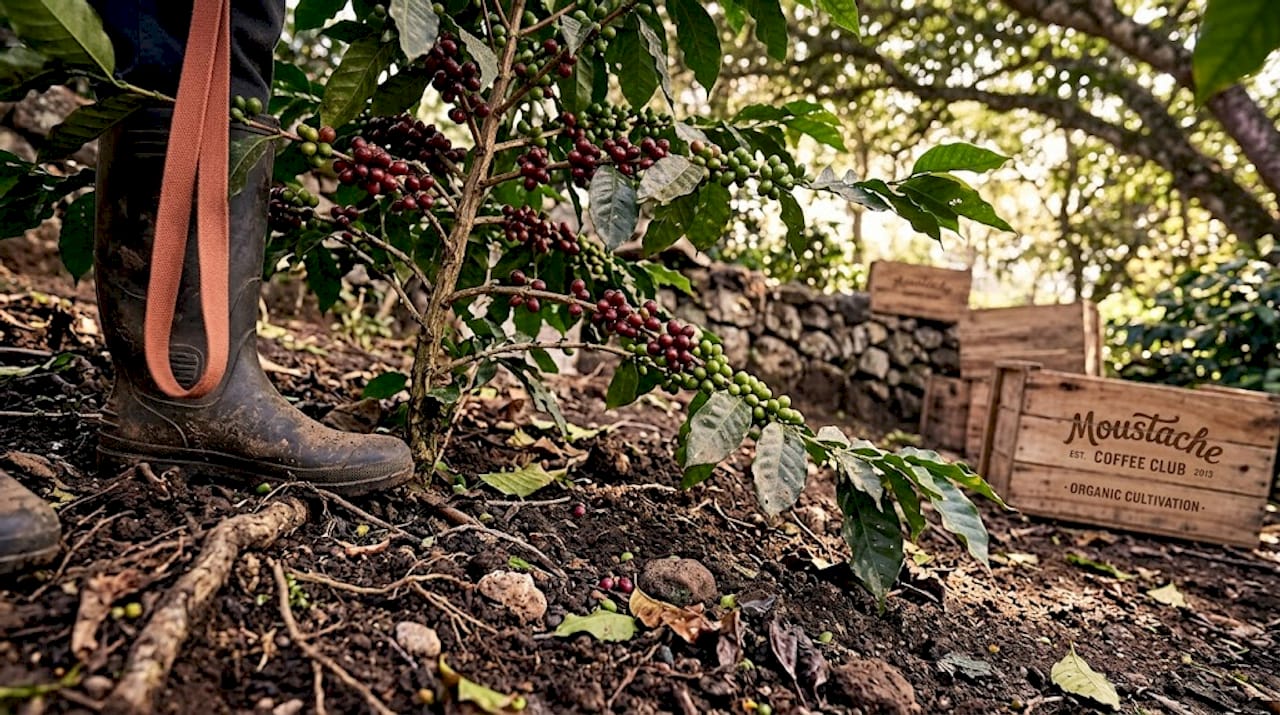
Then there are the microclimates. The Andes split into three distinct ranges across Colombia, creating isolated valleys and slopes where temperature, humidity, and rainfall vary dramatically over short distances. This is why the Colombian coffee geography produces such strikingly different flavor expressions from region to region.
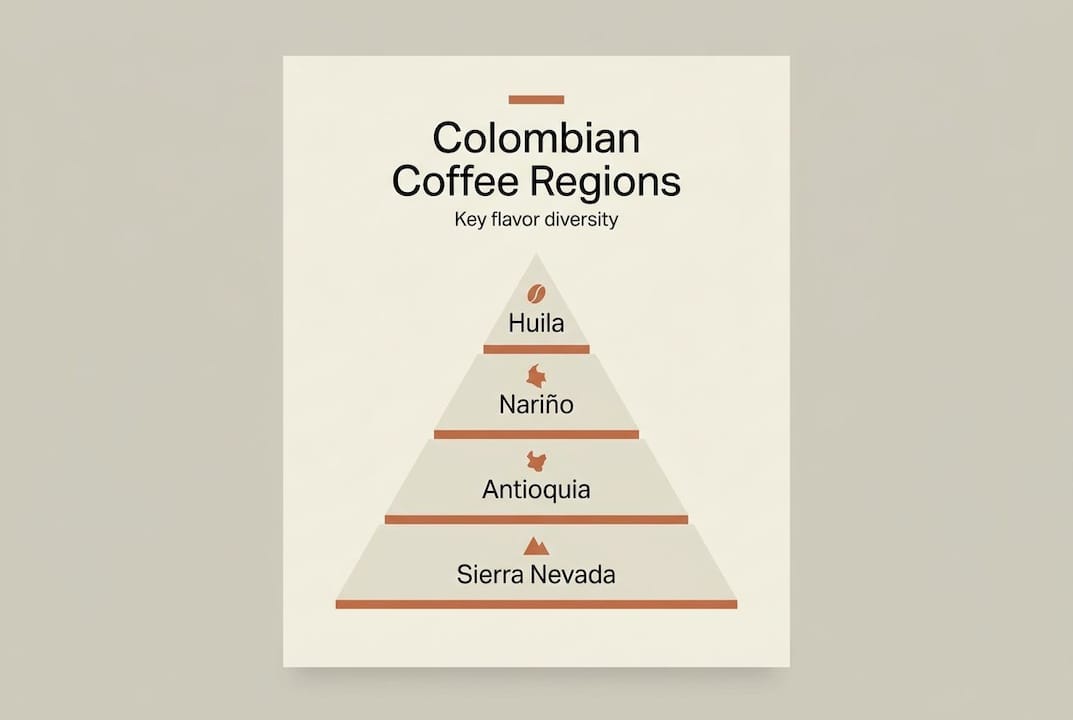
| Region | Altitude range | Standout flavor characteristics |
|---|---|---|
| Nariño | 1,800 to 2,300 m | Floral, high acidity, dense body |
| Huila | 1,200 to 2,000 m | Citrus, caramel, sweet finish |
| Antioquia | 1,300 to 2,000 m | Balanced, chocolate, mild acidity |
| Sierra Nevada | 900 to 1,800 m | Low acidity, heavy body, earthy |
| Coffee Triangle | 1,200 to 1,800 m | Classic smooth, nutty, clean |
Key geographic advantages that shape Colombian coffee:
- Year-round harvest from staggered growing zones means fresher coffee reaches the market more consistently than countries with a single annual harvest
- Distinct wet and dry seasons per region create predictable growing cycles that farmers can time for optimal ripeness
- Cloud cover and shade from the Andes regulate solar exposure, preventing the berry from overheating during development
Strict quality standards and artisanal processing: the secret to Colombian coffee’s consistency
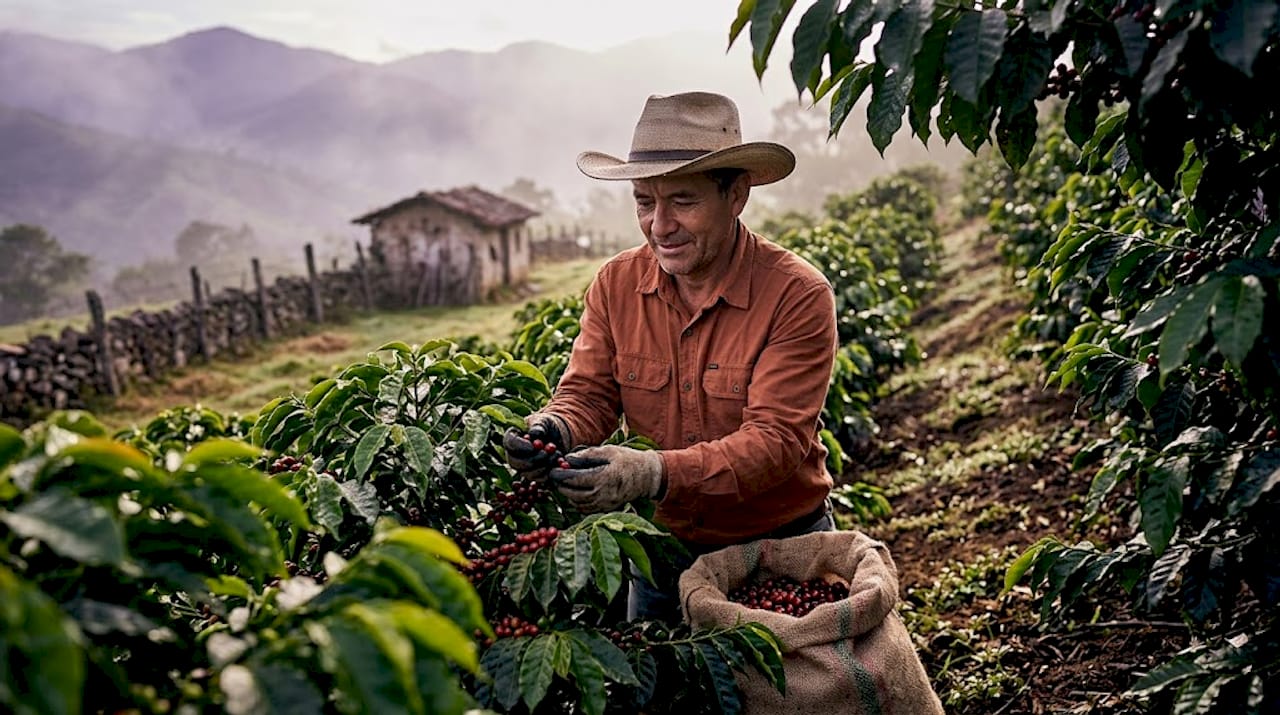
Great geography alone does not guarantee great coffee. What truly separates Colombia is what happens after the cherry is picked. Colombia’s production system, built around hundreds of thousands of smallholder family farms, relies on selective hand-picking. Pickers move through the same tree multiple times during harvest season, choosing only the ripe red cherries and leaving the green and overripe ones behind. This single practice eliminates a primary source of off-flavors before processing even begins.
Once the ripe cherries arrive at the mill, Colombia’s signature washed process takes over. Washed processing removes the fruit mucilage surrounding each bean through water-based fermentation and rinsing, then sun-dries the beans to precise moisture levels. The result is a clean, defect-free bean with a pronounced aroma, balanced body, and what specialty coffee professionals call a “transparent” flavor: the natural characteristics of the bean come through without fermentation funk or fruit interference clouding the cup.
The Federation of Colombian Coffee Growers, known as Fedecafé, enforces a national quality system that covers every stage from farm to export. Fedecafé’s strict standards on Arabica grading, defect tolerance, washing protocol, and moisture content have created a global benchmark that most producing countries do not attempt to match.
Here is how the quality chain typically works on a Colombian family farm:
- Selective harvesting: Only ripe red cherries picked by hand, often by the same family that owns the land
- Depulping: The outer fruit skin is removed mechanically within hours of picking
- Fermentation: Beans sit in water tanks for 12 to 36 hours, allowing natural enzymes to break down the sticky mucilage layer
- Washing: Beans are rinsed thoroughly with fresh water to remove all fermentation residue
- Sun drying: Beans dry on raised beds or patios until moisture reaches 10 to 11.5 percent, the window Fedecafé requires for export
“The washed process, when done with precision and clean water at altitude, creates a clarity of flavor that makes Colombian coffee immediately recognizable. It is a discipline as much as a technique.” — Coffee processing specialist
Pro Tip: When shopping for Colombian coffee, look for the phrase “fully washed” or “wet-processed” on the bag. Combined with a clearly listed region and farm, these details signal that you are buying coffee that followed this careful production chain. You can explore artisanal coffee processing methods to understand exactly how these choices affect your cup.
The cultural heritage behind Colombia’s coffee: beyond the cup
Understanding what makes Colombian coffee special requires understanding Colombia itself. Coffee is not just an agricultural product here. It is the organizing principle of entire communities, the foundation of local economies, and the thread running through generations of family identity in the Andean highlands.
The term colonos refers to the smallholder farming families who built Colombia’s coffee culture through the 19th and 20th centuries, clearing Andean slopes and developing farming practices adapted to the steep terrain. These families did not inherit industrial operations. They built terraced plots by hand, developed water channels for processing, and passed harvesting knowledge from parent to child.
This legacy earned formal recognition in 2011 when UNESCO designated the Coffee Cultural Landscape of Colombia as a World Heritage Site, covering municipalities across Caldas, Risaralda, Quindio, and Valle del Cauca. The designation specifically honors the way traditional farming, architecture, and social customs remain inseparable from coffee cultivation.
“The UNESCO Coffee Cultural Landscape symbolizes Colombia’s national identity through traditional farming, architecture, and social customs linked to coffee cultivation, representing a living cultural tradition that continues to shape community life today.”
Key elements that the cultural designation preserves:
- Traditional farmhouse architecture (finca paisa) adapted specifically for coffee drying and storage
- Community-based harvesting practices where neighbors exchange labor during peak picking season
- Local festivals and rituals tied to the annual harvest calendar
- Sustainable land stewardship passed through oral traditions across generations
Explore more about Colombian coffee cultural heritage to see how origin shapes every aspect of the coffee you drink.
Distinct flavor profiles across Colombia’s major coffee regions
One of the most underappreciated aspects of the Colombian coffee taste experience is regional diversity. When people say they love Colombian coffee, they are often describing a specific regional expression without realizing it. The flavor spectrum across Colombia’s growing zones is wide enough to satisfy drinkers who prefer entirely opposite cup characteristics.
Northern regions like Sierra Nevada produce low-acid, heavier-bodied coffees, while southern regions like Nariño yield complex, floral, high-acid beans. This is a direct result of altitude differences and the distinct microclimates created by the Andes.
| Region | Body | Acidity | Primary flavor notes | Best brewing method |
|---|---|---|---|---|
| Nariño | Full | High | Floral, citrus, tea-like | Pour-over |
| Huila | Medium to full | Medium-high | Caramel, dark fruit, citrus | Pour-over, Aeropress |
| Antioquia | Medium | Low to medium | Chocolate, hazelnut, clean | Drip, French press |
| Coffee Triangle | Light to medium | Low to medium | Balanced, nutty, smooth | Any method |
| Sierra Nevada | Full | Low | Earthy, woody, heavy | French press, espresso |
Regional flavor highlights worth knowing:
- Huila is consistently among the most decorated Colombian regions in international competitions, largely due to its volcanic valley soils and the dense sweetness they produce
- Nariño sits so high that the region actually receives frost at night, which some researchers connect to the intensity and density of flavor the beans develop
- The Coffee Triangle (Eje Cafetero) produces the style most people associate with “classic Colombian coffee”: smooth, approachable, and reliably balanced
Pro Tip: If you are new to exploring Colombian coffee regional profiles and want a clear starting point, try a Huila against a Sierra Nevada side by side. The contrast between the bright, sweet citrus of Huila and the heavy, earthy depth of Sierra Nevada illustrates how dramatically different two “Colombian coffees” can actually taste.
Why Colombian coffee’s reputation endures despite evolving specialty coffee trends
Here is an opinion you will not hear often: Colombian coffee’s global dominance is not primarily a branding success story. Juan Valdez helped, but the real reason Colombian coffee remains the world’s reference point for quality is structural. The combination of a mandatory grading system, a washed-only default process, and smallholder farm density creates a floor of quality that most producing countries simply cannot match at scale.
The specialty coffee world has spent the last decade celebrating natural process coffees from Ethiopia, experimental anaerobic ferments from Central America, and wild-fermented lots from emerging producers. These are genuinely exciting developments. But the more the specialty market diversifies, the clearer it becomes how valuable Colombia’s baseline consistency is.
Despite growing specialty coffee diversity, Colombia maintains trust through decades of standardized quality and its focus on washed Arabica, building a global benchmark that both mass-market buyers and specialty roasters rely on. Most cafes that serve single-origin espresso will rotate their Ethiopian natural or their Guatemalan anaerobic, but they almost always keep a Colombian on the menu as the anchor. It is the coffee that trained palates trust and that new coffee drinkers find most accessible.
The family farm structure also creates resilience that industrial coffee producers lack. When a single large estate has a bad season, it produces a bad season. When 540,000 small Colombian farms have varying seasons, the quality averages out across a vast pool of micro-lots. That is not an accident of scale. It is a system built over a century.
What is genuinely exciting right now is watching Colombia adapt without losing its identity. Younger Colombian producers are experimenting with honey process and natural drying on small lots while Fedecafé maintains the washed standard for the national export stream. You get specialty coffee evolution happening inside a protected quality framework, which is a combination no other country has managed at this scale.
Enjoy the taste of Colombian coffee with Moustache Coffee Club
Reading about Colombian coffee is one thing. Tasting a freshly roasted single-origin Huila or Nariño is another experience entirely.

At Moustache Coffee Club, we source Colombian single origins roasted to order in the ultra-light, Nordic style that lets regional flavor shine without roast character getting in the way. Our coffee subscription delivers freshly roasted beans straight to your door, with detailed origin reports on every coffee so you know exactly where your cup came from and what to expect in the cup. If you want to get the most out of your Colombian beans, our coffee brewing guides walk you through the techniques that work best for washed Arabica, and our dedicated guide to perfect pour-over brewing is built specifically for coffees with the clean, layered profiles that Colombia produces.
Frequently asked questions
What makes Colombian coffee different from other coffees?
Colombian coffee is grown exclusively as Arabica at high altitudes with washed processing, producing a clean, balanced cup with distinctive notes like chocolate, citrus, and caramel that differentiate it from lower-altitude or naturally processed origins.
Why is Colombian coffee so widely trusted worldwide?
The trust comes from decades of enforceable quality control through Fedecafé, which means every export batch meets strict grading, moisture, and defect standards that keep the flavor profile consistent and reliably clean across seasons.
How does Colombia’s Coffee Cultural Landscape impact coffee production?
The UNESCO-designated landscape preserves the traditional family farming practices, social customs, and land stewardship techniques that directly sustain the artisanal production methods behind Colombia’s high-quality output.
What flavor differences exist among Colombian coffee regions?
Regional profiles range from low-acid, heavy-bodied cups in northern Sierra Nevada to complex, high-acidity, floral expressions in southern Nariño, with central regions like Huila and Antioquia offering balanced middle-ground profiles suited to most brewing methods.
How can I best enjoy Colombian coffee at home?
Choose a light roast single origin from a named region like Huila or Nariño, and brew it as a pour-over using water around 93°C (200°F). This method highlights the clean, layered flavors that washed Colombian Arabica is built to deliver.
Recommended
- Best Coffee Subscription | Ultra-Light Nordic-Style Single Origin Coffee | Moustache Coffee Club
- Coffee Education Hub | Ultra-Light Nordic-Style Brewing Guides & Origins | Moustache Coffee Club
- Best Coffee Subscription | Fresh Roasted Single Origin | Moustache Coffee Club
- How To Brew Pour Over Coffee | Step-by-Step Guide | Moustache Coffee Club