Why Single Origin Coffee Puts Money Directly in Farmers’ Hands
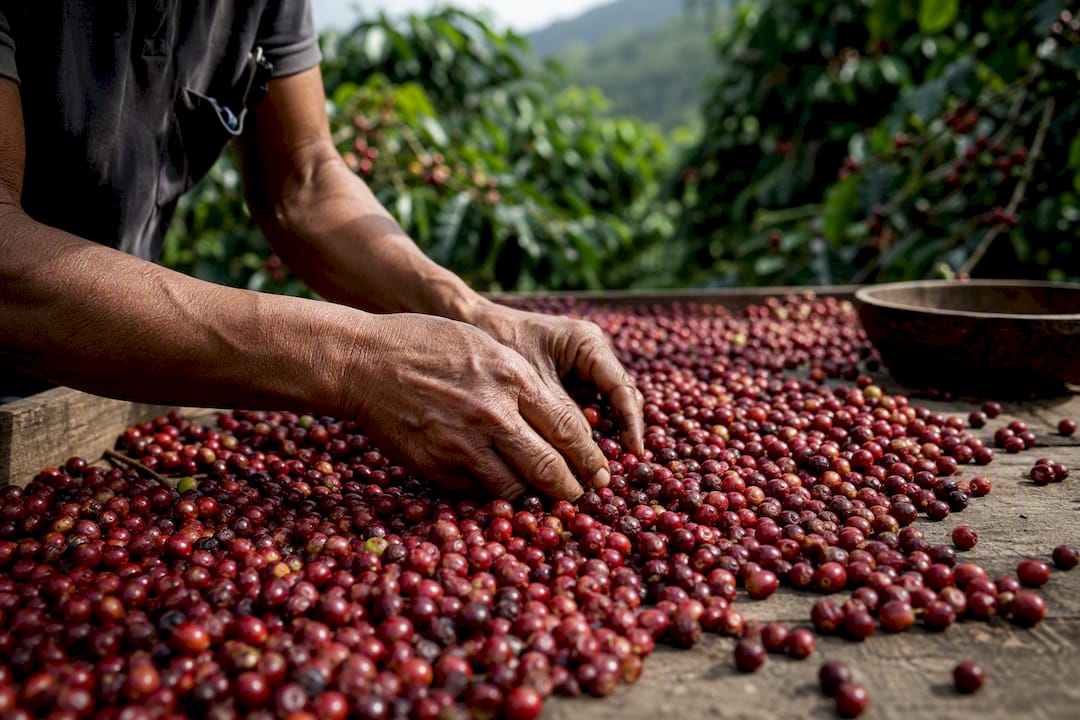
Single-origin coffee routes more identifiable money and support to specific farmers because it makes traceability, quality-based pricing, and long-term buying relationships possible in a way blended coffee rarely does. When a roaster can name the farm, the lot, and the price paid, that transparency is what actually connects your purchase to a farmer’s income.
Three things to know before you buy:
- What the premium pays for: higher per-pound prices, agronomy training, and processing infrastructure that a farmer couldn’t otherwise afford.
- How to verify it’s real: look for origin reports, named farms or cooperatives, and disclosed purchase prices, not just a country name on the bag.
- The catch: a single-origin label alone guarantees nothing. Without transparency, it’s just a marketing term.
Key Takeaways
Single-origin coffee supports farmers directly when traceability, disclosed pricing, and long-term buying relationships back up the label, not when the term is used alone.
| Point | Details |
|---|---|
| Traceability is the mechanism | Named farms, lot numbers, and harvest dates are what let a premium reach a specific farmer instead of a vague region. |
| Quality pricing rewards investment | Standardized cupping through programs like Q-Grader lets roasters justify paying more for better lots. |
| Compare models honestly | Fair Trade offers a certified floor; direct trade often pays more but lacks third-party verification. |
| Price alone proves nothing | A high price with no disclosed farm or terms is marketing, not evidence of farmer benefit. |
| Verify before you buy | Moustachecoffeeclub publishes origin details and roasts to order so subscribers can trace where their coffee, and their money, comes from. |
Table of Contents
- Why Single Origin Supports Farmers Directly, and What That Requires
- How Single-Origin Sourcing Channels Money and Support to Farmers
- What Direct Farmer Benefits Actually Look Like
- Single Origin vs. Blends vs. Fair Trade: What Actually Reaches Farmers
- Why Single Origin Costs More, and Where That Money Goes
- How to Make Sure Your Purchase Actually Helps Farmers
- Where Single-Origin Sourcing Still Falls Short
- Want a Simple Way to Put This Into Practice?
- A Publisher’s Take on Buying With Intention
- Sources
- FAQ
Why Single Origin Supports Farmers Directly, and What That Requires
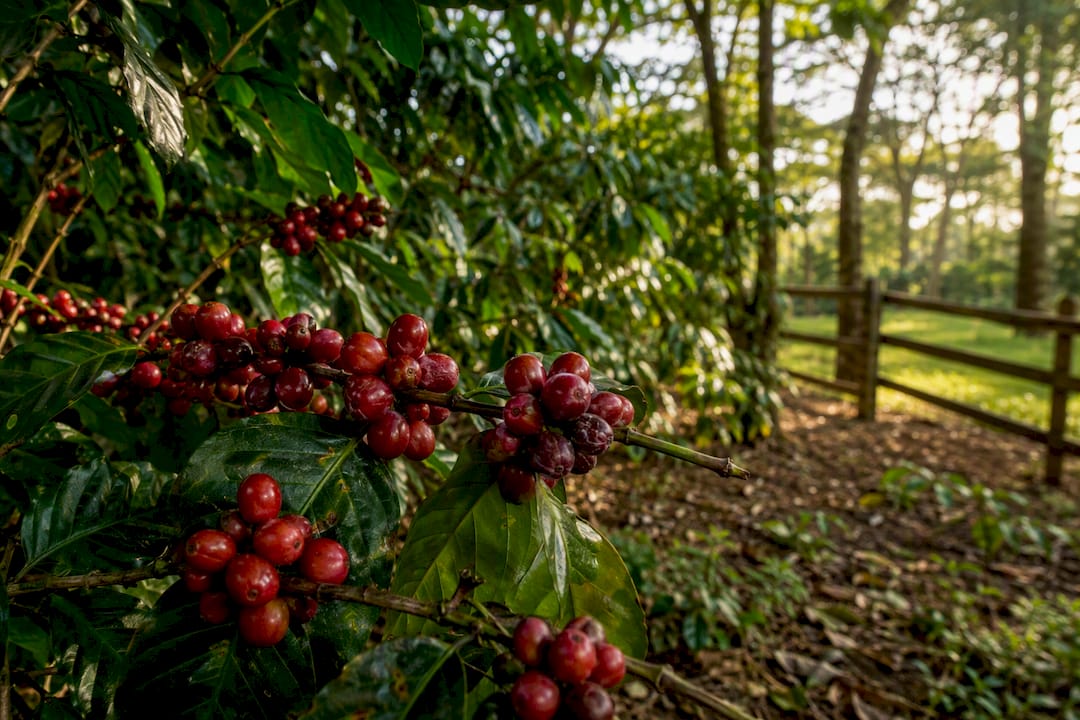
Single-origin, in practical terms, means coffee traced to one country, region, farm, or even one harvest lot, rather than a mix from multiple sources blended for consistency. There’s no single legal standard defining the term across the industry, so the level of specificity varies wildly from “Ethiopia” stamped on a bag to a named farm, altitude, and processing method.
That gap is exactly why traceability matters so much. A roaster that can show a lot number, a farm name, and a harvest year has a paper trail connecting your money to a specific grower. The seed-to-cup supply chain has multiple stages where a lack of documentation lets money and accountability quietly disappear between farm gate and store shelf.
A few terms worth knowing:
- Micro-lot: a small batch from a single field or processing run, kept separate for its distinct flavor.
- Cup score: a quality rating (usually on an 80 to 100 scale) assigned by trained tasters.
- Origin report: a roaster’s documentation of where a coffee came from, who grew it, and what was paid.
How Single-Origin Sourcing Channels Money and Support to Farmers
Traceability by itself doesn’t move money. It’s the mechanisms built on top of it that do. Here’s how single-origin purchasing actually reaches farmers:
- Quality-based price premiums. Micro-lots that score well get paid more per pound than commodity-grade coffee sold on the open market.
- Direct contracts and advance payments. Some roasters pay part of the purchase before harvest, giving farmers cash flow when they need it most, not months later.
- Long-term purchase commitments. A multi-year buying relationship lets a farmer plan investments instead of gambling on whichever buyer shows up that season.
- Capacity building. Training in cupping, fermentation, and drying techniques raises quality, which raises pay.
- Fewer intermediaries. Shorter supply chains mean fewer parties taking a cut between farm and roaster.
- Community investment. Some brands fund wells, schools, or shared processing equipment tied to the specific farms they buy from.
The Specialty Coffee Association’s Q-Grader program is a big part of why quality-based pricing works at all. It gives buyers and roasters a standardized way to score coffee, so a premium paid for quality isn’t just a guess. Without that shared language, negotiating a fair price for a genuinely better lot would be far harder.
Pro Tip: When a roaster’s website only says “Ethiopia” or “Colombia,” that’s a country of origin, not proof of a direct benefit. Look for a named farm or cooperative, a disclosed price, or a mention of a roaster visit. Those details are the difference between a marketing label and an actual paper trail.
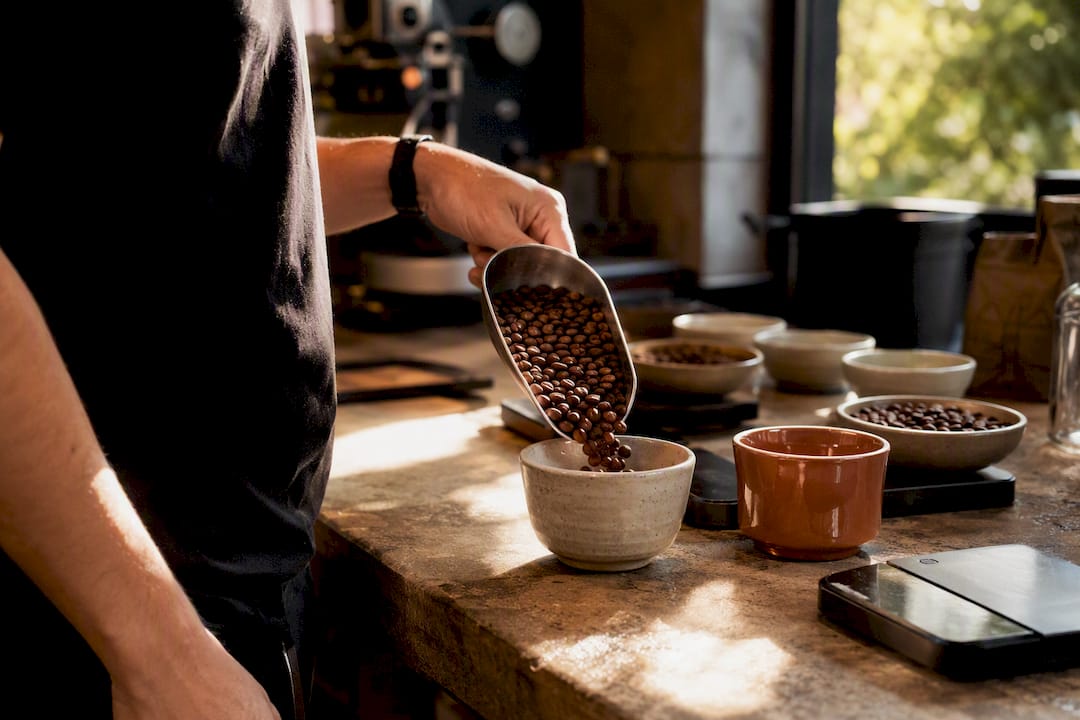
None of this works without traceability underneath it. A single-origin label with no farm name and no disclosed terms is a flavor descriptor, not evidence that a farmer got paid more.
What Direct Farmer Benefits Actually Look Like
Origin reports and cooperative case studies tend to follow a similar pattern: a roaster identifies a specific lot, pays above commodity price for quality, and documents where that money went.
- A cooperative in a coffee-growing region secures a multi-year contract with a specialty roaster, using the payment stability to invest in a shared washing station that improves processing for dozens of member farms at once.
- A single farm known for a distinct micro-lot gets a price tied directly to its cup score, and the income supports upgrading drying beds, which further improves quality (and next year’s price) in a feedback loop.
- A cooperative uses training funded by a roaster relationship to reduce defect rates, moving more of its harvest into higher-paying specialty grades instead of commodity export.
The value of a farm-level story is that it can be checked. A named cooperative, a stated price, a documented training program: these are things a curious buyer can actually verify, unlike a vague claim of “supporting farmers” printed on a bag.
Roast-date transparency plays a smaller but real role here too. A roaster willing to print the exact roast date is usually the same one willing to publish where the beans came from. Publishing an origin report is a good sign the relationship behind the coffee is more than a one-time purchase.
Single Origin vs. Blends vs. Fair Trade: What Actually Reaches Farmers
Each sourcing model treats farmer impact differently, and none of them is automatically the “ethical” one.
- Blends prioritize consistency and volume. They can support stable, ongoing demand for farmers, but the mixing of lots makes it nearly impossible to trace a premium back to any one grower.
- Single-origin enables traceability and quality premiums but requires the roaster to actually disclose farm-level information for that potential to become real.
- Fair Trade guarantees a certified price floor and community development premiums, backed by third-party verification, but the certification itself carries costs that not every small farm can absorb.
- Direct trade is relationship-based and often pays higher quality premiums than Fair Trade’s floor price, but it has no standardized verification, so claims rest entirely on the roaster’s word.
Fair Trade and direct trade solve different problems: one gives a guaranteed baseline, the other rewards exceptional quality with a higher ceiling but no outside auditor checking the math.
Pro Tip: The strongest setup often combines both: a certified price floor as a safety net, plus quality premiums on top for the lots that earn them. If a roaster mentions only one of the two, ask which farmer protections apply when quality scores dip in a rough harvest year.
Why Single Origin Costs More, and Where That Money Goes
A higher price tag on single-origin coffee usually reflects real costs stacked on top of the beans themselves:
- Smaller micro-lots cost more per pound to source and ship than bulk commodity coffee.
- Quality sorting and cupping (often tied to that Q-Grader scoring) takes labor and expertise.
- Specialized processing methods, like extended fermentation or careful drying, add time and cost.
- Disclosed premiums paid above market rate get passed through to the final price.
- Farmer training and infrastructure investment get built into the roaster’s margins.
Forbes has explained why single-origin coffee tends to command a premium: it’s positioned, and priced, as a distinct quality tier rather than a commodity. But a higher price is not proof by itself. A $22 bag with no origin details is just an expensive bag of coffee. A $22 bag with a named farm and a disclosed price paid is evidence your money reached someone specific.
How to Make Sure Your Purchase Actually Helps Farmers
Buying single-origin with good intentions isn’t the same as buying single-origin that delivers. A few concrete steps close that gap:
- Choose roasters that name the farm or cooperative on the bag, not just the country.
- Ask whether the roaster publishes an origin report with price and sourcing details.
- Favor micro-lots or direct-trade offerings where sourcing terms are actually disclosed.
- Subscribe to ongoing programs instead of one-off purchases. Predictable demand helps farmers plan.
- Support brands that publish impact updates, not just a single origin story that never gets revisited.
Before buying, check for these signals:
- Is there a named farm or lot, not just a country?
- Is the price paid to the farmer disclosed anywhere?
- Has the roaster visited, or published a documented origin report?
- Is there a stated long-term relationship, or was this a one-time spot purchase?
Leaving feedback and asking a roaster directly for sourcing updates is one of the simplest ways to push transparency further.
Where Single-Origin Sourcing Still Falls Short
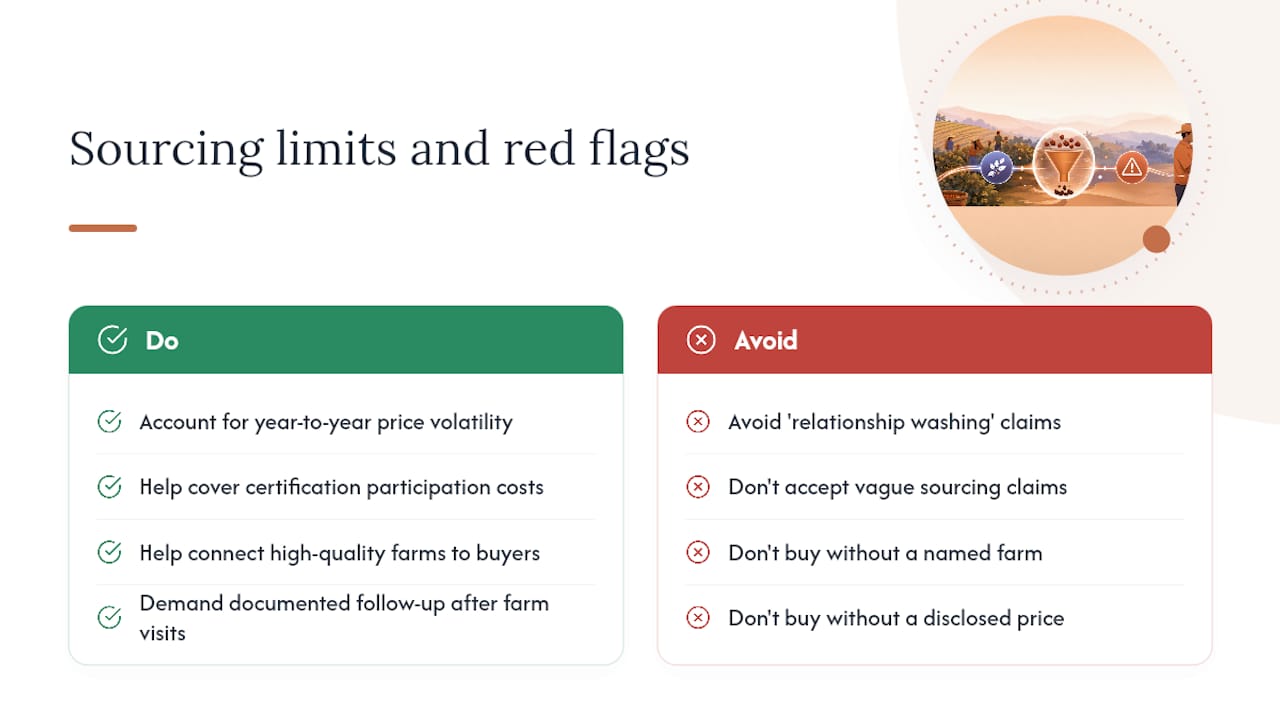
Even well-intentioned single-origin buying has real limits. Farmers still face price volatility year to year regardless of what a bag says, since a single bad harvest can undo a premium gained the year before. Certification programs, where used alongside direct relationships, carry participation costs that smaller farms sometimes can’t cover. Market access remains uneven: plenty of high-quality farms never connect with a specialty buyer at all, no matter how good their coffee is.
Watch for “relationship washing,” a single roaster visit turned into years of marketing copy with no documented follow-up. Vague claims like “sourced with care” or “supporting farming communities,” with no named farm and no disclosed price, are the clearest red flag that a label is doing more work than the sourcing behind it.
Want a Simple Way to Put This Into Practice?
Everything above points to the same conclusion: single-origin only helps farmers when the roaster actually shows you the receipts. Moustachecoffeeclub builds its entire subscription around that principle. Every bag ships roasted to order the same day, with the origin, farm, and sourcing details laid out instead of buried.
Rather than a vague “ethically sourced” tagline, Moustachecoffeeclub publishes origin details for its coffees from growing regions including Ethiopia and Colombia, so you can see where your subscription dollars are actually going. The ultra-light, Scandinavian-style roast is chosen specifically to let those origin characteristics come through in the cup instead of getting roasted into sameness. If the checklist in this article matters to you, that’s the standard to hold any subscription to. Start a subscription and see the origin story behind your next bag before your next shipment even roasts.
A Publisher’s Take on Buying With Intention
The honest gap in specialty coffee isn’t a shortage of good intentions. It’s the distance between a farm story printed on a bag and a farm story a buyer can actually verify. Every claim in this piece points back to that same test: can you check it?
That’s the standard worth holding any roaster to, including this one.
Sources
FAQ
Why should you support local and small-scale farmers?
Buying from identifiable, small-scale farmers keeps more of the purchase price with the people doing the growing, and it rewards quality investments that commodity markets often don’t pay for.
Which single-origin coffee is considered the best?
There’s no single “best” origin; quality depends on the specific farm, processing method, and harvest, which is exactly why traceable, farm-level information matters more than a country name alone.
Why is single-origin coffee more expensive?
Smaller lot sizes, quality sorting, specialized processing, and disclosed premiums paid to farmers all add cost, and Forbes notes it’s priced as a distinct quality tier rather than a commodity product.
Is a coffee blend or single-origin better?
Blends prioritize consistency and are often more affordable; single-origin offers traceability and quality premiums, but only delivers real farmer benefit when the roaster discloses sourcing details, which is the model Moustachecoffeeclub builds its subscriptions around.
Recommended
- How to source single origin beans sustainably and ethically | Blog | The Moustache Coffee Club
- Why Consumer Choices Affect Coffee Farmers: 2026 Guide | Blog | The Moustache Coffee Club
- How specialty coffee supports farmers: The ethical drinker’s guide | Blog | The Moustache Coffee Club
- How Single Origin Differs from Blends: A Coffee Guide | Blog | The Moustache Coffee Club